Counting cobras: why the number you reward stops telling the truth
Goodhart's law says a measure stops being useful the moment you reward it. Cobras, Hanoi's rats and a New Zealand hospital target, in under five minutes.
The Crossing Model is a way of seeing the gap between your people and your customers, and the leadership that bridges it.
Every business depends on two groups of people: the ones who work in it and the ones who buy from it. Between them sits a gap, and the only thing that bridges it is leadership. The Crossing Model™ is how we picture that bridge. When leadership holds, capacity flows out to your people and their signal flows back from your customers. When it contracts under pressure, or erodes through burnout, both stop moving. Two states. Three disciplines. One variable that decides.
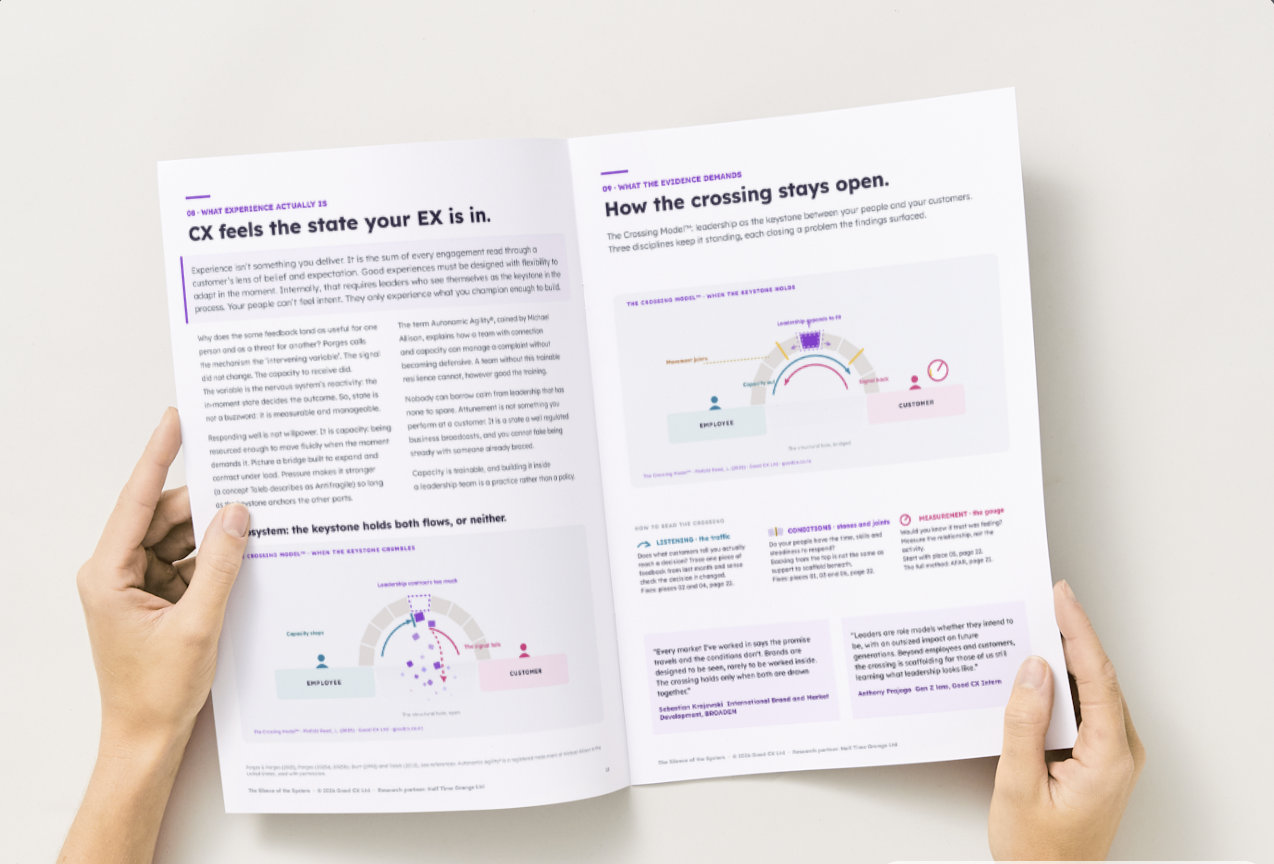
The Crossing Model™ was developed by Liz Pinfold Reed, founder of Good CX, as a way of picturing leadership as the keystone of an arch. On one side of the arch are your people. On the other side are your customers. Between them is a structural hole: the gap where what customers say never quite reaches the people who decide. When the keystone holds, capacity flows out to the team and the customer signal flows back in. When leadership contracts too much, or erodes through burnout, capacity stops and the signal falls into the hole.
So three disciplines keep the arch standing: listening, conditions and measurement. And one variable decides whether they get the chance to work. The model draws on the work of Stephen Porges, Ronald Burt and Nassim Taleb, and it is featured in our research paper The Silence of the System, if you would like to read more.
If you lead a business that has grown past the founder-only stage, you can probably feel it. Customers are louder. Meanwhile, your best people are stretched. The roadmap stalls in the same meeting every month, while the honest conversation keeps not happening. In other words, that is not a performance problem. It is a capacity problem, and capacity is biological before it is organisational.
Every person in your business runs on the same nervous system. When one leader is regulated, a room can think. When one is not, the room narrows too. Stephen Porges calls this the intervening variable: the state that sits between what happens and how you respond, and decides whether feedback becomes action or defence. State is not private. State travels. We co-regulate each other at work whether we mean to or not, and once enough people share the same state, that state becomes the signal your customers feel.
That is why the Crossing Model works on the state of the keystone, not just the strategy that hopes to override it. We wrote about the workplace nervous system through the character of the Heffalump. Read the piece here.

Resilience is not being stoic, and it is not being unemotional. Instead, resilience is the capacity to respond with agility under pressure while keeping the creative, thinking parts of the brain online, because the body has a felt sense of safety. Porges describes a regulated nervous system as metabolically efficient: it spends its energy on the task, not on defence. In contrast, the gritted-teeth version, pushing through with the defences up, is a pathway to burnout, not resilience.
The Crossing Model takes that idea from the individual to the organisation. In other words, a business is resilient when its people can co-regulate each other well enough to keep thinking together when the pressure comes on. That is what we are looking for when we read the crossing with you, and it is what the keystone is holding up.

Craig Manning, in conversation for The Silence of the System
The Crossing Model is a system, not a checklist. Three disciplines keep the arch standing and one variable decides whether they hold under load. Without listening, there is no signal. If the conditions are wrong, there is no capacity to respond. And without measurement, you will not know the arch is failing until the numbers tell you. Finally, without a regulated keystone, none of the three get the chance.
The traffic. Does what your customers tell you actually reach a decision? Most firms collect the feedback. Few act on it. Our DISTIL™ methodology is how we make that listening useful.
Stones and joints. Do your people have the time, the skills and the steadiness to respond? Backing from the top is not the same as support to scaffold beneath. Our OPEN Method™ and our employee experience work shape the conditions.
The gauge. Would you know if trust was fading? Measure the relationship, not the activity. Our AFAR Framework™ tracks the strength of the arch, not the count of the reports.
The state of the keystone. Leadership expands to fit, or contracts under pressure. That one variable decides whether the three disciplines get the chance to work. It is trainable, one leader at a time and one team at a time, and it is where our leadership work begins.
The Crossing Model works in two states. One holds. One does not. Both are the same arch, seen from opposite pressures.

When the keystone holds
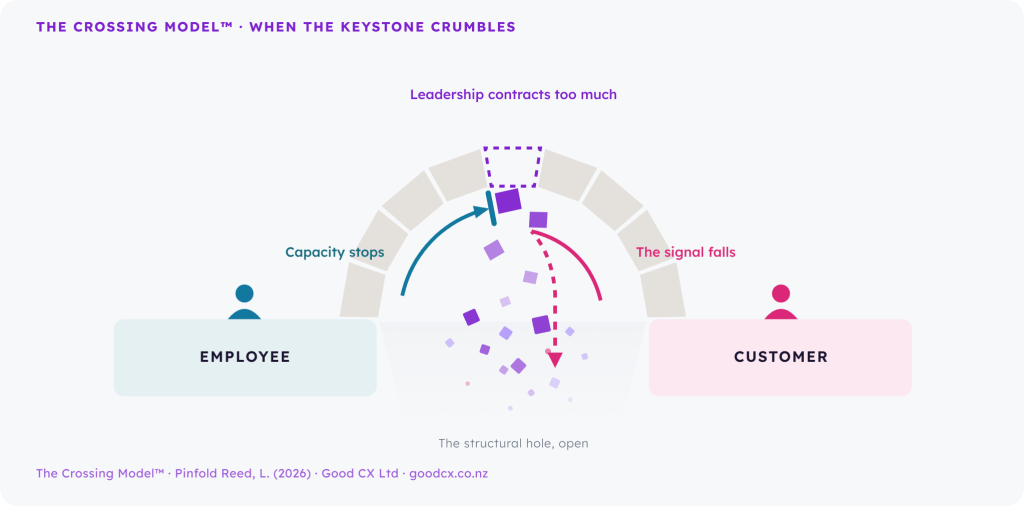
When the keystone crumbles
The keystone grows to meet the load. That is what a regulated leader does under pressure. In other words, it widens rather than narrows.
Capacity moves out to your people and the signal moves back from your customers. For example, the joints are the meetings, rituals and conversations that let both travel.
As a result, employee experience and customer experience stop being two departments and become one crossing. We wrote about the structural hole, and what scaling leaders grow into, in Polish the silver. Hear the signal. Put the suit on.
Under sustained pressure the keystone tightens, or wears away through burnout. Decisions narrow to the top, or the leader is carrying a load they no longer have the capacity to bear. An arch that cannot flex cannot get stronger, and this one starts to crumble.
Your people have the will but not the time, the skills or the steadiness to respond, because backing from the top is not the same as scaffolding beneath.
What customers are telling you never reaches the room where the decision gets made. Then you find out in the numbers, months later, at the most expensive point.
Liz developed the model as a way of seeing. The work is where it earns its keep. It sits at the centre of Liz Pinfold Reed‘s twenty years of customer experience and leadership work, and it is the frame we use across every engagement. Here is what we unpack with you, and what we can design with you, depending on where your keystone sits.
Leadership training for individuals and teams. Liz is a certified Play Zone practitioner, and uses the Play Zone method to build the state of the keystone: a leader who can stay regulated under pressure, and a team that can stay open with them. One to one, or with the whole leadership team.
Articulating intent. A facilitated session where leaders get clear on what they actually mean, and their teams hear it clearly enough to act on it. Scaffolding for the bridge, built in the room, in a half day or a day.
Building capacity. Ways your team can expand rather than contract under load, linked to the biology of real resilience rather than the gritted-teeth kind. Finding where strain is stealing capacity, and designing the scaffolding that gives it back.
Closing the loop. Making the signal your customers are already sending legible and decidable, then designing the journey and the decisions that follow, so listening turns into action before the numbers move.
A team under pressure cannot be creative. That is not opinion. It is biology. Timothy R. Clark calls the top of psychological safety the innovation threshold, and a team cannot cross it under evaluation. That crossing is the heart of the model. The keystone has to hold before the room can think, and the room has to think before the customer feels any difference.
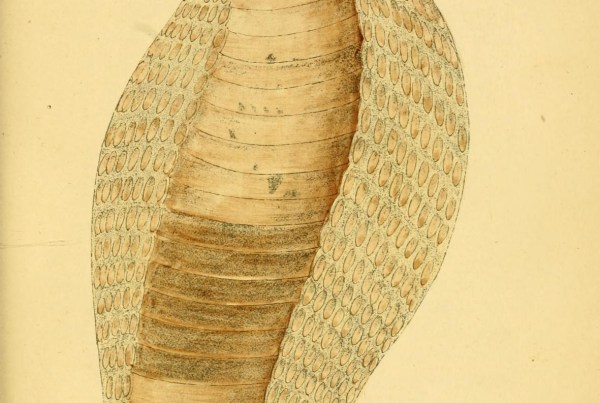 Counting cobras: why the number you reward stops telling the truth
 The pub is still open. It just isn’t the same pub. And your AI project has the same problem.
 The Crossing Model: what is actually holding your customer experience up?
The Crossing Model™ is the framework Liz Pinfold Reed developed at Good CX for leadership as the keystone between employee experience and customer experience. It names two states, holding and crumbling, three disciplines that keep the arch standing (listening, conditions, measurement), and one intervening variable that decides whether the disciplines get the chance to work. You can read it in full, with the research behind it, in The Silence of the System.
Surveys measure activity, and CX programmes usually start with the customer journey. However, the Crossing Model starts one layer below both, with the state of the leadership that has to carry signal in one direction and capacity in the other. A survey tells you the arch is under strain. The Crossing Model tells you where the keystone sits and what it needs to hold. The commercial case is plain: in our research, inconsistent action on customer feedback doubled as firms grew past fifty people, and most leaders named time as the blocker. Closing that loop is a cost a CFO can move.
It is Stephen Porges’s term for the nervous-system state that sits between a stimulus and a response and decides what the response will be. The same piece of customer feedback lands as useful information in a regulated room and as a threat in a defended one. So, in the Crossing Model, the intervening variable is the keystone. It is individual biology first, and it becomes organisational signal once enough people share the same state.
Ronald Burt’s term, from 1992, for a gap between two groups where nobody is doing the bridging. For example, in a scaling business the most expensive structural hole sits between the people who hear customers every day and the people who make decisions. Capacity has to travel one way across it and signal the other. Leadership is the bridge, which is why we draw it as the keystone of an arch. For the longer read, see Polish the silver. Hear the signal. Put the suit on.
Co-regulation is the way nervous systems settle or spike each other. It happens in every meeting, whether anyone names it or not. A regulated leader lowers the temperature of a room, whereas a defended one raises it. The Crossing Model treats co-regulation as an organisational capability: the thing that lets a team keep its thinking online when a customer complaint, a missed target or a hard decision lands. It is trainable, for individuals and for teams, and it is where our leadership work starts.
We use our AFAR Framework™ to measure the relationship rather than the activity. In other words, it is an early-warning system, not a scoreboard. If trust between your people and your customers is drifting, the profit and loss statement is the last place you will see it, and the most expensive.
A first reading runs as a half-day or one-day Innovation Lab with your leadership team. One-to-one work with Liz, using the Play Zone method, typically runs three to twelve months. A fuller diagnostic across listening, conditions and measurement runs three to six weeks. Finally, we confirm timing in the first conversation once we understand the scope.
Yes. The Crossing Model™ is a proprietary framework owned by Good CX Ltd, developed by Liz Pinfold Reed and featured in The Silence of the System (2026). Its two-state diagram, the model and the name are the intellectual property of Good CX.
We will not pitch you a six-month programme. Instead, we will start with one conversation. We will listen, tell you what we hear, and name where your keystone sits right now. Then, if it is useful, we will design the scaffolding with you. And we will tell you honestly whether the Crossing Model is the right frame for what you are facing. If it is not, we will say so.