
When you picture your business, where do you stand in the picture? Most leaders I ask put themselves at the top of something: an org chart, a pyramid, occasionally a war room. Almost nobody puts themselves where their customers and their people actually need them to be.
In the middle. Holding the span. Get that wrong and you have the beginning of an answer to why customer experience transformation stalls.
Key takeaways: why customer experience transformation stalls
- 82 per cent of senior leaders across Australia and New Zealand gather customer feedback. Only 23 per cent act on it through a clear process. (The Silence of the System, Good CX with Half Time Orange, 123 leaders, 2026)
- The gap is structural, not attitudinal. The sociologist Ronald Burt called it a structural hole: two groups who do not talk to each other, and nobody carrying what neither side can move alone.
- The Crossing Model™ places leadership as the keystone of an arch spanning that hole. Capacity flows out, from leader to employee to customer. Signal flows back the other way.
- An arch is strengthened by load and brought down by contraction. So is a leader. Under sustained sympathetic load both flows fail at once.
- Your customer never sees the structure. They only feel the state of the employee at the end of it. CX feels the state your EX is in.
Why does customer experience transformation stall?
This year we researched why customer experience transformation stalls between intent and action, with our research partner Half Time Orange and 123 senior ANZ leaders. One number from that work explains why we ended up drawing bridges: 82 per cent of leaders gather customer feedback, and only 23 per cent act on it through a clear process. The listening happens. The closing does not. The full findings live in the paper, The Silence of the System. This piece is about the model the findings forced us to build.
What is the Crossing Model™?
The Crossing Model™ is Good CX’s way of seeing how experience actually moves through a business. Your employee stands on one side. Your customer stands on the other. Between them sits a gap, and leadership is the keystone in the arch that spans it. Two flows cross that arch: capacity flowing out, from leader to employee to customer, and signal flowing back, from customer to employee to leader. Everything depends on whether the crossing holds. The model was developed in The Silence of the System, our 2026 research into why customer experience transformation stalls, and it is built to be argued with.
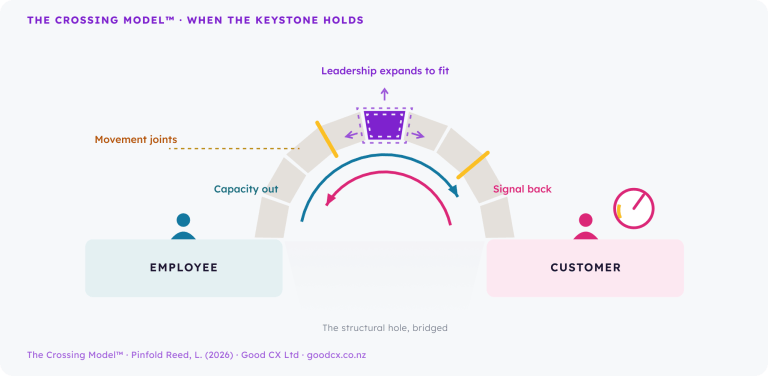
The Crossing Model™ © 2026 Good CX Ltd. Cite as: Pinfold Reed, L. (2026). The Crossing Model™. Good CX Ltd.
The physics, because the physics is the point
The gap under the crossing has a name. The sociologist Ronald Burt called it a structural hole: a gap between two groups that do not talk to each other. Burt’s finding was that whoever bridges one carries what neither side can move alone. (We have written about the Richie-from-The Bear version of this. He polishes forks.)
Now, the arch. A real stone arch is a small miracle: load makes it stronger, because pressure locks the stones together. Taleb has a word for things that gain from stress: antifragile. Engineers add one more grace note, movement joints, because a bridge that cannot expand and contract with the day will crack. Read that again as a leadership spec. Built to carry load. Strengthened by pressure. Designed to flex.
And then notice what actually brings an arch down, because it is not weight. It is contraction. When the material loses its flexibility, the joints open, and the keystone slips through its own seat.
The keystone is you, and the keystone breathes
A leader with capacity expands to fit what the day asks. They hold steady, their people borrow that steadiness, and the customer feels the difference at the far end of the span.
A leader under unsustainable sympathetic load does the opposite. Trying to be everything to everyone, they can no longer take the pressure of the stones around them, and contraction becomes implosion. It goes one of two ways. In flight, the energy scatters: spread ever thinner, everywhere at once, present in every meeting and absent in all of them. In fight, it combusts. Either way the keystone crumbles, and both flows fail together. Capacity stops flowing out to your frontline. The signal stops flowing back from your customer. Nothing crosses.

From the Crossing Model™ © 2026 Good CX Ltd.
Here is the uncomfortable part. Your customer never sees any of this structure. They only feel the state of the employee at the end of it. As the paper puts it: CX feels the state your EX is in. And state is the operative word, because state is a variable. It is not fixed. It moves with the moment, and it is set in the meeting itself: how you arrive, how the other person arrives, and how the two states read and react to each other. Same feedback, different state, different result. The good news, and the reason this is a business model rather than a wellness poster, is that state is measurable and manageable.
How to read your own crossing this week
The model earns its keep as a diagnostic. Three walks along it:
Stand at the customer end. Pick one recent complaint and follow it backwards. Did it cross to someone who could act, or did it fall into the gap somewhere past the frontline? If you cannot trace where it landed, you have found your structural hole.
Check the joints. When did your team last change how they respond to what customers are telling them? A bridge that has not moved in a year is not stable. It is seized, and seized is what cracks under the next cold snap.
Then the hardest one: inspect the keystone. Who do your people borrow calm from, and does that person currently have any to lend? Nobody can borrow calm from leadership that has none to spare. If the honest answer is that everyone is borrowing and nobody is lending, the model says your customer already knows, they just have not told you.
If you want to instrument the far end of the span properly, that is a measurement question, and it has a name: the AFAR Framework™, our layer for measuring the relationship rather than the activity.
Where the model came from
A model is only as good as the evidence that forced it into existence. The paper holds that evidence: six findings from 123 leaders on where the signal dies, the biology of why (this is where Porges, Edmondson and a missing stuffed kangaroo come in), the three disciplines that keep the crossing open, and six places to start. We are not going to summarise it here, partly because it deserves better and partly because it is free.
Download The Silence of the System.
The same gap opens whenever a new technology lands on an organisation that has not prepared its people, which is the subject of why AI projects die at the question stage rather than the technology stage.
And if you would rather argue with the crossing in person, that is genuinely our favourite kind of meeting. Let’s talk.
Liz Pinfold Reed is the founder of Good CX, an insight-first customer experience and leadership practice in Auckland. The Silence of the System was produced with research partner Half Time Orange. Good CX is a member of the Research Association of New Zealand.
The model itself now has a home of its own: the Crossing Model™, leadership as the keystone between your people and your customers.
The latest thinking from Good CX
Ideas worth arguing with
Every so often we share what we’re learning about customers, the people who serve them, and what a leader can do with it. If we get in touch, it’s with something worth pulling apart with your team. Unsubscribe in one click.
You’ll get one confirmation email first, so we know it’s really you. We handle your details in line with our privacy policy.