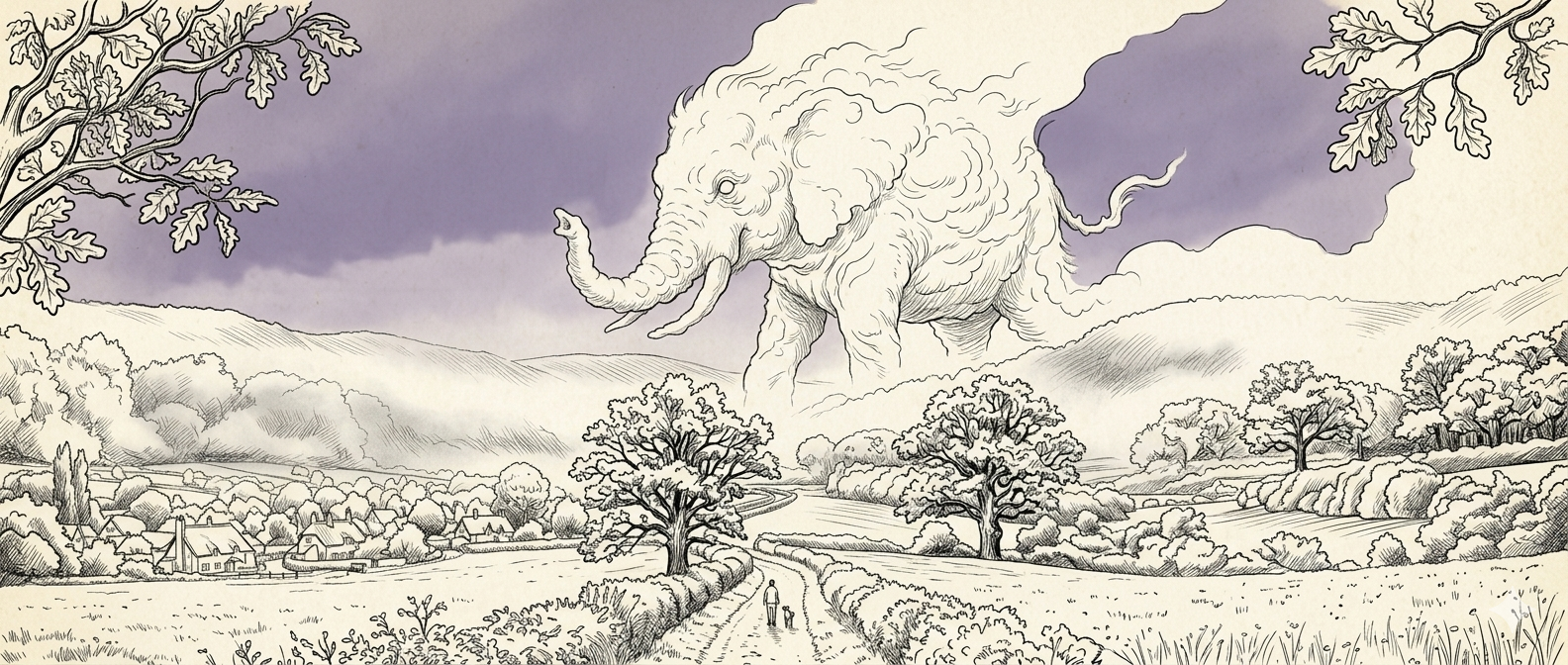
A piece on the biology of psychological safety, told through the stuffed animals on Christopher Robin Milne’s shelf. A companion to the Good CX research paper, The silence of the system.
Have you ever looked around a leadership meeting and known, before anyone spoke, who was Eeyore that morning? Who was Tigger? Who was missing in the way Roo is missing? You can usually pick them in the first three minutes, before the agenda is even open. They are the same animals A. A. Milne set on his son’s bedroom shelf in the 1920s. It is just that the room is now a boardroom.
The stuffed animals themselves are still on display at the New York Public Library, just across the room from Charles Dickens’s writing desk, an original Bill of Rights and a Gutenberg Bible. They are not in that company by accident.
The bear, two rooms over from the desk and the Bible, is one of the most quietly accurate accounts of the human nervous system ever written for an audience that thought it was reading about a bear. And he was written by a man who had a reason.
Key takeaways: Winnie the Pooh psychology in the workplace
- Winnie the Pooh psychology is the popular name for a 2000 paper in the Canadian Medical Association Journal by Shea, Gordon, Hawkins, Kawchuk and Smith, which applied DSM-IV criteria to every character in the Hundred Acre Wood.
- A. A. Milne served as a signals officer on the Somme in 1916. He wrote the Wood a decade later, and it reads as a map of how nervous systems hold, or fail, under load.
- Pooh is the regulated state we romanticise. Tigger is sympathetic activation in fight. Piglet is flight. Eeyore is freeze. Roo is shutdown: the colleague who stopped raising the issue because last time nothing moved.
- The Heffalump is the creature nobody has met. In most boardrooms this year that is AI, and the trap-building is costing more than the creature.
- The Wood works because it holds every state without trying to eliminate any of them. That is the move worth taking back to the boardroom.
What is Winnie the Pooh psychology?
Winnie the Pooh psychology is the popular name for a 2000 paper in the Canadian Medical Association Journal by Shea, Gordon, Hawkins, Kawchuk and Smith at Dalhousie, which applied DSM-IV criteria to every character in A. A. Milne’s Hundred Acre Wood. Pooh came back with attention deficit hyperactivity disorder, inattentive subtype, with obsessive-compulsive tendencies organised around honey. Piglet came back with generalised anxiety disorder. Eeyore presented as depressive.
Read in 2026, those diagnoses turn the Wood into something more useful than a children’s story. They make it a workplace nervous-system map, drawn by a Somme veteran whose own war had taught him how signals fail.
The signals officer who came home
Enlistment and the Somme
A. A. Milne enlisted in February 1915. He was thirty-three. He was commissioned into the 4th Battalion of the Royal Warwickshire Regiment and sent to the Western Front during the Somme Offensive, where he served as a signals officer. Milne’s job was to keep communications alive between men under fire, which is to say, to make sure messages travelled through a system that was actively trying to interrupt them.
Long before trauma research had the language for what he was watching, Milne already knew that nervous systems do not so much fail as lose the agility to move between safety, mobilisation and shutdown. Stephen Porges PhD has since described the vagal physiology that governs that agility, and the conditions under which it falters; we have written more about his work elsewhere on the site.
Milne knew it before any of them. He saw the difference, in his battalion, between the men who could still shift between those states and the men who could not.
What A.A. Milne carried home
His best friend, Ernest Pusch, was settling down to a cup of tea when a shell came over and blew him to pieces. Pusch’s brother Frederick was killed by a sniper a few days later. The Somme was thorough that way.
On 12 August 1916, Milne’s platoon attacked across no man’s land under German machine-gun fire. None of his men got within twenty yards of the trench they were sent to take. But the attack changed his view of the war for the rest of his life. In November, trench fever took him, and he was invalided home, which on balance was the better outcome of his Western Front.
Thankfully, he never went back, and spent the rest of his life as a pacifist. A decade after the Somme, in 1926, the signals officer who had spent his war trying to keep communications alive between men sat down at a writing desk and gave us a Bear of Very Little Brain whose entire personality is built around noticing when his friends have gone quiet.
The Hundred Acre Wood is not, in this reading, a children’s story. It is what a shellshocked signals officer thought an adaptable nervous system looked like, drawn in stuffed animals because that was the form gentle enough to carry the freight. The Wood is the corrective vision of a man who had watched signals fail when failing meant the death of someone he was about to have tea with.
What the trenches had given A. A. Milne, in the meantime, was the one thing the convalescent leader most missed when he came home. The men in the trenches had each other. (Until, of course, they didn’t.)

A walk through the Wood: who you are working with on Monday morning
The bear in the chair
You meet Pooh first. You always meet Pooh first, because Pooh is the one your culture has decided to celebrate. Curious. Hungry. Action-oriented. Gets stuck in the rabbit hole; gets himself unstuck, sits with whoever is having the worst time of it and stays for as long as is needed. He looks, on the surface, like exactly the bear every recruitment process is trying to hire.
The psychologists, however, haven’t been kind to him. Winnie the Pooh psychology, as the CMAJ paper laid it out, finds Pooh meeting criteria for attention deficit hyperactivity disorder, inattentive subtype, with a working diagnosis of obsessive-compulsive tendencies organised around honey.
Read like that, the safe-and-engaged bear starts to look less like a model of leadership and more like a chief executive who has learned to manage a challenged nervous system through ritual consumption. The honey is not innocent. It is what keeps him regulated enough to function in a room.
What Bupa found, and when
In the summer of 2020, between the end of June and the end of July, Bupa Global ran its Executive Wellbeing Index: 450 high-net-worth individuals across the United Kingdom, the United States, France, the UAE and Egypt, of whom 322 sat at board level. It is a small, wealthy, five-market sample taken at the peak of the pandemic, and that is precisely why it is worth reading. It is not a picture of now. It is a measurement taken at the moment of impact.
Sixty-four per cent of executives experiencing mental ill-health symptoms turned to unhealthy coping mechanisms. Thirty-eight per cent reached for alcohol or drugs, whether recreational or over the counter. Others reached for cigarettes, vaping, exercise past the point of usefulness, disordered eating, or gambling. In the UK portion of the sample, thirty-nine per cent said they would not be able to seek help for fear of what it would do to their standing or their professional reputation, and only twenty-seven per cent of those affected had spoken to a medical professional.
If Pooh were a CEO, in other words, the honey would be whiskey. He would be functioning beautifully in the meeting and reaching for the bottle the minute he got home. And the room he was leading would not know, because Pooh is too well-loved and revered to be questioned about whether he is well. The Hundred Acre Wood is not a utopia of healthy nervous systems. It is a community that works because everyone intuitively knows each other’s coping mechanisms and chooses to hold them anyway.
Three flavours of activation
If Pooh is the state we romanticise, the next three animals are the states we live in.
Tigger, in the fight direction
Tigger is sympathetic activation in the fight direction. Always on, always bouncing, the colleague whose schedule has no white space and whose productivity is, on close inspection, motion mistaken for progress. Performance is identity. Stillness is intolerable. Asked to slow down, he experiences it as criticism, because in his body the bounce is the only proof he is still useful. None of which, of course, is sustainable.
Naturally, Tigger’s springs break eventually, because no nervous system is built to bounce that long. While he is still bouncing, he cannot see what is happening to anyone outside his own frame of reference. The Tigger in your team is rarely the problem you think he is. He is usually a high performer running his engine into the ground because the room rewards bounce and punishes pause. That, by the way, is your room. Not his biology.
Piglet, in flight
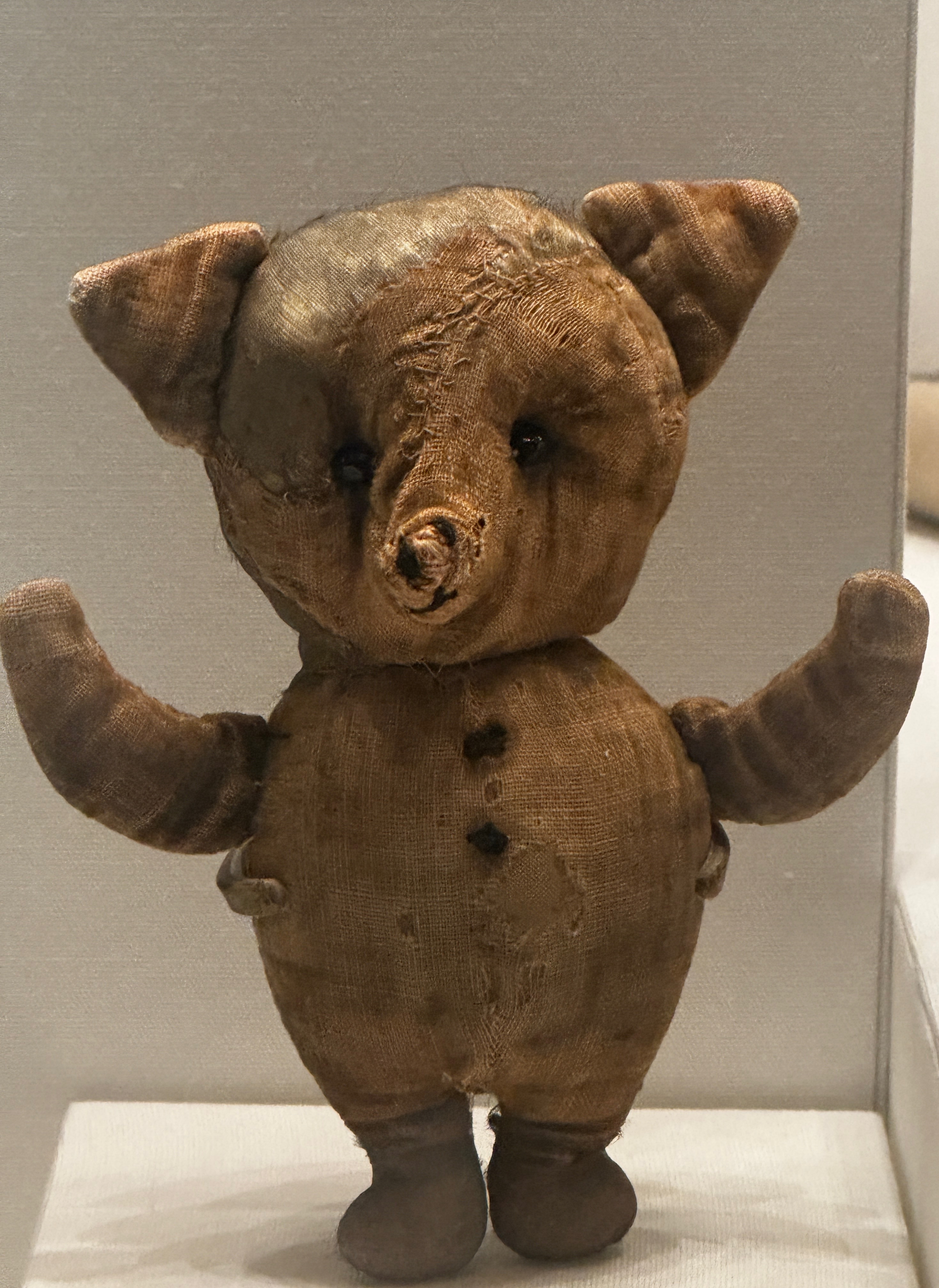
Piglet is the flight version, and the CMAJ paper diagnosed him with generalised anxiety disorder, which you can feel almost immediately. Anxious, jumpy, loyal. The leader who is competent at the work and exhausted by the proximity to risk. Piglets are often the most reliable people on a high-stakes team and the most likely to burn out, because they will not tell you the work is too much, because telling you would itself be too much. The first sign is usually a quiet resignation email, three months after the moment you might still have helped.
Eeyore, in freeze
Eeyore is the freeze. Still in the Wood. Unable to leave. But doubts every step, expects every outcome to disappoint, and carries his self-worth in a tail that keeps falling off. In an organisation, Eeyore is Presenteeism. The colleague who attends every meeting and contributes only enough to remain unnoticed. The lights are on, but no one’s home.
What the Wood understood about Eeyore, and what most workplaces miss, is that he does not need fixing. Rather, he needs his community. The Wood does not try to turn him into Pooh. The invitation to the picnic still arrives. Someone notices when he is missing. And someone walks a little slower so he can keep up. None of that fixes Eeyore, and it does something better. It holds him. If you want to know what your business culture is actually like, watch how it treats its Eeyores.
The one who got away, and the one nobody has met
That leaves the two characters most leaders are not trained to notice.
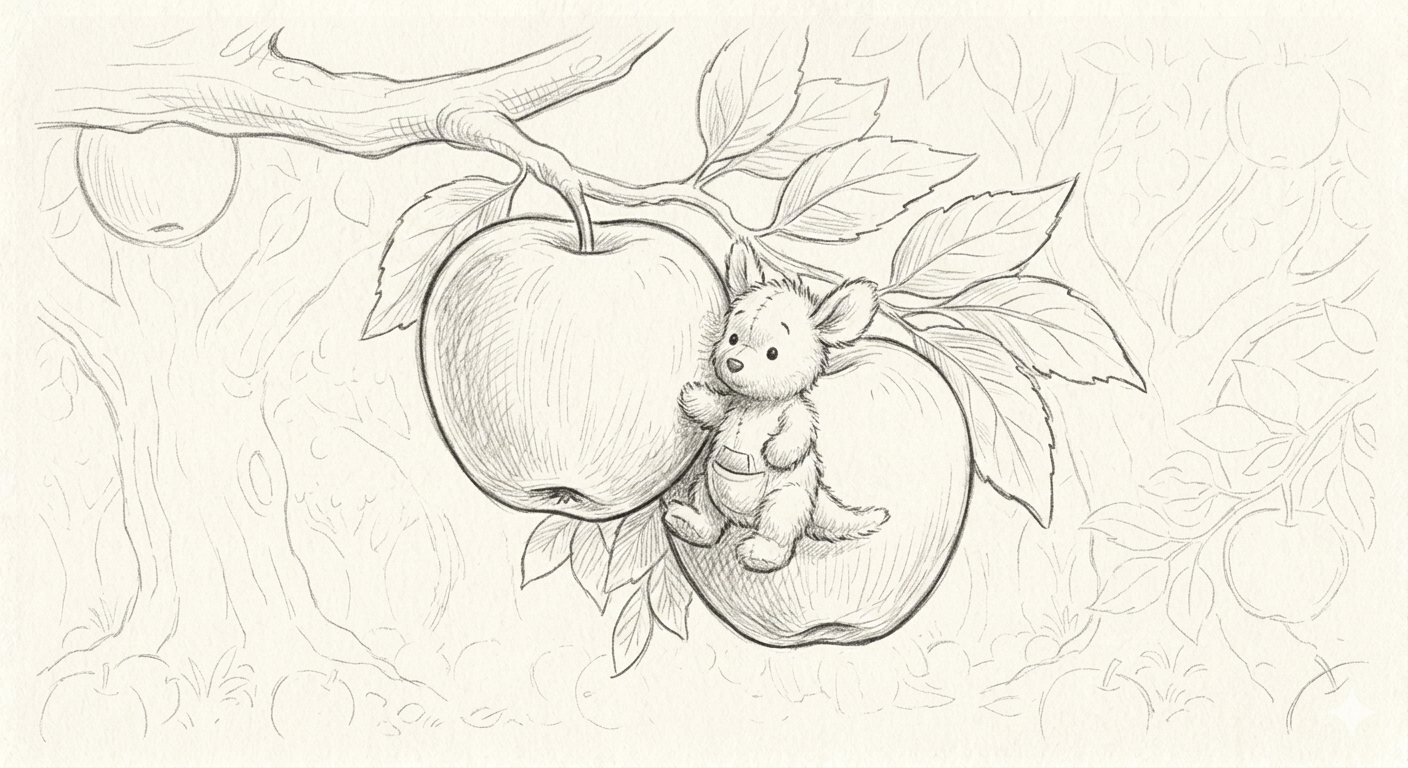
Roo is the state of shut down. Disconnected. Unresponsive. The signal never lands. He is the one stuffed animal of the original five who never made it to the New York Public Library. He is still there in A. A. Milne’s writing, hopping happily about the Wood. His physical self, however, was lost in an apple orchard in the 1930s and never recovered, possibly eaten by a dog.
Roo lives in the story and is dissociated from his body, which is, with no small accuracy, what shut down looks like in a person. In your organisation, Roo is the colleague who stopped raising the issue, because the last time they raised it, nothing moved. A senior leader who learned that bad news travels poorly upward and eventually stopped sending it. Then a customer who switched providers without ever filing a complaint, because filing the complaint felt like effort that would not be returned. The character keeps performing. But the body has gone elsewhere. By the time you notice Roo has dissociated, the apple orchard has done its work.
The Heffalump in the room: AI
The Heffalump is the one nobody has met. The Wood spent a great deal of energy worrying about a creature no one had ever seen, building traps for it, imagining what it might look like, and the imagined Heffalump was always larger and worse than any actual Heffalump turned out to be, if any actual Heffalump turned out at all.
AI is the Heffalump in most boardrooms this year. Nobody in the room has fully encountered it. Everyone has heard reports. Many are building traps and budgets and three-year strategies around a creature they cannot quite picture, and the energy spent on trap-building is itself the cost.
Decisions about AI are being made from sympathetic activation, which is approximately the worst state from which to make a decision about anything, let alone one that will reshape how the business operates. I am not saying the Heffalump is not real. The fear of the Heffalump is doing more damage than the Heffalump itself is likely to. And that fear is biological before it is strategic.
Year six since the pandemic
What I was watching in the healthcare clinics
My own pandemic was spent thinking about how to signal safety inside healthcare patient journeys. I was consulting at a distance (mostly), first on urgent care and then on primary care, while everyone else was trying their best not to be in a hospital or clinic at all. The brief was to help launch new clinics the health system desperately needed, and then to coax back into them the people who had become too frightened to leave the house.
The patients I worried about most were the ones triaging themselves at the kitchen table, asking whether a cut finger was worth a trip to A&E and swiftly answering no. Stitches, or sellotape and stay safer with the consequences?
Five years on, primary care is now picking up the bill, because the people who skipped their preventative visits in 2020 and 2021 are arriving in 2026 with conditions that did not need to become urgent. What clinicians call disordered anxiety has isolation as both its key symptom and its key cost.
The body’s protective machinery turns against the very social contact that would settle it, and the missed care that follows turns into the urgent care that arrives later. I was watching, although I did not know it at the time, what would become the pattern of every boardroom I have stepped into since.
A. A. Milne’s century, and ours
Milne’s war was a hundred years ago. The reason his map still matters is that we are now in the sixth year of our own version of the convalescence he came home into.
The pandemic was not the Somme, and nobody is suggesting it was. The two have a different signature and a different cost. There is, however, one parallel worth considering. The Somme caught most of Milne’s fellow soldiers between eighteen and twenty-five, at the moment their brains were still most plastic. The pandemic caught its own generation at the same developmental window, and shaped them in a different way.
We retreated behind our screens. Many of us worked from our burrows. The boundary between home and work dissolved, and for many of us it has not fully re-formed. Some of us have bounced back, and some have not. The part that was harder this time, in a seemingly innocuous way, is that we did not return from it as a Band of Brothers. We returned as lone wolves. The shared adversity that bonded Milne’s generation did not bond ours in the same way: because we lived our adversity alone, in separate rooms, looking at separate screens.
The cohort hit hardest: Gen Z
The cost is sharpest for the youngest. Today’s twenty-five-year-olds sat through two years of lectures on Zoom, took their finals from a kitchen table, and many of them never met their cohort in a lecture theatre, let alone in the pub afterwards. They are the workers we are now asking to come back to five days a week in the office.
We are asking Gen Z to do it without the social rehearsal that used to come before it, and in many cases without the friendships that used to make the work bearable in the first place. We did not pave the way.
What the belonging gap costs
Six years on, that cost is measurable, and close to home. In June 2026 Sonder published its State of Employee Health and Wellbeing Report with YouGov, surveying 6,105 workers across Australia, New Zealand and the United Kingdom, 518 of them here. Forty per cent of New Zealand workers had experienced anxiety in the past year. Twenty-five per cent had experienced depression.
But the number that should stop you is this one. Eighty-seven per cent said they perform better with a sense of community. Twenty-six per cent said they feel it now.
That is the gap, and it is not a wellbeing problem. It is a performance one. The Wood has been telling us how to close it for a hundred years.
Back into the room
Now we are being drawn back to the Wood. Back into meetings, back into rooms, back into shared work. The boardrooms are full of nervous systems that have spent six years in a state most of them did not recognise as injured. Tigger is overcompensating. Piglet is more easily startled than she used to be. Eeyore is louder than he was, because being quietly Eeyore in a Teams meeting did not get noticed. Some Roos never came back to the office at all.
The map is not just a metaphor for what the workplace has always been. It is a vocabulary for what the workplace is now.
Even Christopher Robin forgets
In 2018 Marc Forster made a film called Christopher Robin in which the adult Christopher has forgotten how to find the Wood. He works as an efficiency expert at a luggage company. Christopher’s weekend with the family in Sussex is about to be ruined for the sake of a Monday presentation. Pooh, finding himself alone in the Wood one morning, walks through a door and emerges, by some grace of dissociation, in London. He has come because Christopher has forgotten what it is to sit at the table with his friends, even when, as the CMAJ paper would have it, they are all certifiable.
The film is a children’s story. It is also a perfectly adequate description of late-career leadership. The Christopher Robins of your boardroom have forgotten the Wood. They will not find it again on their own. Someone has to go and get them.
What this map is for
Set your OWN state first
You cannot lead a team into safe-and-engaged from a state of mobilisation. The nervous system in the room follows the nervous system at the front. Your state sets everyone else. So the work upstream of the agenda, upstream of the slide deck, upstream of the AI strategy, is to notice your own state before you ask anyone else for theirs.
The most useful three minutes of any leadership meeting are the three minutes before it begins.
A vocabulary for the room
After that, the map gives you a vocabulary. You can ask a Tigger to sit down without asking him to be less. A Piglet wants the small bit of certainty he needs to focus. The Eeyore in the room comes to the picnic anyway, even when he says he does not feel like coming. And you can notice when Roo has gone quiet, while there is still time to find him. Then you can name the Heffalump, so that everyone in the room can see they are arguing with a creature nobody has actually met.
Clark’s Four Stages
Vocabulary is the start, but it is not the work. The work is what Timothy R. Clark calls the Four Stages of Psychological Safety. Inclusion safety first, the basic conviction that you have the right to be in the room. Then learner safety, the conviction that asking questions will not cost you. Then contributor safety, the conviction that your work will be received. Finally challenger safety, the conviction that you can disagree with leadership and still belong. Belonging is the floor under all four. None of the holding the Wood does for its animals is possible without it.
Pave the way
Which makes the present moment delicate. If we are asking a cohort of workers who spent their formative years alone to come back to the office and challenge their leadership in person, we have a duty to pave the way for them. Inclusion before contribution. Belonging before challenge. A Pooh to sit with the Eeyore. And the three minutes before the meeting, every time.
The whole Wood is a functioning ecosystem because it holds all the states without trying to eliminate any of them. That is the move worth taking back to the boardroom.
No man gets left behind
A family story
My own great-grandfather was at Ypres. His lungs were burned by mustard gas, in the way only mustard gas could burn them. He should have died in that field. But he did not, because his friends would not leave him there.
The family story is that they strapped him to a gun carriage and dragged him out, his lungs still working, just.
After that, the story is what he did with the life they gave him back. William Barrand sang at the coronation of King George VI (the bass part of Elijah) and then Queen Elizabeth in 1937. Next, solo at the Proms. At Eton College, where he taught music, the boys called him Rumbleguts. His communities held him: the local theatre, the Freemasons, his students, his family. He had a life, in the precise sense that he had a place inside several rooms full of people who knew him and chose him.
He had a life because he did not get left behind in a field.
What this epistle is for
That is the only worthwhile ending I have for any piece I have written about the workplace nervous system in the last decade. The Hundred Acre Wood works because nobody gets left behind in it. Christopher Robin forgets. Tiggers break. Eeyores doubt. Roo dissociates. And the others go out to find them. They go in Milne’s writing, and in the films Disney made afterwards. They went at Ypres. And they will go, with any luck, in your boardroom on Monday morning, if you are paying attention.
In April 2026, Queen Camilla visited the New York Public Library and presented a replica Roo, made by Merrythought, England’s oldest surviving teddy bear maker, working from what they believe is the same product held in their own archive. It formed part of the centenary celebrations for the first Winnie-the-Pooh book. The collection of Christopher Robin Milne’s stuffed animals is now complete for the first time in nearly a century. Roo, in spirit, came home.
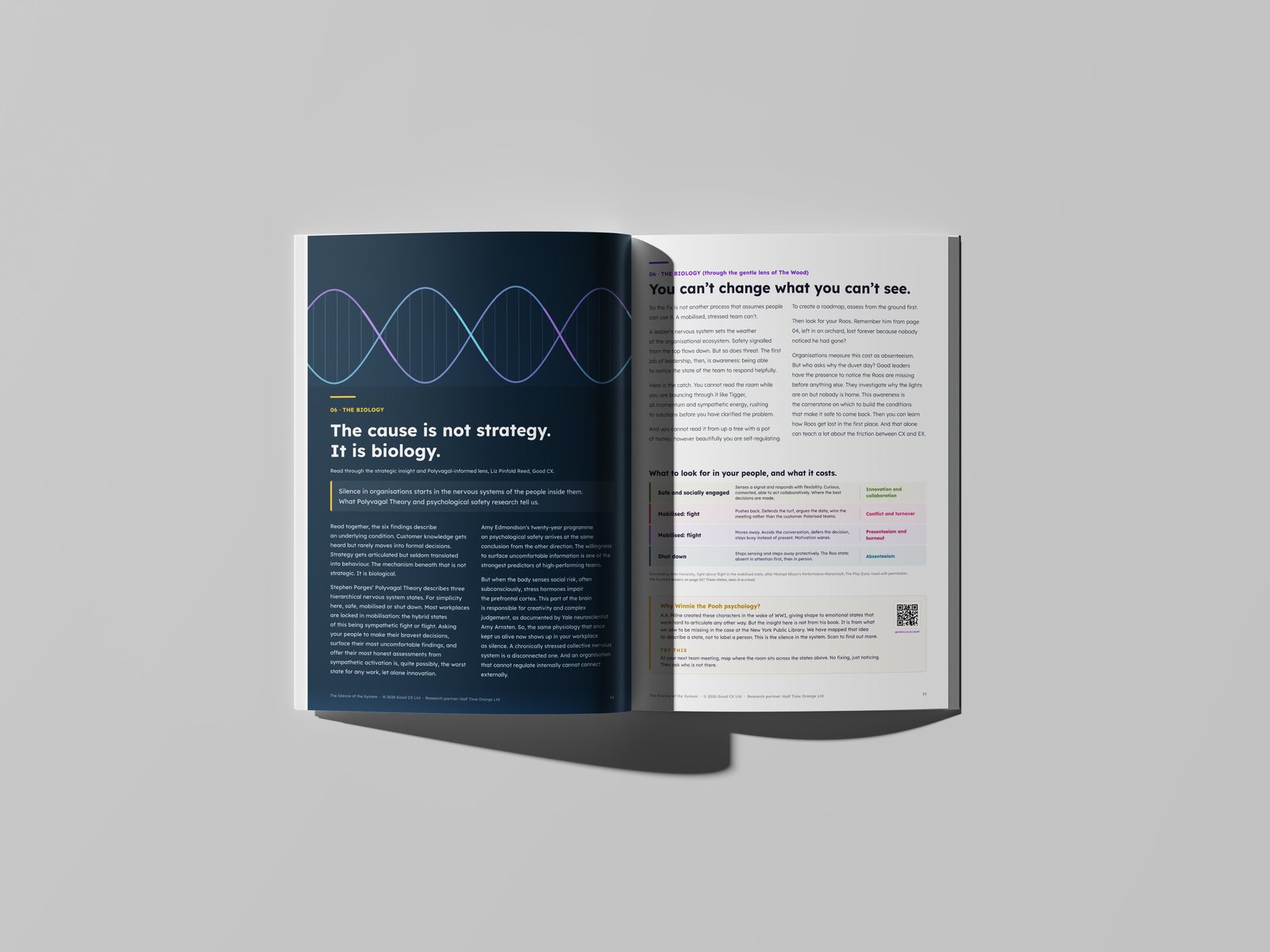
Six findings from 123 senior leaders across Australia and New Zealand, and what the biology says about why the signal dies before it reaches anyone who can act on it. Download the paper.
If the map is useful to you, the longer argument it sits inside is in the Good CX research paper, The silence of the system, and the model it produced is set out in The Crossing Model™ (and unpacked in why customer experience transformation stalls). Pick up the pencil. Find Roo. No man gets left behind.
Liz Pinfold Reed is the founder of Good CX and chair of the CX Summit. The full research paper, The silence of the system, is free to download. Book a 15-minute readiness conversation.
Part of a wider Good CX study
This post is one of the readings that sits alongside The Silence of the System, our white paper with Half Time Orange on why customer and employee experience transformation stalls between intent and action.
- Download The Silence of the System — the full paper.
- Employee Experience at Good CX — how we work with leaders on the system underneath.
The latest thinking from Good CX
Ideas worth arguing with
Every so often we share what we’re learning about customers, the people who serve them, and what a leader can do with it. If we get in touch, it’s with something worth pulling apart with your team. Unsubscribe in one click.
You’ll get one confirmation email first, so we know it’s really you. We handle your details in line with our privacy policy.