Media and press resources

The Silence of the System

What if the reason customer feedback never turns into a decision isn’t the process, and isn’t a lack of will? Most leaders want to act on what customers tell them. But the question is whether they have the capacity to hear it, and state drives capacity.

New research by Good CX with Half Time Orange. 123 senior leaders across New Zealand and Australia: 82% gather customer feedback, 23% have a clear process to act on it. Everything on this page is free to use with attribution.

Download the paper (PDF)Request an interview
The Silence of the System white paper open on the lead finding: 82 per cent of Australian and New Zealand leaders gather customer feedback, 23 per cent have a clear process to act on it

Key numbers

  • 82% of senior leaders gather customer feedback. 23% have a clear process to act on it.
  • Inconsistent action rises from 27% in small firms to 55% in firms of 51 or more staff.
  • 63% cite lack of time or competing priorities as the blocker, not belief.
  • 61% of larger firms say customer experience has executive sponsorship. 13% run a standing governance forum where decisions are owned.
  • 51% say their people are empowered to improve customer experience. 23% say those people have been trained for it.
  • 31% do not measure customer experience at all.
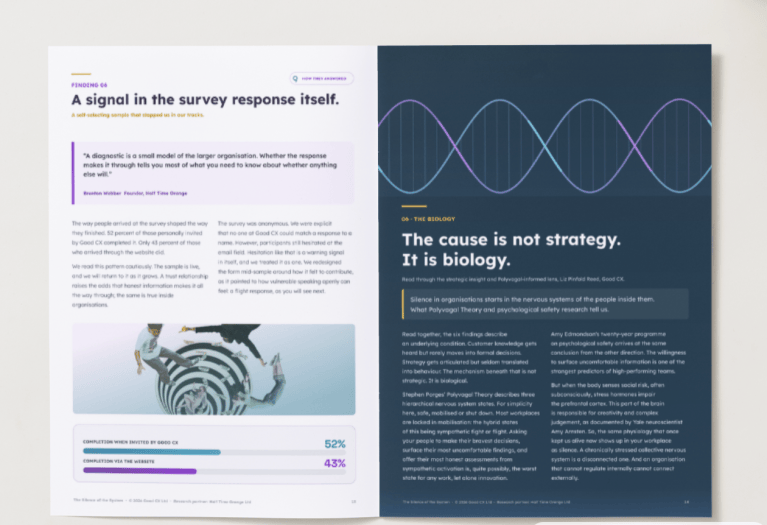
  • Leaders invited personally completed the anonymous diagnostic at 52%. Those arriving via the website, 43%.

Pages from the paper

Screen captures of three pages, free to use online with the credit line: The Silence of the System, Good CX and Half Time Orange, 2026. For print-quality pages, use the PDF above or email media@goodcx.co.nz.

Listening as theatre: 82 percent of leaders gather customer feedback and 23 percent act, a page from The Silence of the System
The cause is not strategy, it is biology: the polyvagal argument, a page from The Silence of the System
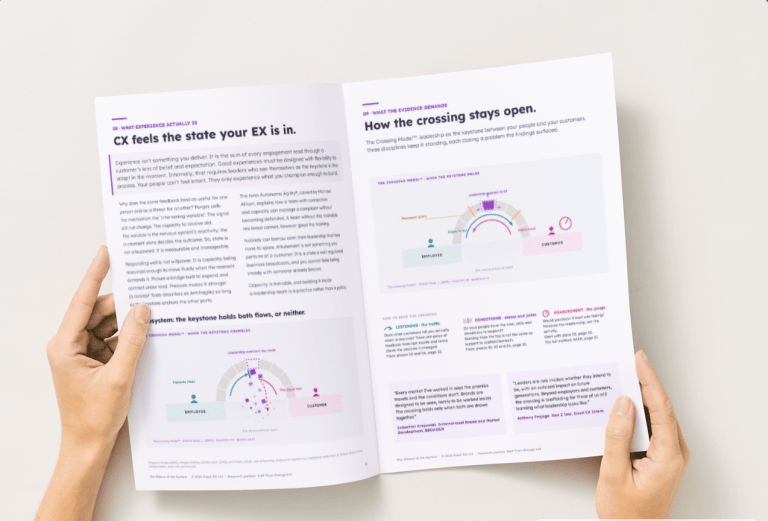
The Crossing Model by Good CX white paper open at the bridge diagram: leadership as the keystone between your people and your customers
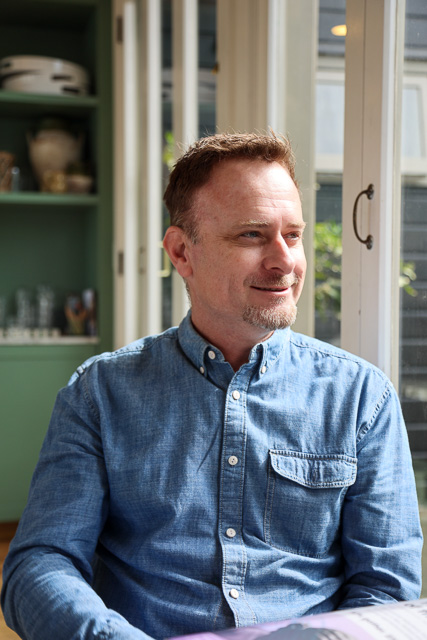
Liz Pinfold Reed, founder of Good CX

Spokesperson

Liz Pinfold Reed is the founder of Good CX, an Auckland customer experience and leadership practice. Her work starts with the customer: what people actually need, and the wider ecosystem they buy within. Understanding that is what turns engagement into purchase, and purchase into growth. She spent twenty years in strategy at MRM McCann, BBDO and Havas across Europe, Asia, the Americas and Australasia before founding Good CX. She also holds certificates from the Polyvagal Institute, the home of the science of safety and threat, and is a Play Zone Pro coach in the science of high performance.

Good CX designs for the part of a decision nobody sees. Most of what a business knows arrives from the edges: the frontline, the customer, the corridor. The centre mostly listens. By the time a decision reaches the boardroom, the system has already voted. So the practice designs the experience with real utility around the customer’s actual problem, and the conditions inside the business so the centre has the capacity to hear. Both grounded in the science of connection.

Available for interview and comment: media@goodcx.co.nz. Download the headshot.

Brenton Webber, founder of Half Time Orange, research partner on The Silence of the System

Research partner

Brenton Webber is the founder of Half Time Orange, whose Orange Zest diagnostic is the instrument behind the study. Half Time Orange works at the diagnostic layer of customer experience, where customer ambition meets organisational reality. Its Orange Zest and Blood Orange diagnostics show leaders whether customer intent can travel through a business into ownership, decisions and follow-through.

Available for interview and comment: brenton@halftimeorange.co.nz. Download the headshot.

What people are saying

“The challenge is not usually a lack of customer insight or people wanting to do the right thing. In a large and complex organisation, the harder part is making sure what we hear from customers translates into clear decisions, ownership, and action.”

Ezra HenryCustomer Experience Lead, Chorus NZ

“Customer experience is a commercial lever. When internal and external links fall silent, organisations lose clarity, trust, and momentum. A connected, responsive system isn't a nice-to-have. It's fundamental to delivering value and protecting the customer relationship.”

Sandra KingBeacon Strategy and Growth

“The richest insights about our customers, good and bad, become collectively trapped in our minds. The solution is less of a process problem and more of a culture shift. Everybody has to recognise the value of what they personally know, before they can contemplate sharing it.”

Andy Mitchell3Green

For the desk

The full press release is also available as its own page: goodcx.co.nz/research/silence-of-the-system/press-release, and as distributed on Scoop and PRWire Australia.

Press release

Most leaders gather customer feedback. Fewer than one in four act on it. New research says the reason is capacity, not will.

The Silence of the System, from Good CX and Half Time Orange, reads a diagnostic of 123 senior leaders through the science of safety and threat, and finds that the state a leadership team is in decides whether customer signal ever becomes a decision.

Auckland, September 2026. Leaders across New Zealand and Australia rate customer experience as a top growth priority, yet most cannot turn what customers tell them into decisions, according to new research from New Zealand customer experience practice Good CX and diagnostic partner Half Time Orange.

The Silence of the System draws on Half Time Orange’s Orange Zest readiness diagnostic, completed by 123 senior leaders across New Zealand and Australia. It finds that 82 percent gather customer feedback but only 23 percent have a clear process to act on it. The rest either act inconsistently (59 percent) or have no signal landing at all (18 percent).

The gap widens with scale. Inconsistent action on feedback rises from 27 percent in small firms to 55 percent in firms of 51 or more staff, and 63 percent of leaders cite time or competing priorities as the blocker, rather than belief.

The paper’s central argument is that the cause is biological before it is organisational. Drawing on the science of safety and threat, Stephen Porges’ Polyvagal Theory, and Yale neuroscientist Amy Arnsten’s research showing that stress hormones impair the part of the brain responsible for complex judgement, it finds that most workplaces are locked in mobilisation. In that state the same piece of feedback lands as a threat rather than as something useful, and the capacity to receive it falls. A leader’s nervous system sets the weather for the organisation. A mobilised organisation with faster tools is mobilised at speed.

The researchers redesigned the survey mid-sample after the silence appeared in the instrument itself. Leaders invited personally completed the anonymous diagnostic at 52 percent, those arriving via the website at 43 percent, and respondents hesitated at an optional email field.

“The listening happens. The closing doesn’t. And it isn’t a lack of will. The same piece of customer feedback lands as useful or as a threat depending on the state the leadership team is in when it arrives, and a mobilised team has less capacity to receive it. That capacity is measurable and it is trainable, which is the good news in this paper,” said Liz Pinfold Reed, founder of Good CX.

“When 82 percent gather and 23 percent act, the listening is theatre. The signal arrives, and the system has no idea what to do with it,” said Brenton Webber, founder of Half Time Orange.

Among the other findings: 61 percent of larger firms say customer experience has executive sponsorship, but only 13 percent run a standing governance forum where customer decisions are owned. 51 percent say their people are empowered to improve customer experience, while 23 percent say those people have had customer experience training. 31 percent do not measure customer experience at all.

The paper is a fix as well as a diagnosis. It sets out the Crossing Model™, which positions leadership as the keystone between employees and customers; the AFAR Framework™, a measurement layer that shows a customer relationship drifting in affinity, advocacy, frequency and recency before it reaches revenue; and six practical places to start, from replacing executive cheerleading with named governance forums to treating psychological safety as a measurable condition.

The Silence of the System is available at goodcx.co.nz/research/silence-of-the-system. The diagnostic remains open for its next wave, and participating organisations receive their own readiness report.

Media contact: Good CX, media@goodcx.co.nz. Half Time Orange, Brenton Webber, brenton@halftimeorange.co.nz, halftimeorange.co.nz.

Notes to editors

Survey of 123 senior leaders across New Zealand and Australia, fielded April 2025 to March 2026, with a further 17 international respondents bringing the total study to 140; the paper reads the New Zealand and Australian findings only. The sample was self-selecting and should be read as patterns within an engaged population rather than a national average. We rounded figures; base sizes vary by question (n=61 to n=123). Contributing experts: Liz Pinfold Reed, Brenton Webber, Craig Manning, James Brosnahan and Anthony Prajogo. Good CX is a member of the Research Association of New Zealand. The Crossing Model™, DISTIL™, the OPEN Method™ and the AFAR Framework™ are proprietary frameworks developed by Good CX Ltd. Autonomic Agility® is a registered trade mark of Michael Allison, used with permission.

Research Association of New Zealand member badge, Good CX

Join the next wave

The diagnostic behind this research is still open. Ten minutes, then your organisation receives its own readiness report.

Take the diagnostic