
The printer is chittering. Tickets are stacking. Someone is shouting “Heard!” Someone else is shouting “Behind!” The chef has not slept properly in a year. And the new lead cook is starting to wonder, with growing precision, whether she should have taken the corporate job after all.
Meanwhile, you, somewhere in the middle of all this, are writing the email that explains, for the third time, why the invoice will be a week late.
You have been in this business for eight years. Maybe twelve. Regardless, by now you know where every screw lives, which couriers will pick up on a Sunday, and who is about to quit before they do. People keep telling you they are indispensable. But they tell you the way they tell a vintage cabinet it is indispensable: the building could not move without it, and also nobody would notice if it did.
Worth pausing on this. And …have you watched The Bear?
If you have (of course you have – it’s brilliant), the casting in this reflection on it is about to get uncomfortable. You are not Carmy. Carmy is your founder. He is brilliant. And he is also, as we speak, locked inside his own head (or possibly the walk-in freezer). Either way, he’s definitely behind on the foundational repair he keeps promising will get done next quarter. The fix is not yours to make. Oh yes…you can love him. You can hold the floor for him. But the door does not unlock from the outside.
Nor are you Sydney. She – the brilliant Sous Chef – is the next generation. Sydney joined for the purpose, not the salary, and she has started to suspect, with some accuracy, that if the people around her do not learn to self-regulate, she is going to leave. Not because she stopped believing. Because belonging without safety is its own form of injury.
So you are Richie.
The cousin. Not blood, but family by long association. Holding the floor while the kitchen tries to find itself. Convinced you have hit your ceiling. Some days suspecting you reached it some years ago and have been calling it loyalty ever since. We might call this Freeze too (just not the freezer type.)
What does scaling leadership look like in practice?
Scaling leadership is the practice of becoming a load-bearing bridge between people and functions that no longer talk to each other — what sociologist Ronald Burt called sitting in a structural hole. It requires developing taste, what Cal Newport in Slow Productivity describes as the engine of mastery. And it requires what Will Guidara, in Unreasonable Hospitality, calls the discipline of noticing what people actually need and caring enough to do something unreasonable about it. Richie from The Bear is doing all three on screen, slowly, with a tray of forks. Most scaling businesses skip this work because it is slow, unglamorous, and not visible on the dashboard.
What a structural hole actually is
In the early 1990s the sociologist Ronald Burt wrote a book about why some people in organisations get promoted and others, equally capable, do not. The variable he identified was neither skill, nor hours, nor even relationships. It was position. Specifically, sitting in what he called a structural hole. (There’s a whole maths equation and everything.)
A structural hole is the gap between two groups that do not talk to each other. The kitchen and the floor. The founder and the customer. The product team and the people whose job it is to apologise to the people who bought the product. Whoever occupies that gap can move information; neither side can move on its own. Whoever occupies that gap, Burt found, gets paid more, gets promoted faster, and tends to generate the better ideas.
The trouble with bridges is that they have to be load-bearing.
You can stand in a structural hole and still not be a bridge. Most people do. They occupy the gap defensively, hoard information, protect their indispensability, and argue about who is paying for the napkins. They stay valuable, but they stay small. Unfortunately, they never carry weight.
To become a bridge, you have to grow up. Soz. But it’s true.
Forks
Season two, episode seven. Richie is sent to Ever, a fictional but completely believable fine-dining temple in Chicago, to learn front-of-house service for a week. He thinks he is being sidelined. In fact, he thinks Carmy is parking him while the real work happens elsewhere. Predictably, he is furious.
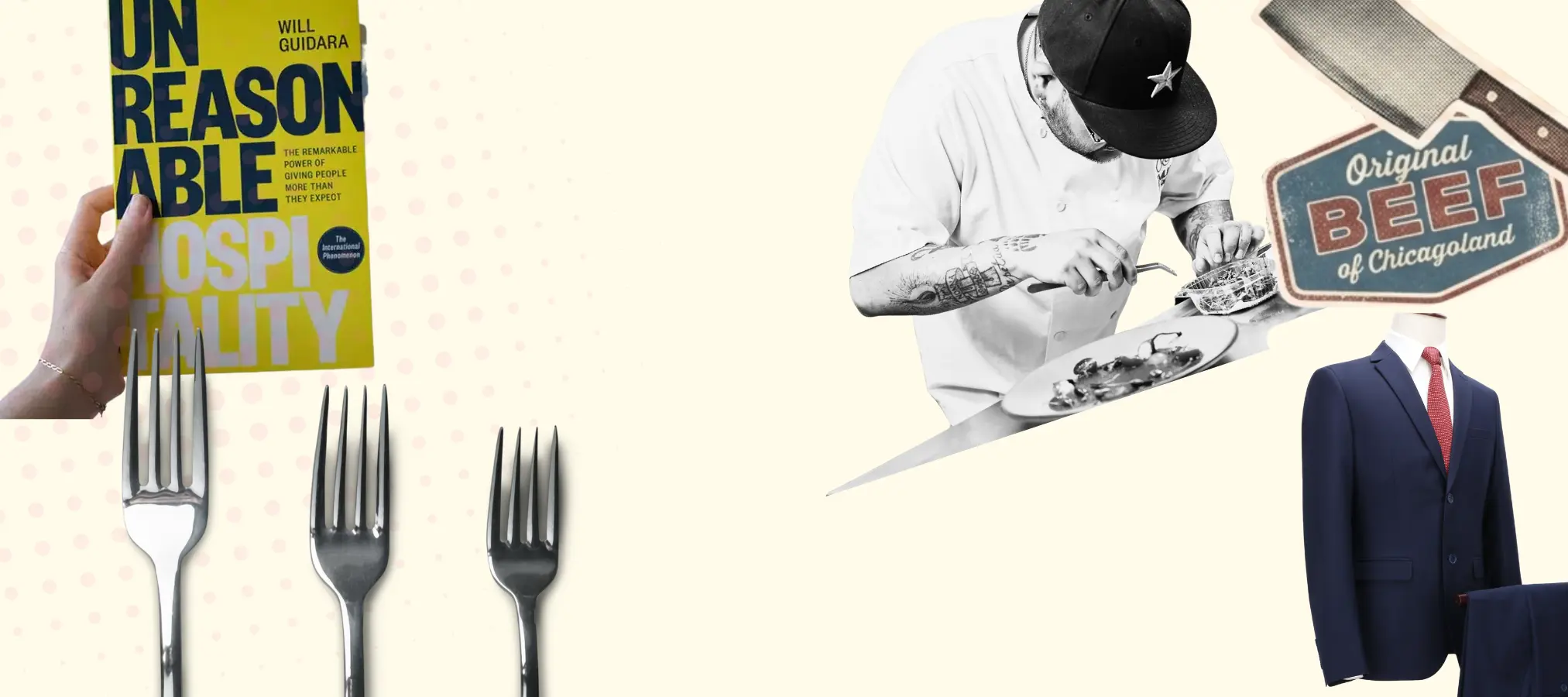
On day one, Richie is handed a tray of forks and told to polish them. All of them. Now, personally, I love polishing – especially silver – I’d rescue my Hagertys in a fire. But Richie – he nearly walks out. What the show does, and does brilliantly, is refuse the redemption montage. There is no music swell. No moment of clarity. Just a man in his forties, in a borrowed jacket, holding a fork and a cloth, deciding whether his dignity will let him do this.
He stays.
That is the inflection point. Not the famous deep-dish pizza moment two days later. The pizza is the result. The hinge is the morning he chooses not to walk. By staying, he chooses to receive what Ever is trying to give him, which is a slower kind of attention than he has paid to anything in his adult life. The fork is the medium. The transformation is in the man holding it.
A few episodes in, the head chef of Ever addresses Richie as “Chef.” Just once. In passing. Not ceremonial. Not even particularly kind. A working title, applied as if Richie had earned it, said as if it were a fact about him. But he nearly comes apart on the spot. Being treated like he matters, by someone with no incentive to flatter him, is more than his nervous system is currently equipped to process.
This almost never happens in offices, by the way. We are more likely to call each other “mate” or “big guy” than to confer working titles. The version of you that has been performing the same role for ten years is rarely asked, out loud and by name, to outgrow itself. Right, Boss?
Most real growth, in scaling businesses, looks like this. Not a workshop. Not a leadership retreat. One person, somewhere in their forties, being treated like they matter by an environment that demands something better of them than the version they have been performing for a decade. Do not underestimate the importance of being seen, people.
Unreasonable Hospitality (the book Richie reads on screen)
A few episodes into Forks, Richie starts carrying a book. The book is real. It is Unreasonable Hospitality by Will Guidara, who really did run Eleven Madison Park, really did take it to number one in the world, and really did write a memoir about what it took. The show puts the book in Richie’s hands because Richie, the character, is using it as a manual. The piece you are reading now is using it as a thesis. (Nerds.)
Here is the story from the book I have the most post-it notes on. A family from out of town has just finished a tasting menu at EMP. They are heading to the airport, and they mention to a server that they never got around to having a New York hot dog. Guidara, who is hosting, overhears. He sprints to a street cart, buys a hot dog, brings it back, has the kitchen plate it on fine china with a smear of mustard and a flick of relish, and serves it as the final course. The family weeps. Their flight home becomes a piece of folklore they will tell strangers about for the rest of their lives.
This is one strand of our methodology for leading people well.
”Most people think of hospitality as something they do. Will thinks about service as an act of service: about how his actions make people feel.
Simon SinekOn Will Guidara, Unreasonable Hospitality
Guidara’s point is not that you should start serving hot dogs at fine-dining restaurants (although if you want to, nobody is stopping you). The point is that hospitality is the practice of noticing what the person in front of you actually wants, and then caring enough to do something unreasonable about it. The dance, he calls it, when an entire dining room is moving in attention to each other without anyone explicitly conducting. The brand is what happens when the dance works.
So the book describes a discipline. The show, in Forks, dramatises it. Both are saying the same thing from different ends of the same kitchen.
It is also, for what it is worth, the actual definition of customer experience. (By the by, if you want another good read, try The New Gold Standard. An oldie but a goodie.)
What Sydney can feel
More attuned than she realises, rising star Sydney can feel the disconnect in this structural gap. Because she knows this place could be exceptional. The food is already there. What is missing is the system around the food: the dance, the regulation, the leader who does not shout back when the printer screams. Unafraid to roll up her sleeves, she will work the hours. But she will not lose her own cool to a kitchen that cannot find its own.
If the people around Carmy do not grow up, Sydney will activate flight. She will leave for a corporate place, regardless of the pay, because they have a working freezer door. Worse, the next-gen talent leaves with her, because young brilliant people watch each other carefully, and they tend to exit in formation.
Which means you, in the Richie seat, are not just holding the floor for an old loyalty. You are the thing that decides whether the next generation stays. Because even if you didn’t sign up for this, you are the co-regulation Sydney is seeking. You are the difference between this business becoming The Bear and remaining The Beef.
The Freezer
There is an episode near the end of season two in which Carmy gets locked inside the walk-in freezer during the soft opening. The door has been broken for weeks. He has been meaning to fix it. For the same reasons most founders have been meaning to fix things: but he is busy, it is not on fire, and there is always something more visible to do this week.
So the door fails on the worst possible night. While Carmy is trapped, the service collapses. Sydney cannot plate. Richie has to hold the room. The team does not know what to do without its chef. The cost of the unfixed foundation arrives all at once, on the night that was supposed to prove the place worked.
This is the part where most thought pieces try to sell you something. We will not.
What we do at Good CX is the equivalent of Forks. A slow, attentive environment in which scaling leaders are led back to the original signal of their business: what the customer is actually paying for, what the team actually needs, what foundation has been moved around because moving around it was cheaper than facing it. This is the practice we call strategic discovery, built into the DISTIL methodology we run with clients ready to do the deeper work, and grounded in human-centred design. We work with the Carmys to fix the door. Liz works with the Richies to find the suit. Occasionally, we work with the Sydneys to remind them why they came in.
The work is not a workshop. It is a polish.
Taste
In Slow Productivity, Cal Newport calls what Richie develops at Ever taste. Taste, in Newport’s reading, is the practice of being able to recognise what good actually looks like, sounds like, feels like, and to explain why. You develop taste by paying close, slow attention to how the best people make the thing. Then your own output begins to catch up.
”Focus on creating something good enough to catch the attention of those whose taste you care about, but relieve yourself of the need to forge a masterpiece.
Cal NewportSlow Productivity, Chapter 5 (Obsess Over Quality)
Newport’s claim, and Forks confirms it, is that taste is the hidden engine of mastery. A line cook who can describe exactly why one sauce is balanced and another is muddy will get better faster than the cook who just keeps making sauces. Same is true for leadership. The senior leader who can articulate exactly why a meeting landed, why a customer felt seen, why one team is regulated and another is not, is developing the same engine.
Taste, in this reading, is the rare and underrated skill of telling the difference between competent work and excellent work. And being able to say why. Most operations do not develop this foundational understanding of ‘good’. Most operations are, as a result, competent.
The work most scaling businesses skip is exactly this. They keep producing. They never slow down enough to develop taste in their own operation.
If you have read this far, you are probably standing in a Richie seat. You are probably wondering whether what you have outgrown is the job, or the version of yourself you have been performing inside it. Both can be true. Both can be the same answer.
Every second counts. The tickets are still printing. But you do not have to be Behind any more.
And when you cross your own Rubicon, when you finally put the suit on, the work shifts again. To keeping your head once you are across. The next piece on that: lessons from SAS Rogue Heroes: cross the Rubicon, keep your head.
Polish the silver. Develop the taste. Put the suit on.
