What scaling founders actually need after they cross the Rubicon. When warrior mindset stops being enough.
Cairo, 1941. Before the ice had time to melt, the Suffering Bastard was gone. Stirling ordered another. You could not blame him for downing a drink. A parachute jump months earlier had nearly killed him. His pain was real. The pitch was due. Somewhere in the building was the Deputy Chief of Staff, Major General Sir Neil Ritchie, who was about to become rather important to Stirling’s afternoon. The piece of paper in David Stirling’s pocket proposed a unit that did not exist. Needless to say, he intended to leave the building with the case made. Bowie was not playing in the bar that day. Bowie’s ‘Heroes’ was however playing in this scene in Steven Knight’s 2022 adaptation of Ben Macintyre’s SAS: Rogue Heroes. Probably because Knight suspects the men felt modern. In the actual room, Vera Lynn would have been on a wireless and a barman polishing glasses. And the kind of British staff officer who would later look at Stirling’s piece of paper and reach for his own stiff drink and get on with it. The doctrine on the paper, more or less, was this. Send tiny teams of misfits into the desert. Let them blow things up. Bring them back. Repeat. The Special Air Service – insofar as one could call it a service. Insofar as the air had much to do with anything. This was not the war HQ thought it was fighting. HQ was looking at maps. Big ones. Anyone who remembers Blackadder Goes Forth will know what I mean. “What is the actual scale of this map, Darling?” “Erm, one-to-one, sir….It’s superbly detailed. Look, look, there’s a little worm.” Different war. Different show. Same problem. Sometimes what is needed on the ground is simply not visible from the top, and the people on the ground have to walk into HQ with a piece of paper and a limp and a Suffering Bastard already in them. Ritchie took the paper to Auchinleck. Auchinleck signed. Just like that, the unit existed. The pitch was the easy bit. (It always is.) The part to worry about is what came after.
Key takeaways
Here is the shape of what follows.
- The pitch is the easy bit. What scaling leaders actually need is the work that comes after the bold strategic commitment. The keeping of the head once the Rubicon is behind them.
- Combat VUCA is short bursts. Boardroom VUCA is sustained months and years. The modern performance industry, led by voices like Mark Divine, sells tools calibrated for the burst, not the marathon.
- Marcus Aurelius wrote Meditations on military campaign across two decades of compounding crisis. The Stoic discipline he describes is what modern polyvagal theory now calls sustained ventral vagal regulation.
- Ryan Holiday has carried these Stoic ideas into the modern self-help market. The boardroom application is adjacent rather than competitive.
- SAS: Rogue Heroes is honest about what the men paid to hold the unit together. The mythology of the indispensable founder discounts that bill.
- The work of crossing well has three parts: cross deliberately, keep your head once you are across, and understand the helix you brought with you. The wiring that was already in the nervous system doing the crossing.
The Rubicon is the easy bit
Stirling’s pitch was, in its way, a Rubicon moment. The strategic commitment from which retreat is no longer available. The decision that calls the rest of the chapters into being. Every founder has one. Some have several. First, the big customer signing. Then the export move. The series A. The hire that breaks the founder-as-glue model. The Pivot. And the point at which the founder is no longer running a small thing well, but instead running a complicated thing they do not yet know how to run. Caesar’s Rubicon was a literal river he was not legally permitted to cross with an army. Nevertheless, he crossed it. Then took Rome. He also got knifed to death on the floor of the Senate five years later, having lost his head in both the literal and figurative senses by the time the daggers came out. If you are going to cross the Rubicon, the work is not the crossing. The work is keeping your head once you are across. SAS: Rogue Heroes is a slow-motion case study in what happens when men cross brilliantly and then spend the rest of their lives trying not to come apart in the years that follow. Half the show, watched carefully, is about the cost.
What the modern performance industry sells
The performance industry sells the crossing. Mark Divine talks about downloading new software. He has a point. You can train the mind as deliberately as the body. You can box-breathe through a hostile board meeting. You can run the protocol that lets you walk in on three nights of bad sleep and not lose the room. The tools work. They are calibrated for the meeting. They are not calibrated for the eighteen months that contain the meeting. The military template assumes a cycle. Extreme mobilisation. Explicit stand-down. Repeat. The boardroom does not give you the stand-down. There is no After Action Review. The market does not pause. The team does not stop watching your face. You are asked to stay activated, low-grade, for years. The human nervous system can do bursts. It cannot do eighteen months in second gear without something giving. (More on what gives, and where, in The future of CX is human.) The performance industry sells the burst. The burst is the easy bit.
What is sustained high performance under VUCA?
Sustained high performance under volatile, uncertain, complex, and ambiguous conditions is not what the warrior-mindset industry tends to advertise. It is not a burst of grit. Not a stack of breath protocols. Not the kind of unbeatable mind that survives a single bad meeting. It is a nervous system that can stay regulated for years. The boardroom version of VUCA is multi-year, not multi-minute. What gets you through is a sustained ventral vagal state. Stephen Porges’s polyvagal theory describes this in modern neurological terms. Marcus Aurelius described it in Stoic terms eighteen hundred years earlier. Both names point at the same operation. The leaders who survive sustained complexity are not the ones who push hardest. They are the ones who can stay reachable to themselves under a long pressure.
Aurelius, who wrote Meditations on campaign
Stirling pitched in Cairo. Eighteen hundred years earlier, another commander was writing in the field, this time on the Danube frontier. Marcus Aurelius wrote Meditations between roughly 170 and 180 CE, in the gaps between commanding the Roman legions through one of the most sustained periods of military and political VUCA the empire ever faced. Plague at home. Germanic incursions on the border. Court politics behind him. Two decades of compounding crisis. What did he write in those gaps? Not strategy memos. Not battle plans. Notes to himself about how to keep his own nervous system functional under conditions that almost guaranteed it wouldn’t be.
The sustained, regulated leadership this calls for is the work of our customer experience framework.
”Today I escaped from anxiety. Or no — I discarded it. Because it was within me, in my own perceptions, not outside.
Marcus AureliusMeditations, Book IX.13 (Hays translation)
That is response-ability in its original form. The recognition that what happens to you is not what matters. What happens next, inside you, is. The space between the event and your reaction is where leadership actually lives. The Stoics worked this out, in field conditions, before anyone had the vocabulary of cranial nerves or sympathetic activation. Aurelius is the case study the modern performance industry tends to gloss over. He did not have a SEALFIT programme. He had Stoicism, written in Greek in a leather notebook, in the cold of a Roman military camp. And the work he describes is not warrior mindset. It is the opposite. The patient cultivation of equanimity. The practice of meeting difficulty without flipping the lid. The discipline of inner attention while everything outside is moving. The obstacle, he wrote, ‘is the way.’ The work is the discipline, not the heroics. (Meditations 5.20) Ryan Holiday has spent the last decade carrying these ideas into the modern self-help market, and his work is good and has earned its readership. The proposition here is adjacent rather than competitive. What Stoicism looks like when it lives, daily, in the boardroom, rather than on a bestseller list.
”Where the head goes, the body follows. Perception precedes action. Right action follows the right perspective.
Ryan HolidayThe Obstacle Is the Way (Portfolio, 2014)
He is also, importantly, the case study in keeping your head. Aurelius did not lose Rome. He did not lose his mind. He died in his bed at fifty-eight, in camp, of natural causes. He had held the empire together for nineteen years across some of its hardest decades. That is the keep-your-head outcome. That is what the work, properly done, looks like over the long run. A small personal disclosure. I once stood at the foot of the Marcus Aurelius statue on the Capitoline Hill, at midnight, with the man who would become my husband. He proposed there. The third figure present, looking on with mild Stoic indifference, was the bronze emperor himself. My daughter’s middle name is Aurelia. I have a habit of taking the old emperor seriously.
And what came before
Aurelius could only do the work on himself because he knew what was inside. The first book of Meditations is not philosophy. It is a list. A catalogue of debts. What he learned from his father. What he learned from his stepfather. From his tutors. From his mother. From the slaves who raised him in the palace. He names them. He names what each gave. He had to know the wiring before he could discipline the impulses. Most founders, in my experience, do not. They are crossing the Rubicon with a nervous system shaped by everything that happened before the business existed. The parent who was hard to please. The early win that became the only win that counted. The childhood story that taught them what success was meant to look like. None of it is labelled “operating system.” All of it is doing the deciding. The work of crossing well, then, has two parts. One is keeping your head once the Rubicon is behind you. The other, older and slower, is understanding the helix you brought with you. How the personal narrative and the business narrative have wound around each other, and which threads in that double strand are still earning their place. The Aurelius work and the helix work are the same work. The only difference is how far back you choose to look. I will write properly about the helix in another piece. For now: if you are about to cross, or you have just crossed, or you crossed years ago and have been quietly unwell about it ever since, the question you cannot afford to skip is whose nervous system is doing the crossing.
What it cost the men who held it together
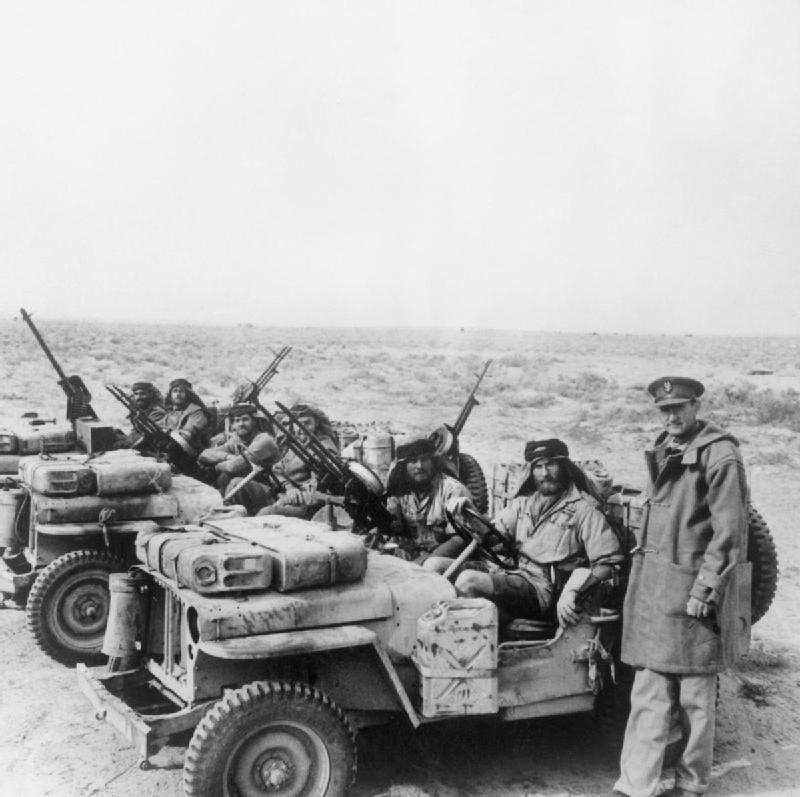
Colonel David Stirling with an SAS jeep patrol in North Africa, 18 January 1943. Imperial War Museum, E21338.
Macintyre’s book is honest about cost. The series, less so. The originals who founded the SAS were extraordinary at what they did. Many of them were also paying a bill nobody had handed them in writing. Jock Lewes, the technical genius behind the unit’s early weapons innovations and patrol doctrine, was killed by a Messerschmitt strafing run on 31 December 1941. He was ten days past his 28th birthday. Paddy Mayne deserves a more careful sentence than the series gave him. He was, by the assessment of the men who served under him, one of the finest field commanders of the war. Four Distinguished Service Orders. In April 1945, after Operation Howard near Oldenburg, Field Marshal Montgomery recommended him for the Victoria Cross. The recommendation was downgraded somewhere along the chain of approval. King George VI later remarked that the VC had “so strangely eluded him.” Mayne led from the front, looked after his men, and held the unit through extremities that broke other commanders. He drank heavily after the war, struggled with what we would now name plainly as PTSD, and died in a car accident in Newtownards in December 1955. He was forty. He is owed a more generous read than he has often received. David Stirling, the founder, was captured in Tunisia in January 1943 and spent the rest of the war in Axis captivity, attempting multiple escapes and eventually held at Colditz. The unit he had built carried on without him. The shape of modern special-forces soldiering exists because he walked into that office in Cairo with a piece of paper. He is owed more than this paragraph can settle. The unit survived them all. That is the achievement. The cost the men paid is not incidental to the story. It is the story. And the cost is what the mythology obscures when it gets repackaged for the modern boardroom and sold as grit, with the bill discounted to nothing.
The modern name for old discipline
What Aurelius described in Stoic terms, Stephen Porges has described in the language of cranial nerves. Polyvagal theory, developed over the past thirty years, names the physiological state the Stoics were cultivating without yet having the vocabulary for it. Porges calls it the ventral vagal state. The social engagement system comes online. Heart rate regulates. Face becomes expressive. Voice becomes prosodic. The prefrontal cortex stays available. It is the state in which a leader can read the room. Hold complex tensions. Make decisions that integrate incomplete signals, rather than collapsing into fight, flight, or freeze. The ventral vagal state is, crucially, sustainable. It is the state the human nervous system is calibrated to inhabit for long stretches. It is not aroused. It is not heroic. It does not make for good action films. It is, however, what a leader actually needs to hold a complex business through a long stretch of VUCA without compounding interest on themselves and the people around them. The methodology I work with, OPEN, is a deliberate sequence for activating and sustaining this state at four scales of human experience: sensory through collective. Optics restores outer sensory orientation and brings the social engagement system back online. Presence is the body as instrument, the practitioner’s regulated field, the pause between event and reaction. Engagement is dyadic and group co-regulation, the work that lets a team co-perform without each person having to perform alone. Network thinking is the allocentric ecosystem orientation that makes cathedral thinking possible. OPEN is not the burst toolkit. The burst toolkit is calibrated for ninety minutes of acute performance under fire. OPEN is calibrated for the marathon. For eighteen months in a market that will not behave. For a founder whose nervous system is being asked to underwrite a strategy whose horizon is longer than their current capacity to sustain mobilisation. The work is to make the eighteen months survivable. Then thrivable.
After the Rubicon
The Caesar story does not end well. The Aurelius story does. The difference between the two is not what they crossed. It is what they did once they were on the other side. Caesar kept fighting wars. He kept performing the role of conqueror. He never sat down. He never wrote Meditations. He was famously fearless. By the time he was warned not to go to the Senate on the Ides of March he was so well-defended by his own sense of inevitability that he did not hear the warning. Famously fearless and famously dead. Aurelius held the empire. Through plague, war, court politics, the unreliable son who would succeed him. He wrote in Greek to himself in the dark, asking what could be done about his own state under conditions he could not change. He kept his head. He died in his bed. So. If you are going to cross the Rubicon, three things matter, not one. Cross deliberately. Build the unit. Write the pitch deck. Pull off the impossible thing. Then sit down. Find the regulated state that lets you hold what you have built without breaking the people in it. Read the room. Listen for the long signal underneath the loud ones. And know whose nervous system is doing the crossing. The helix you brought with you is the third part of the work, and most founders skip it. They cross. They survive the first chapter. They lose the second one to a pattern they could have named years earlier, if anyone had asked them the right question. Aurelius would have called the whole thing discipline. Porges calls a piece of it ventral vagal regulation. The performance industry sells the crossing. The work I do is the keeping of the head, and the knowing of the head, and the slow patient excavation of how the head got built in the first place. It is, in the end, slower leadership than the kind currently being marketed. It is also the only kind that holds at the timescales scaling businesses actually live on. Let’s talk.
A small pedantry, by way of postscript
Pedantic readers may have noted that the Suffering Bastard (gin, brandy – purists note the original used bourbon- lime, ginger beer, mint, plenty of ice) was invented by Joe Scialom at the Long Bar of Shepheard’s Hotel in Cairo to revive hungover British soldiers, and the cocktail is more reliably dated to 1942 than 1941. Reader, if this matters to you, I commend you to a quieter essay. Cairo bar culture was already that scene. Stirling was certainly drinking something. The recipe, by the way, holds up. Try one. (Equal parts gin and brandy, half lime juice, top with ginger beer, garnish mint. The original is on every reliable cocktail history that touches the war years.)
About the author
Liz Pinfold-Reed is an insight-first strategist and thinking partner for founders and senior leaders at the crossing, the strategic threshold where the business has outgrown the founder’s current ways of holding it. She helps clarify the roadmap, past and present. She edits the story until the truth of it can be acted on, and the through-line becomes legible as a blueprint for true north. Her work sits at the intersection of strategy, customer insight, and the human nervous system: polyvagal regulation, mindsight and theory of mind, attachment, the steadiness under pressure that lets a leader read the room rather than react to it. She is Polyvagal-Informed with certificate to prove it, creator of the OPEN Method™ for team activation, and regularly chairs the New Zealand CX Summit. She has never seen the back of her own head, so she surrounds herself with people and the books of writers cleverer than herself. More about Liz | Follow on LinkedIn | Good CX