Remember Del Boy? Briefcase in hand, Reliant Robin rattling down Peckham High Street, absolutely convinced that this time next year they’d be millionaires. The hustle was magnificent. The belief, unshakeable. The problem? Nobody actually wanted what he was selling. Del Boy is the patron saint of everyone who has ever led with the pitch before understanding the person on the other side of it. As he so memorably put it: “It’s a financial jungle. It’s a case of He who dares, wins.” True enough, Del. But in professional services, he who listens first wins more often, more sustainably and with considerably less explaining to do.

Only Fools and Horses gave us the world’s greatest pitch. Nobody bought it.
What if the problem is not that you are bad at business development? But that you’ve simply approaching new clients with the wrong end of the stick?
That question should matter to you more than it might first realise, especially right now. Ouch – you’re feeling this – New Zealand’s professional services sector has been through a genuinely difficult stretch. After GDP contracted in 2024, the recovery underway in 2025 and 2026 is real but uneven.4 And many consulting, advisory, legal and financial services leaders and their people are still feeling the effects. Tightened discretionary spend, slower referrals, and longer client decision cycles all sound familiar, yes? At the same time, AI implementation is reshaping what clients expect from expert advisers. According to the AI Forum NZ’s 2025 productivity report, 87% of New Zealand organisations now use some form of AI, and 88% report a measurable positive impact on their operations.11
All this changes the conversation significantly. Understanding how clients buy is key. Your clients who once paid for information and process are now asking a harder question: what, exactly, am I buying from you that I cannot get elsewhere? Which is why the frame most of us have inherited for business development is not just unhelpful. It’s a hard truth, but in this market, you might just have to up your game beyond traditional WOM referrals.
Selling your expertise is different from selling anything else
The instinct most professionals carry into business development is a selling by, well, instinct. Sharper pitch. Cleaner offer. More confident close. Yet your clients in professional services are rarely waiting to be convinced by the polish of your deck or the size of your corporate box. They are asking more human questions – and subconsciously reading the room for the untangible information you bring to it. ‘Can I trust this person? Do they truly understand the reality I am operating in? Will working with them make things clearer, not harder?’
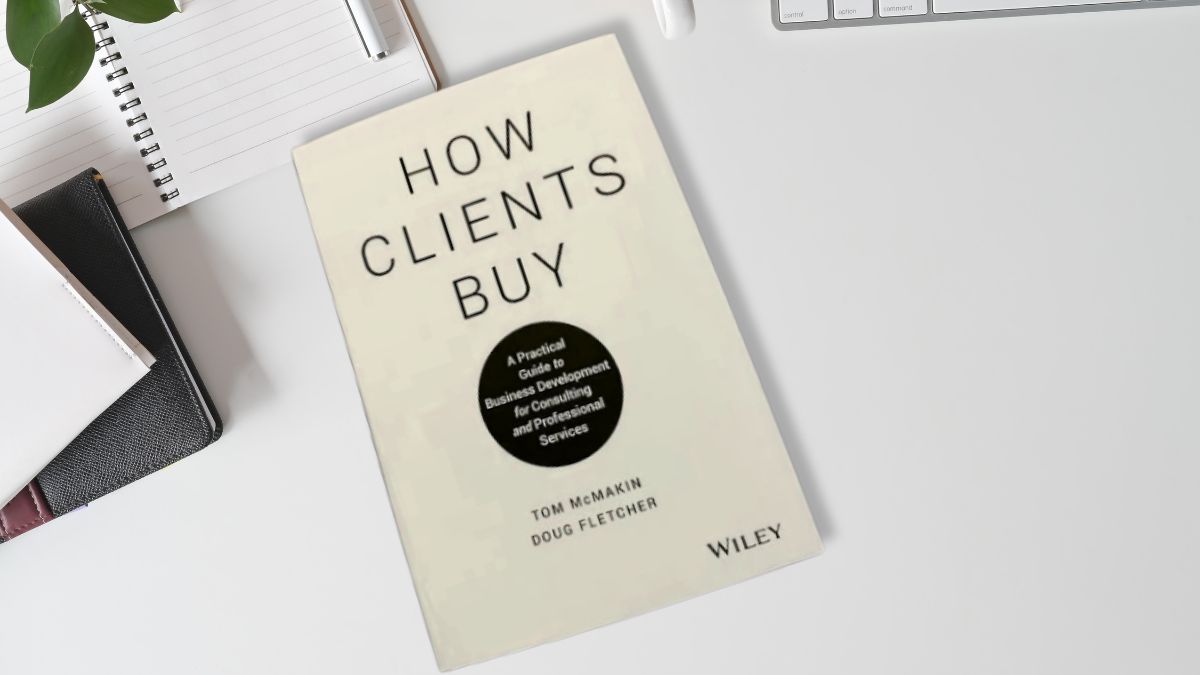
Those questions are not answered by a proposal. They are answered over time, through relationship and through the coherence of who you are. In fact, that is the central argument in How Clients Buy by Tom McMakin and Doug Fletcher. As they put it, growing a professional services practice is not a sales problem. Oh contraire Rodney – it is a trust problem. And trust, once you see it clearly, turns out to be the mechanism of the whole thing.
In New Zealand’s current climate, that truth hits differently. When budgets are under pressure and clients are more selective, they do not simply ask whether you are capable. They ask whether working with you feels safe. Whether you understand the weight of the decision. Whether you will still be the right person when it gets complicated.
Why capable people still struggle to say what makes them different
Here is the paradox that we see come up again and again . The people with the most distinctive value are often the least equipped to name it. Not because they lack insight, but because they are too close to their own thinking to see what is genuinely unusual about how they work.
Ultimately, their strengths feel normal to them. Our values become so deeply embedded that they no longer register as differentiators. And their best relational instincts are practised but unnamed. So when asked to describe what sets them apart, they reach for the same language everyone else uses. Trusted adviser. Strategic thinker. Results-driven. Collaborative. None of it is untrue, and none of it is memorable either.
More importantly, none of it helps a client understand why this particular person is the right thinking partner for this specific moment. That gap — between the value that genuinely exists and the value that can be clearly communicated — is where a great deal of potential growth quietly stalls.
“I am a black belt in origami.” or…The real work is not self-promotion. It is self-translation.
This distinction is worth making carefully. The challenge for most people doing business development for consultants or running professional services practices is not learning to market themselves more loudly. It is learning to translate who they already are into language that creates genuine resonance.
Clients are not simply buying capability. They are interpreting your signals. Listening for whether your story holds together and whether your values feel lived rather than claimed. They are sensing for common ground, and for a believable exchange between what they need and what you specifically bring. When those things are present, winning consulting clients starts to feel less like performing and more like connecting. That honesty is often where the real differentiator lives.
The question, of course, is how to surface it.
Why is writing your own reviews so hard to do on your own?
Most consultants, founders and relationship owners of key accounts cannot easily get to this view of themselves without outside facilitation. The pattern is too familiar. Our strengths are too habitual for us to see. So the relational value is too embedded for us to see ourselves clearly from the inside. It’s that old badger of trying to read your label from inside your own jar. Yes, the insights are there in plain sight – but you’re blind to them (you’re more fascinating than you know). It simply that no one has helped you name it, shape or build these nuggets into a story that other people can recognise and trust.
That is precisely where our work together begins.
”I actually don't think you can sell professional services. I think you have to help clients buy them. Clients buy based on intangible criteria such as credibility, respect and thought leadership
Tom McMakinHow Clients Buys
How we help individuals and teams to surface their truth and re-story
Liz Pinfold Reed has spent 20 years understanding what drives people and how trust forms between businesses and their clients. Her work is grounded in behavioural psychology, customer insight (often surfaced through a voice of customer programme) and the kind of careful listening that surfaces what most advisers miss. As she puts it:
“It’s hard for brands to deliver value to customers who they can’t understand as individuals.”
The same is true in reverse. It is hard to communicate your value to clients who do not yet understand what makes you different.
Our work is to facilitate that process of surfacing, shaping and translating. We help bring the right insights forward so that personal values come to the fore. From there, we work together to build them into a clearer story, a stronger value exchange and more meaningful common ground with the clients and relationships that matter most.
If this feels like a deeply personal thing (normally the case), you’d work 1:1 with Liz. Together you identify what is genuinely distinctive in how you think, relate and lead, then turn that into positioning and language that feels true to you and lands with the people you serve.
For teams, we do this through our Trust Advantage programme, run in cohorts for established professional services firms. It builds shared language, relational capability and differentiated positioning that drives more trust-led growth together. No scripts. No pressure. And without the founder carrying the client-winning load alone. This workshop is registered with the Regional Business Partner Network. To explore if your business may be eligible for support, contact us so we can put you in touch with your local Regional Business Growth Advisor if appropriate to discuss further.
And if you are a scaling leader who also needs to sharpen vision, test strategy and build a practical growth roadmap, our Leadership Vision and Roadmapping programme offers a structured place to do exactly that.
Both paths start from the same place. Not a framework imposed on you from the outside, but the insight that live within you already, waiting to be found.
The shift that changes everything
So perhaps the most useful question to carry into your next business development conversation is not, how do I sell this better? It is simply: what would help this client feel clear enough, safe enough and confident enough to move forward?
That shift changes the energy. It also changes the quality of everything that follows, moving the work away from performance and towards something more durable. Relationship. Meaning. Real differentiation. In consulting, especially in a market asking harder questions of every adviser, that is almost always where growth begins.
If this has landed, we would be glad to help you unpack your superpower. You can book a discovery conversation with Liz to start surfacing your personal differentiator and build it into a story that creates genuine traction. Or explore the Trust Advantage cohort to develop this as a team capability. Either way, no pressure, no script. Which, given what this is all about, feels like exactly the right way to start.
The latest thinking from Good CX
Ideas worth arguing with
Every so often we share what we’re learning about customers, the people who serve them, and what a leader can do with it. If we get in touch, it’s with something worth pulling apart with your team. Unsubscribe in one click.
You’ll get one confirmation email first, so we know it’s really you. We handle your details in line with our privacy policy.