
OPEN Method™
Insight led team activation for innovative problem-solving.
Most leadership teams arrive with the frameworks. However, the ones that compound learn to land them. OPEN Method™ is a polyvagal-informed methodology developed by Liz Pinfold-Reed and owned by Good CX Ltd. Four pillars. One condition. Beginning where most leadership work skips: with the body.

Here is a pattern you might recognise. The leadership team has been through the offsite. The frameworks have been printed. The values are on the wall. And yet the meetings still drag. The same things get said. The brave conversation does not happen.
However, the question nobody has paused to ask is whether the room is in a state that can actually use the frameworks it has been given.
Building psychological safety
Why the body must move before the mind can disagree
Peter Levine, founder of Somatic Experiencing and author of Waking the Tiger, reminds us of a missing piece in most leadership work. When a body senses threat and cannot fight or flee, it freezes. As a result, the defensive instinct does not complete. It stays in the body as what Levine calls a ‘thwarted instinct’. Multiply that across a year of boardroom pressure and you have a leadership team that is, biologically, full of incomplete fight-and-flight responses sitting in the chair.
The body cannot regulate while it is sitting still on top of thwarted instincts. It needs to move. Not for fitness. For completion. The defensive energy needs somewhere to go, in a context that is safe enough to let it complete without harm.
This is why OPEN Method™ engagements involve movement at every layer. From simple walks to paddleboards, yoga or improvisation. They are not team-building gimmicks but structured practical containers in which thwarted instincts can complete and the body can return to the state from which it can listen, regulate, and disagree.

The cost of leadership without nervous system literacy
When organisations skip the body’s work and go straight to the content, everything downstream sits on guesswork. Therefore, the strategy does not get executed. Moreover, the culture work does not stick. The senior leaders look effective in the deck and exhausted in the diary.
In other words, the cost stays invisible until it shows up in turnover, sleep, or the quiet decision to leave. The EMA Wellbeing Survey found that 78% of New Zealand employees reported problems sleeping in the last three months because of work. That is the downstream signal of what nervous systems did with what their days held.
OPEN™ exists to put the conditions before the content. The shift it trains has a name.
allocentric (adjective)
Having one’s interest and attention centered on other persons.
Merriam-Webster. First known use 1916.
Allocentric attention is the move from self-centred default to inclusion of the other in the room. It is what becomes possible when interoception and neuroception are working together. And it is the one variable that most reliably distinguishes a leadership team that compounds from one that does not.

Surfacing the unseen
What is essential
is invisible to the eye.
Antoine de Saint-Exupéry
How OPEN™ works: four pillars, one condition
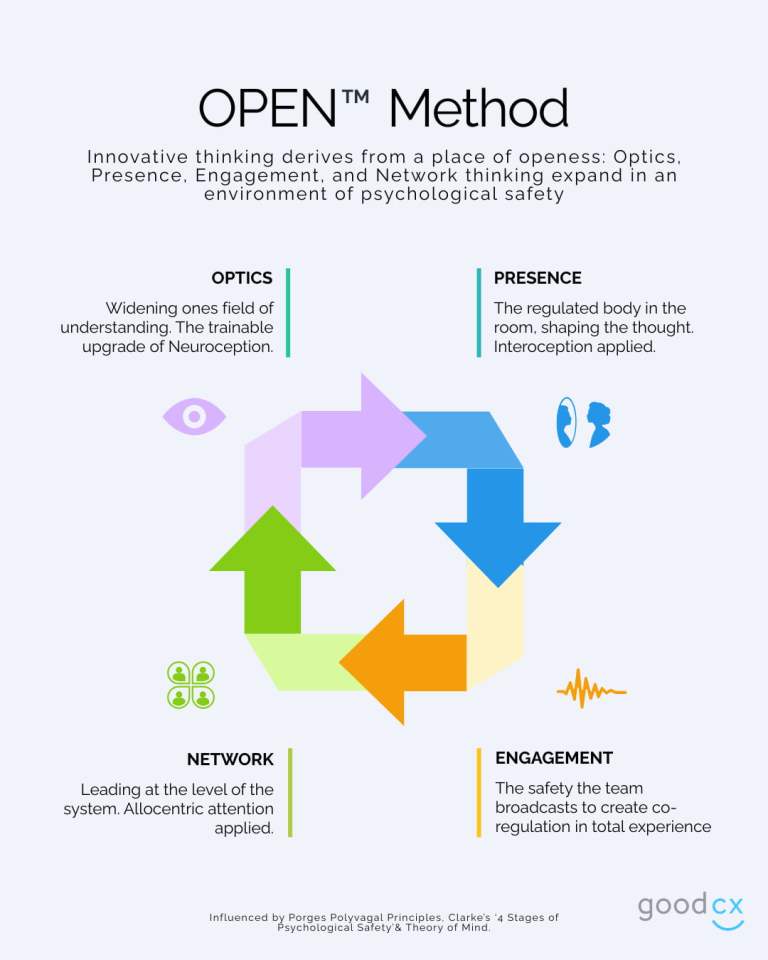
OPEN™ is a system, not a checklist. The four pillars compound. Without the first, the second cannot hold. Without the second, the third has no traction. The condition the pillars build, together, is a team that can do the cognitive work the business needs from them under sustained pressure.
Optics
Widening the field. Under sustained pressure, the visual field narrows and peripheral signal drops away. Optics is the practice of widening: soft eyes, peripheral attention, the kind of looking that takes in the room rather than locking onto one face. It is the trainable upgrade of neuroception. As a result, teams trained in Optics catch more of what is being said, and more of what is not.
Presence
The regulated body in the chair. What a room reads first is not the slide. Indeed, it is the body of the most senior person in the room. Posture, breath, tone, the small involuntary signals one nervous system sends another. Presence is interoception applied. You feel your own state shift, and you choose what your body is saying before the room has to translate it. Therefore, a regulated leader gives the room permission to think.
Engagement
The safety the team can feel. Psychological safety is the precondition for the cognitive work the business is paying for. The mechanism is co-regulation: one nervous system literally calms another. Engagement is where OPEN™ trains leaders to read where a team sits on the safety map, name the gap, and design the practices to climb. The result is observable, teachable, and measurable in a single half-day session.
Network thinking
Leading at the level of the system. The job of a senior leader is no longer to be the smartest person in the room. It is to engineer the right adjacencies, surface the right bridges, and let the system generate ideas no individual could produce alone. Network thinking is the move from leading the individual to leading the graph. Ultimately, it is allocentric attention applied to a whole organisation.
Six symptoms most likely to be visible in your team
Does any of this look familiar? These are the most commonly searched workplace problems in 2026. All of them are downstream of the same underlying default that OPEN™ addresses.
The OPEN Method is one of the methods in our customer experience framework.
If you are seeing more than two of these in your team, the conversation is overdue.
1. Absenteeism
People stop showing up because the body has read the room as unsafe. The defensive response is completing through avoidance.
2. Presenteeism
People show up but the nervous system has gone into freeze. Body present, mind elsewhere, work output thin.
3. Quiet quitting
A polite modern name for psychological withdrawal from a room that has stopped offering safety. The behaviour follows the biology.
4. Employee burnout
Sustained sympathetic activation with no recovery loop. The most common outcome of leading from ego mode for too long.
5. Low morale and disengagement
The signal that allocentric attention has dropped out of the team. The other has stopped being seen.
6. Failure to speak up or innovate
The exact diagnosis of missing challenger safety. People know what is wrong. They do not say it. The room cannot bear the risk.
How team readiness is measured: the four stages of psychological safety
How do you know an OPEN™ engagement is shifting the team? OPEN™ references Timothy R Clark’s Four Stages of Psychological Safety as a readiness map. Four conditions that compound across customer experience, employee experience, and leadership performance. Together, they tell you whether the team can do the cognitive work the business is asking for. Where a team sits on the map determines which pillar of OPEN™ leads the next engagement.
Inclusion safety
Does every person on the team feel they belong here? Inclusion safety is the felt sense that the room has space for you. When inclusion is low, people manage their visibility and the team loses the contribution of its quieter half. When it is high, the floor of the conversation rises.
Learner safety
Can people ask the question they do not know the answer to? Learner safety is the permission to admit gaps without political cost. It is the variable that most determines how quickly a team adapts to new information. As a result, low learner safety produces teams that perform certainty they do not feel.
Contributor safety
Can people bring their best work? Contributor safety is the permission to do the thing you are actually good at, in a room that will use it. Without contributor safety, talent is present but underused. As a result, the team looks senior on paper and operates as a meeting of cautious experts.
Challenger safety
Can people disagree with the most senior person in the room? Challenger safety is the highest condition, and the rarest. It is what allows a team to surface the brave conversation in time to act on it. Most strategic failures are visible inside the organisation months before they are visible outside it. Challenger safety determines whether anyone says so out loud.
OPEN™ methodology FAQs
The innovation threshold
Challenger safety is the innovation threshold. Yet it is also the stage most teams never cross. Crossing it requires what clinical psychotherapist Jan Winhall calls the felt sense of safety: a body that has been allowed to turn off its threat surveillance long enough to push energy into the creative centres of the brain. Winhall’s Felt Sense Polyvagal Model, building on Eugene Gendlin’s earlier work on the felt sense and Stephen Porges’s autonomic nervous system science, names what challenger safety actually requires at the level of the body.
That biofeedback work is what OPEN™’s Optics and Presence pillars train. It is what makes Engagement possible. Without the felt sense of safety, no amount of training in challenger behaviours will produce them. The body has to be allowed to know it is safe before the room can know it.
For what an OPEN™ engagement looks like in a real room, see notes from a peer learning lab at Auckland Theatre Company.

Not sure where to start? An Innovation Lab is usually the right first step.
What is the OPEN Method™?
OPEN™ is a four-pillar team activation methodology: Optics, Presence, Engagement, and Network thinking. It was developed by Liz Pinfold-Reed and is owned by Good CX Ltd. It is polyvagal-informed. Liz is Polyvagal-Informed via the Polyvagal Certificate Course, which means we teach the body-and-room work with the underlying science, not as a vague feeling. Where DISTIL™ is the strategic methodology, OPEN™ creates the team conditions in which DISTIL™’s Discovery can surface what the business actually needs to know.
How is OPEN™ different from leadership training or mindset work?
Most leadership training works at the level of cognition: frameworks, language, behaviours. However, OPEN™ works one layer below, at the nervous system that has to operate those frameworks under pressure. As a result, cognitive tools delivered to a dysregulated team do not stick. OPEN™ builds the regulatory floor first. Our role is not to tell your team what to do. Our role is to facilitate the conditions in which the team can do their own thinking.
What are interoception and neuroception?
Two concepts central to OPEN™ that most leadership coaches do not name and most polyvagal-informed practitioners take for granted. Interoception is the sense of your internal state: heartbeat, breath, gut, muscular tension. It is the inner-mirror skill that lets a leader notice their own state shifting before it shows up in their voice or their decisions. Neuroception, a term coined by Stephen Porges, is the nervous system’s unconscious surveillance of safety, danger, or life-threat in three places at once: in the environment, in other people, and in your own viscera. It is the thing your nervous system is doing while your conscious mind is composing the next sentence. Both are trainable. Both are taught inside OPEN™.
Why does OPEN™ involve movement?
Because bodies do not regulate while sitting still on top of unfinished defensive responses. Peter Levine’s work on Somatic Experiencing names what most leadership work skips: when a body senses threat and cannot fight or flee, it freezes and the defensive instinct does not complete. Levine calls these thwarted instincts. Consequently, they accumulate in any team operating under sustained pressure. OPEN™ engagements involve walks, paddleboards, yoga, kayaks, and improvisation because the body needs somewhere to complete what was started. Movement is not a team-building activity. It is the physiological precondition for the cognitive work the business actually needs.
Can our team run the pillars internally?
Yes, and this is by design. Once an OPEN™ engagement has been run with the leadership team, the practices travel. We embed the four pillars in your team’s working rhythm and equip your senior leaders to hold the conditions themselves. The visible tip of the practice is three observable behaviours that work the same way in a leadership meeting as they do in a sales conversation. Speak in hypotheses, not headlines. Name the bigger scheme. Trade risk for responsibility. The deeper craft is what we facilitate. In short, Good CX builds the floor. Your team holds the room.
What is the measurement framework?
OPEN™ uses Timothy Clark’s four stages of psychological safety as its readiness map: Inclusion, Learner, Contributor, and Challenger safety. Together they tell you whether a team can do the cognitive work the business needs from them. Where a team sits on the map determines which pillar of OPEN™ leads the next engagement.
How long does an OPEN™ engagement take?
A focused Innovation Lab runs as a half-day or one-day intensive. An atelier engagement with a senior leadership team typically runs four to twelve weeks. A full programme design integration runs three to six months. We confirm timing in the first conversation once we understand the scope.
How does OPEN™ connect to the DISTIL™ methodology?
DISTIL™ is the strategic methodology that begins with Discovery: the team surfacing what is actually going on inside the business. However, teams can only surface clearly when they are open. OPEN™ creates those conditions. The two methodologies are integrated rather than sequential. Our role is not to tell you what we see; it is to facilitate the state in which your team can see for themselves. DISTIL™ is the work. OPEN™ is the room in which the work can happen.
Is OPEN™ trademarked?
OPEN™ is a proprietary methodology owned by Good CX Ltd, developed by Liz Pinfold-Reed. The framework, pillar architecture, and methodology name are the intellectual property of Good CX.
Ready to find out which pillar of OPEN™ your team needs first?
We will not pitch you a six-month programme. Instead, we will start with one conversation. We will assess where your team sits on the safety map. And we will confirm whether OPEN™ is the right framework for what you are facing. If it is not, we will tell you.