
Most of us have built a customer journey map at some point. You get the team in a room, cover a wall in sticky notes, draw a wobbly line for the emotional highs and lows, and for an afternoon it feels genuinely useful. Then the workshop ends. The map gets photographed and tidied into a slide, and a few weeks later it is wallpaper. Nice to look at, changing nothing.
I have made that map. You probably have too. And the longer I do this work, the more I think the disappointment is almost never about the drawing. It is about what happens, or does not happen, once everyone has left the room.
Key takeaways
In short: Customer journey mapping is the practice of visualising the steps a person takes to reach a goal with your product or service, capturing what they think and feel at each stage. A map is only useful if it changes how you treat the real journey.
- Start with a clear persona and the unmet need, not the map.
- Build it around one actor and one scenario, plot the emotional highs and lows, and mark the moments that matter.
- Assign an owner to every opportunity. A map without an owner is a poster; a map with owners is a roadmap.
- Treat the map as a living document, not a monument, and revisit it as behaviour and technology shift.
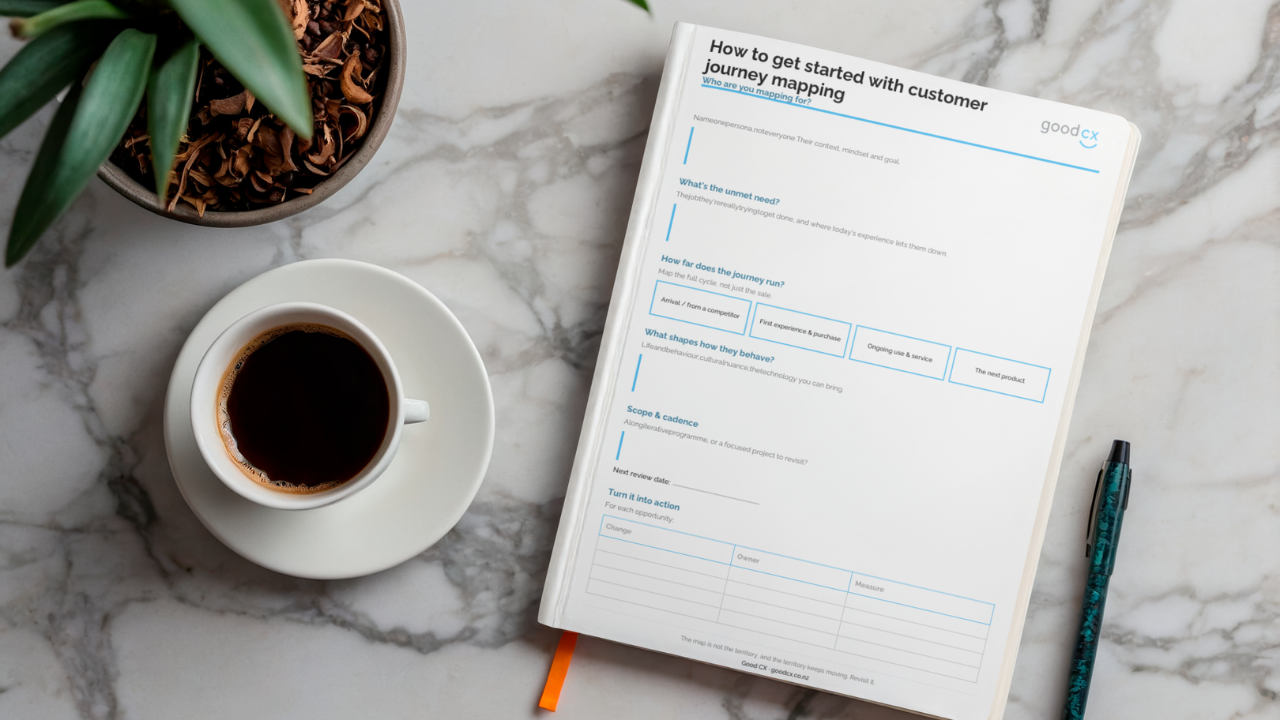
📥 Download the free customer journey mapping planner to map out who you are mapping for before you begin.
What is customer journey mapping?
Customer journey mapping is the practice of visualising the steps a person takes to reach a goal with your product or service. It also captures what they think and feel at each step. As the Nielsen Norman Group puts it, a journey map is simply a visualisation of the process someone goes through to accomplish a goal. A good map gathers actions, mindsets, emotions and the moments that matter into one shared picture. Done well, it gives a whole team the same view of the customer, and the same reason to act.
The map is not the territory
One idea should sit behind every map you make. In 1933 the philosopher Alfred Korzybski wrote that the map is not the territory. He meant that a model of something is never the thing itself, and we get into trouble when we confuse the two. Your journey map is a model. So it is useful only to the degree that it changes how you treat the real journey. That is the one your customer is living, whether you have mapped it or not.[/vc_column_text]
”A map is not the territory it represents.
Alfred KorzybskiScience and Sanity, 1933
Hold onto that, because it explains why so much journey mapping disappoints. Teams fall in love with the artefact and forget the territory. They map the journey they wish customers took, then act surprised when the real one keeps misbehaving.
The journey is bigger than a single purchase
Journey mapping is not new. What has changed is the scope. In our experience with international clients, the real purpose of a map is to scale ideas across universal unmet needs (often surfaced via a voice of customer programme) and the technologies now available to meet them. That is a bigger ambition than tidying up a checkout flow.
Take the work we have done in automotive. The journey is not the sale. It is the full cycle. First you transition someone away from a competitor brand. Then you bring them into the test-drive environment. From there, you onboard them through a major purchase and support them through the life of the product and its servicing. Finally, you anticipate the moment they are ready to move to the next vehicle in the range. The sale is one beat in a much longer piece of music.
That cycle also looks wildly different depending on who is living it. Picture someone in Barcelona with a weekend car, the one they take to the coast to kitesurf. Now picture a family in Surrey doing the ballet run and the weekly shop. Same brand, two completely different journeys, and two different sets of moments that matter. Driver behaviour reshapes the whole map. And when the journey crosses a border into a new export market, the seven cultural variables that shift become their own discipline, which we unpack in our piece on customer journey mapping for export markets.
The terrain keeps shifting
The terrain shifts under the map as well. The journeys we map in automotive today have to weigh things that barely registered a decade ago. Fuel and energy shocks, the cost-of-living squeeze, even the proximity of a war in Europe shaping where and how people buy. Rewind to the last global financial crisis and the considerations were different again. That was a world that did not yet have telematics in every car. Buyers now arrive carrying bigger ecosystems of stress, and that stress quietly rewires how they behave. It is the volatile, uncertain terrain that leaders are learning to navigate, something we explore in our piece on leading through sustained VUCA.
Start with persona and unmet need, not the map
Here is the part most guides skip. If journey mapping is new to your business, the map is not your first move. Your first move is to understand who you are mapping for, and what they are really trying to get done.
That means two pieces of groundwork. First, clear personas, because a journey only makes sense through one person’s eyes. Our blog on why customer personas matter is the place to start. Second, the unmet need sitting underneath the behaviour, which our piece on revealing the customer unmet need unpacks. Without these two, you are not mapping a journey. You are decorating a guess.
There is a harder truth underneath this. Even with personas in hand, most of us are not naturally good at getting beyond ourselves. Psychologists call that skill allocentrism, the knack of holding someone else’s reality without erasing your own. It is rarer than design-thinking workshops like to admit. Under pressure we slip back to the egocentric question, how does this affect me, and quietly paint our own assumptions onto the persona. Good insight work is what closes that gap, both for the consumer and for the frontline employee who actually meets them. We explored the theory of mind and mindsight behind this in a night at Auckland Theatre Company. There, we put two groups’ private thoughts on the same stage to practise exactly that move.
From there, a good map weighs three things against each persona. It looks at the technology and capability you can actually bring to bear. It accounts for the cultural nuance of the market you are in. And it leans on the insight that maps to that specific person. Get those aligned, and the map starts to earn its keep.
What actually goes on a customer journey map
Maps come in many shapes, but the useful ones share the same handful of parts. The Nielsen Norman Group names five, and they are a sensible backbone. First, an actor, which is one specific customer seen through one clear point of view. Second, a scenario, the situation and the goal the actor is trying to reach. Third, the journey phases, the high-level stages the experience moves through. Fourth, the actions, mindsets and emotions within each phase, ideally in the customer’s own words. Fifth, the opportunities, the insights about what to fix and, crucially, who owns the fix.
In fact, only the first four describe the customer. The fifth is about you. That is the part most maps skimp on, and it is the part that turns a picture into a plan. A persona gives the actor depth, which is why our customer persona development work tends to come first.

How to create a customer journey map
Here is a customer journey mapping process you can run without a six-week programme. It is the sequence we use, stripped to its working parts.
1. Choose one actor and one scenario
First, resist the urge to map everyone at once. Pick one actor and one goal, because a map that tries to hold every customer holds none of them well. You can always build a second map later.
2. Get out of the building
Then go and gather real signal. Talk to actual customers, listen to support calls, read the verbatims, and watch what people do rather than what they say they do. This is the difference between a map and a guess, and it is where our DISTIL methodology and the discipline of strategic discovery earn their place.
3. Lay out the phases and actions
Now build the spine. Map the high-level phases the actor moves through, then the concrete actions inside each one. Keep it a narrative, not a forensic log of every click.
4. Add the emotional line
Next, plot how the experience feels. Draw the emotional highs and lows across the phases, because feeling is data. The dips are where trust leaks away, and they are usually where the money is too.
5. Mark the moments that matter
Also, some touchpoints carry far more weight than others. Find the moments that make or break the relationship, and be honest about which ones you are currently fumbling. A handful of these matter more than the rest combined.
6. Turn the map into a decision
Finally, convert insight into action. For every opportunity, name the change, the owner and the measure of success. A map without an owner is a poster. A map with owners is a roadmap.
Why most customer journey maps fail
If you have tried this before and it fizzled, the reasons are predictable, and none of them are about your drawing skills.
The first failure is the wall problem, where the map becomes a beautiful artefact that nobody acts on, because step six never happened. A second is mapping fiction. Teams chart the tidy journey they designed rather than the messy one customers actually live, which takes us straight back to Korzybski. A third is orphaned opportunities. Insights get listed, but no one owns them, so nothing moves. Avoid those three, and you are already ahead of most.
It helps to remember why you are doing this at all. The real value, as the research consistently shows, is alignment. The act of mapping forces a shared conversation and a single view of the customer, across a team that usually sees only its own slice. That alignment is the prize. The poster is just the by-product.
How big a job is this?
That depends on your size and your ambition. For a large business with a real budget, journey mapping can be a long, iterative programme that runs across teams and markets. For a smaller business, treat it as a focused project instead, one you return to and refine over time rather than perfect in a single sitting.
Either way, treat the map as a living document, not a monument. Customer behaviour, technology and expectations are shifting faster than at almost any point in memory. A map that was accurate last year may quietly mislead you this one. So revisit it, because the territory keeps moving even when the map does not.
Journey mapping also sits inside a bigger picture. Our guide to building a customer experience strategy that actually works shows where it fits, and our human-centred design practice is where we put it to work with clients.
Before you start: your customer journey mapping planner
So, to make the first move easier, we have put together a one-page planner. It is not the map itself. It is a short worksheet of the things worth thinking about before you begin: who you are mapping for, the unmet need beneath their behaviour, how far the journey runs, what shapes the way they behave, and how often you will revisit it.
You do not need a culture programme to begin. You need one persona, one honest look at the unmet need, and the willingness to act on what you find. Download the free worksheet, or if you would like a hand running your first map, let’s talk. We will not pitch you. We will help you turn a map into a decision, and tell you honestly if you do not need us to.
Frequently asked questions
What is the difference between a customer journey map and a process map?
A process map describes your internal steps and systems. A customer journey map describes the experience from the customer’s point of view — their actions, mindsets and emotions at each stage — and ends with opportunities someone owns.
What are the key elements of a customer journey map?
The Nielsen Norman Group names five: an actor (one specific customer), a scenario and goal, the journey phases, the actions, mindsets and emotions within each phase, and the opportunities to fix — including who owns each one.
How do you create a customer journey map?
Choose one actor and one scenario, gather real signal from customers, lay out the phases and actions, add the emotional line, mark the moments that matter, and turn each opportunity into a decision with an owner and a measure of success.
Why do customer journey maps fail?
The three common reasons are the wall problem (a map nobody acts on), mapping fiction (charting the journey you wish customers took), and orphaned opportunities (insights no one owns).
How long does customer journey mapping take?
It depends on size and ambition. A large business may run it as an ongoing programme across teams and markets; a smaller business can treat it as a focused project to refine over time. Either way, treat the map as a living document, not a one-off.
For the export-market variant of this thinking, see our cornerstone on global brand adaptation. That is the discipline that reshapes a journey map before it crosses a border.
The latest thinking from Good CX
Ideas worth arguing with
Every so often we share what we’re learning about customers, the people who serve them, and what a leader can do with it. If we get in touch, it’s with something worth pulling apart with your team. Unsubscribe in one click.
You’ll get one confirmation email first, so we know it’s really you. We handle your details in line with our privacy policy.