
When the dashboard says everything is fine
AFAR™ is the measurement layer in our customer experience framework.
Most measurement counts activity. AFAR™ measures trust. A proprietary framework developed by Liz Pinfold Reed, owned by Good CX Ltd. Four signals, each paired with the brand condition that generated it. Built on the marketing-science lineage of recency- and frequency-based measurement, updated for the behavioural and AI era.


AFAR™ is the measurement layer in our customer experience framework.
Here is a pattern you might recognise. The board pack looks healthy. NPS is up. Email opens are steady. Repeat purchase has not moved much, and what has moved looks within tolerance. And everyone is doing the work.
Even the numbers are doing what numbers are supposed to do. But underneath, the relationship with the customer is heading in a different direction. And by the time the revenue catches up, the cheapest intervention window has already closed.

Ticking boxes is not the same as measuring trust.
Most measurement systems trace back to a marketing-science world where the customer-brand relationship was largely transactional. Recency, frequency, basket size, conversion rate. The behavioural turn changed what customers buy on, and the AI turn has accelerated it. People now choose brands on identity, alignment and what psychologist Eugene Gendlin called the Felt Sense as much as on price.
Frameworks built for the old world cannot see the new signals. This is not a failure of effort. It is a failure of what we have been counting.
When measurement stays at the level of activity, intervention always arrives too late. The drift shows up in affinity first, then in advocacy, then in frequency, then in recency, and finally in revenue. By the stage finance can see it, the relationship has already moved through four earlier signals that nobody was reading.
AFAR™ exists to make those earlier signals legible while there is still time to act.
”What we measure affects what we do; and if our measurements are flawed, decisions may be distorted.
Joseph StiglitzNobel laureate in economics
AFAR™ is a measurement framework, not a dashboard. Four customer signals, each paired with the brand condition that generated it. Together they form a mirror you can hold up to the relationship between brand and customer.

Each pillar is a customer signal paired with the brand condition that generated it. Together they read as a four-signal mirror of the relationship. AFAR™ applies across customer experience and employee experience, at both programme and product level.
Do customers genuinely recognise themselves in what your brand stands for, or are they politely buying anyway? Allocentric Affinity measures the alignment of values between your brand and the people it serves, paired with the brand-side condition of allocentricity, the practice of decentring toward the customer. When affinity is real, customers describe you back in your own values vocabulary. When it drifts, they keep buying out of habit and the discount spiral starts looking inevitable. Commercially, affinity is the loyalty signal that holds revenue through pressure.
How often do customers actually feel your brand in their lives, not how often you transmit at them? Felt Frequency measures the cadence of return, paired with the brand-side condition of whether your signal is being put out in a form the body recognises. Eight emails sent is not the same as eight times felt. A brand that is felt is bought without being chased. Commercially, this collapses cost-per-acquisition and lifts contribution margin.
Will customers lend you their voice when no one is asking? Attuned Advocacy measures spontaneous mention, unprompted referral and defensive support, paired with the brand-side condition of attunement: the responsiveness sharp enough that customers want to repay it with their voice. NPS measures one thin slice of advocacy from a survey. Attuned Advocacy measures the rest from how customers actually behave. Commercially, advocacy compounds. One advocate this quarter brings two next quarter at near-zero acquisition cost.
Are customers still showing up, and at what cadence? Regulated Recency measures the rhythm of return, paired with the brand-side condition of whether your brand is regulated enough to sustain presence rather than lurching between silence and panic. Recency is the earliest leading indicator on the dashboard. Commercially, it is the cheapest revenue early-warning system you will ever own. By the time the drift appears in the P&L, the relationship has already moved.
For what the discipline asks of senior leaders standing in the structural gap between functions, see scaling leadership lessons from ‘The Bear’
For AFAR applied to a new export market, see customer journey mapping for export markets — measuring whether the new-market journey is actually moving the relationship when there’s no home baseline to lean on.

”In God we trust; all others must bring data.
W. Edwards DemingAmerican engineer and quality management pioneer
AFAR™ is a customer experience measurement framework that tracks four signals of trust: Allocentric Affinity, Felt Frequency, Attuned Advocacy, and Regulated Recency. Each customer signal is paired with the brand condition that generated it. Together they read as a four-signal mirror of the relationship between brand and customer. AFAR™ was developed by Good CX and builds on the marketing-science lineage of recency- and frequency-based measurement, updated for the behavioural and AI era. It is grounded in the Trust Equation (Maister) and polyvagal theory (Porges).
No. NPS measures one thin slice of advocacy, asked in a survey. AFAR™ measures advocacy from how customers actually behave when nobody is asking, alongside three other signals NPS does not see at all. You can keep NPS and run AFAR™ over the top. Most clients do.
The signals work at different cadences. Recency is real time. Frequency is monthly. Affinity and advocacy are quarterly reads, because they take longer to move and longer to read honestly. The shape of the trend matters more than any one month of data.
AFAR™ is the measurement layer that closes the loop on the other two. DISTIL™ finds the insight beneath the brief. The OPEN Method™ builds the team conditions to act on it. AFAR™ measures whether the resulting work actually moves the relationship over time. Together they form the three-method spine of the Good CX methodology.
Not on its own, no, and not without honest questions. With a properly built listening architecture and a framework that knows what it is looking for, yes. AFAR™ gives the framework. The AI does the listening at scale. The honest read still needs a human who is willing to be told the truth.
We will not pitch you a six-month programme. Instead, we will start with one conversation. We will ask the questions most measurement work skips. And we will confirm whether AFAR™ is the right framework for what you are measuring. If it is not, we will tell you.
Featured Headlines

Strong and wrong: trust, AI, and the case for honest measurement

Building a voice of customer programme that actually influences decisions

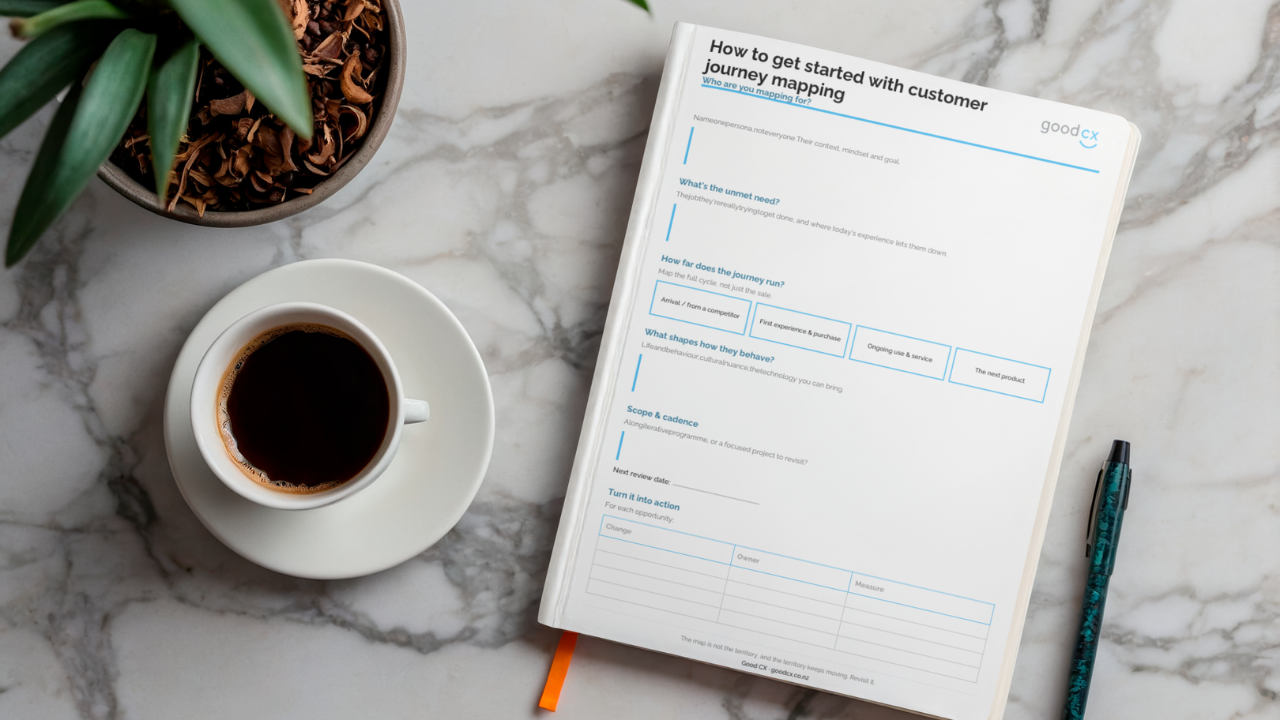
Customer Journey Mapping Guide