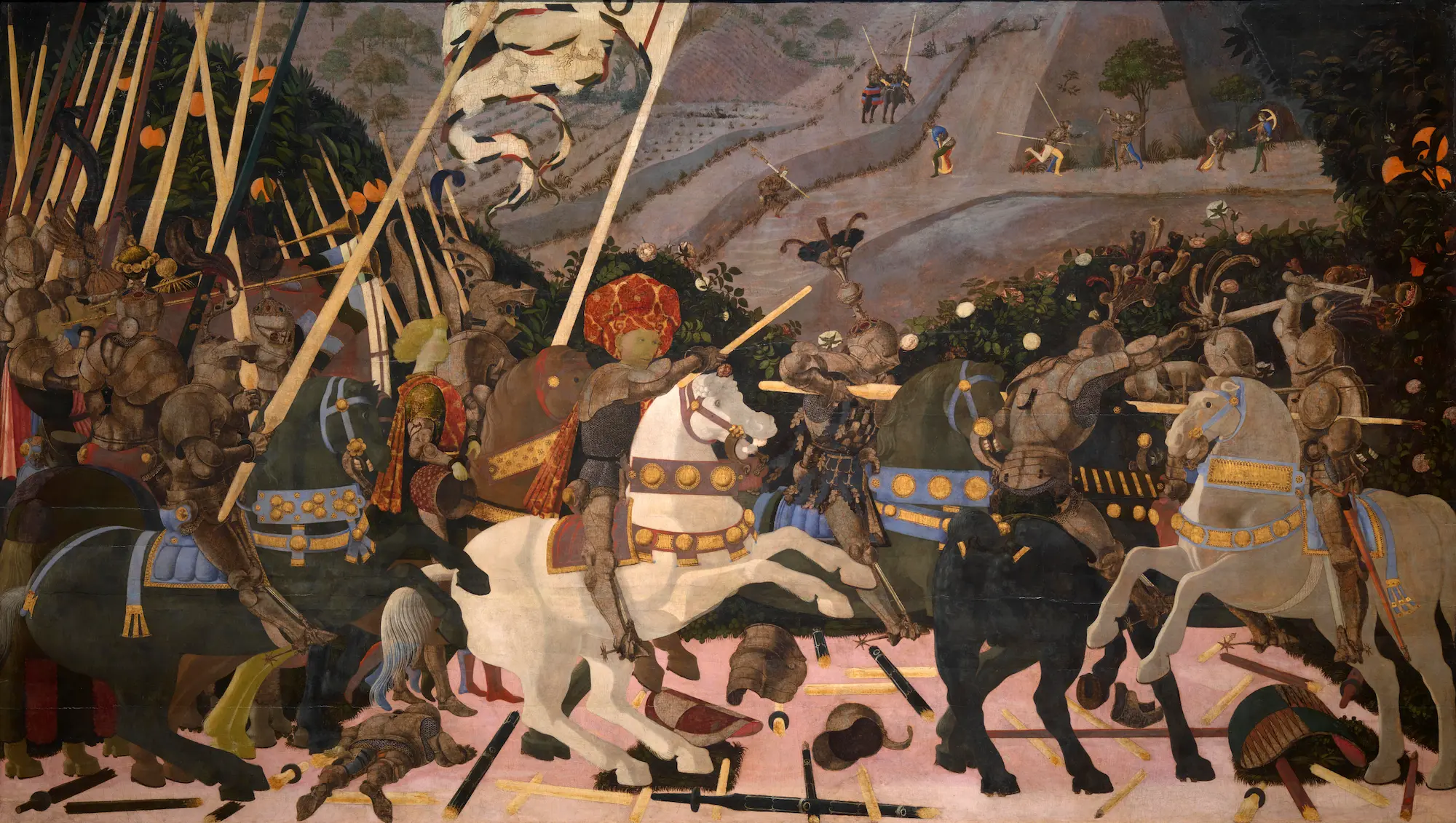
Paolo Uccello could not leave perspective alone. In the 1430s, linear perspective was the thrilling new technology of the Florentine Renaissance. Uccello became so taken with it that his wife, in Vasari’s telling, would call him to bed while he murmured about what a sweet thing this perspective was. The result is The Battle of San Romano. Three panels, now scattered across the National Gallery, the Uffizi and the Louvre, in which he throws every new principle he has just learned at the wall. Broken lances laid out in a careful vanishing grid. A fallen soldier foreshortened with enormous, slightly desperate effort. Horses like magnificent wooden rocking-horses. It is dazzling, and by the standards that came later, it is wrong.
He hangs in the great galleries anyway. Partly because the work is glorious, and partly, if we are honest, as a brave and gloriously imperfect first draft of an idea other people would later get right. He went, to borrow a phrase I use far too often when I am coaxing a nervous team to experiment, strong and wrong.
I should confess a bias. The love of Uccello started in the single art history paper I took at the very end of my degree, and I have spent the years since trying to stand in front of every painting that course covered, because there is so much learning in the human hand. Dragging a four-year-old and an eighteen-month-old into the National Gallery once, I held the room for roughly five seconds before someone needed a nappy change. On calmer visits I have stood there far longer, marvelling at what it costs to put your name to brand-new work.
Good CX vs great CX: the question is the wrong way round
The honest answer is that the question is the wrong way round. Good CX is the foundation: the experience working, measured against the real thing rather than the comfortable version. Great CX is what compounds on top of good once the foundation is real. You cannot leap to great. You cannot even be good until you know what good actually looks like, which is the job of honest measurement. In the age of AI, where flattering versions are infinite and free, the discipline of looking in the true mirror is what separates a brand worth trusting from one that disappears by Tuesday. This piece draws on the Trust Equation (Maister), polyvagal theory (Porges), and the Johari window.
The error is the fingerprint of a real person
Here is the thought I cannot shake. Hand Uccello a laptop and Photoshop today and he would spend the rest of his life fixing those panels. Every horse corrected to anatomical truth, every sightline mathematically perfect, the foreshortening flawless. And something would die in the fixing. The wonky, effortful, unmistakably human reach for something new is the very thing that keeps the work alive five centuries on. The error is the fingerprint.
I have been thinking about Uccello because I suspect we are standing exactly where he stood, in front of a technology that resets everything. The difference is that our tools are frighteningly good at sanding the fingerprints off. This is, in the end, a piece about trust, and about why the least fashionable discipline I know, honest measurement, matters more in the age of the perfect machine, not less. I should also say that I have been working it through with an AI. I am not going to pretend otherwise, partly because pretending is the exact problem I want to describe.
The currency of content is being debased
Here is the mechanism underneath the unease. For most of history, content was a costly signal. Writing something good took effort, and the effort was the proof. You trusted the handwritten letter because faking it was expensive: a person had to think. The economists have a name for this. An honest signal is one that is hard to fake. The moment it becomes cheap, it stops meaning anything.
AI has taken the cost of producing fluent, confident, perfectly reasonable content down to roughly nothing. So content is inflating like an over-printed currency. A beautifully written message now arrives with a faint question mark rather than a thank you. The words are no longer evidence that anyone was present.
When money came off the gold standard it needed new backing. Content is coming off the effort standard, and I think the only thing left that is expensive to fake is what we might call proof of human. Verified provenance, and genuine presence. The value is no longer in the words. It is in a known, accountable person standing behind them, and in the increasingly rare moment of real exchange.
Where human connection actually happens
I put a question to the AI I had been thinking aloud with, the one I could not shake. When a machine writes the message, and the reader’s machine summarises it on the other end, where does the human connection actually happen? The answer that came back was uncomfortable, and I have been turning it over since. There is a synthetic layer in the middle now. It erases the one moment that ever produced trust: the point where a real person takes the thing in and is changed by it. Call it the last human inch.
This is not sentimental. In the Trust Equation we teach on the Trust Advantage course, trust is built from credibility, reliability and intimacy, divided by self-orientation. AI scales the first two beautifully. It is accurate and it is consistent. What it cannot manufacture is intimacy, because intimacy needs a human to actually receive the signal, not a digest of a digest. Stephen Porges, whose polyvagal theory gave us the language for this, would point out that connection is a nervous-system event. Two systems exchanging summaries produce no co-regulation, no felt sense of being met. The body knows the difference between being received by a person and being processed by a system.
The trouble with mirrors, and why businesses need them
Years ago, while I was shaping this practice, I became slightly obsessed with the true mirror. It is two mirrors joined at a precise right angle, so that for once you see your own face the way everyone else sees it, not flipped. Most people do not like it. We grow up looking at a reversed version of ourselves, then feel a small jolt at every photograph, where the world’s version stares back. There is one part of me I have genuinely never seen: the back of my own head. That is the literal shape of a blind spot, and the Johari window has a name for that quadrant, the part that is known to others and unknown to you.
Robert Burns got there first, watching a louse crawl across a fine lady’s bonnet in church: “O wad some Pow’r the giftie gie us, to see oursels as ithers see us.” Businesses need that power more than individuals do, and they have it even less. An organisation is an ecosystem of people, beliefs, systems, levers and hidden drivers, and it gets stuck in its own bias without ever noticing. The only way out is a true mirror, which means the genuinely uncomfortable act of measuring the honest situation and then sitting with it, warts and all.
Epiphany, then habit
I have watched this discomfort for years. Clients come in, we find the real story, and there is often an epiphany, the brand told back to them in a way they had never quite heard. And then, weeks later, habit has its way and they have drifted back to the comfortable version. We hear what we want to hear. Two things hold the line: structured measurement, and the discipline to actually use it. To stop, look hard at what it is telling you, and act on the feedback rather than flinch from it.
Good CX comes before great CX
This is, I think, what the brand has been trying to teach me, a signal that revealed itself slowly. When I started, almost nobody used the term CX. Friends asked why I would name a business after two letters no one understood. The answer was always in the other word. Good. People reach for great CX, but you cannot have great CX until you have good CX, and you cannot have good CX until you know what good actually looks like. Even before AI arrived, very few people did. My job, in the end, is to hold people to account about that. To be the true mirror.
There is a search people type that tells you a lot: good CX vs great CX, and what the difference between the two actually is. The honest answer is that the question is the wrong way round. You go to foundations first. Great CX is what compounds on top of good CX, once good CX is real and measured and known.
A printing-press moment for trust

The Gutenberg Bible, c. 1454 to 1455. The first major book produced with movable type in the West, and the tool that reset who got to make meaning. Public domain, via Wikimedia Commons.
We have been here before, although not for a very long time. Not since the printing press has a single tool so completely reset who gets to make meaning and who gets believed. Gutenberg’s press did not just spread information; it forced a renaissance and then an enlightenment. When the old signals of authority stopped being scarce, people had to work out, painfully, what was actually true. It also made the Reformation possible. When Martin Luther nailed his ninety-five theses to the church door at Wittenberg, the new presses carried them across Europe in weeks, and he spent the rest of his life bearing the consequences of putting his name to his truth. We are in another one of those moments. The synthetic layer is our printing press, and the same question is back on the table. When everything can be produced, what can be trusted?
My answer is that the value moves to the human capacity the machine cannot counterfeit: judgment, accountability, and the willingness to look in the true mirror. AI does not remove the need for the honest reflection. It raises it, because now the flattering version is infinite and free.
Why I built a measurement framework for the mirror
If trust is going to be the currency, and trust is cumulative, built or eroded one interaction at a time, then you need a way to see whether it is actually accumulating. Not vanity metrics that measure traffic in the synthetic layer, but the human signals. Whether people genuinely align with what you stand for. The rhythm of their return. The voice they will lend you when no one is asking. How recently they really showed up. That is what AFAR Framework™ measures, and it is the closest thing I have to a true mirror you can hold up to a business. It is why measurement, the least glamorous part of this work, is the part I will not let clients skip. I will write separately about how AFAR works, and how AI changes what it can see.
So here is my encouragement, the one I give the nervous teams. We need a new Uccello. Someone brave enough to make the new thing imperfectly, to go strong and wrong, to put their name to a flawed human attempt rather than a flawless, machine-smooth one with nobody home. Yes, you risk hanging in the gallery for future generations to giggle at. The alternative is worse: mathematically perfect, and forgotten by Tuesday, because no one was ever there.
Another spring, and the nerve it asks for
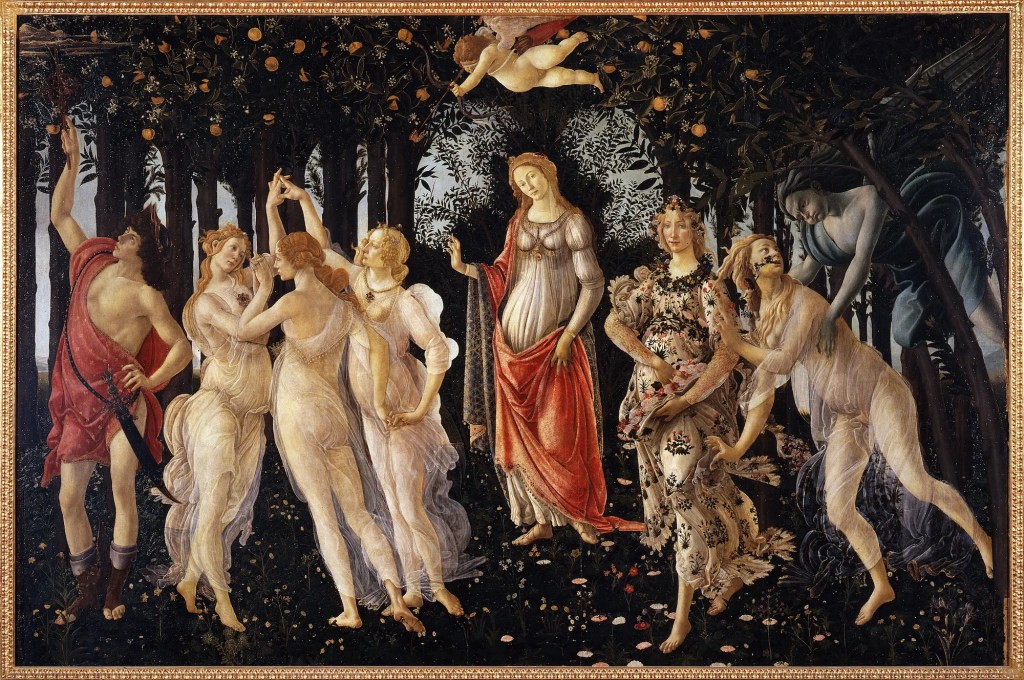
Sandro Botticelli, Primavera, c. 1482. Uffizi Gallery, Florence. Public domain, via Wikimedia Commons.
My favourite painting is Botticelli’s Primavera. It is a Renaissance picture about renewal: the seasons turning, innocence lost, something new being born. I think we are in another of those springs, and it asks for what the first one did. Bold, creative, daring humanists, with faith in the arts and the nerve to step off the production line that industrialisation built. I sell ideas for a living. I happen to think it is time we built a currency around them.
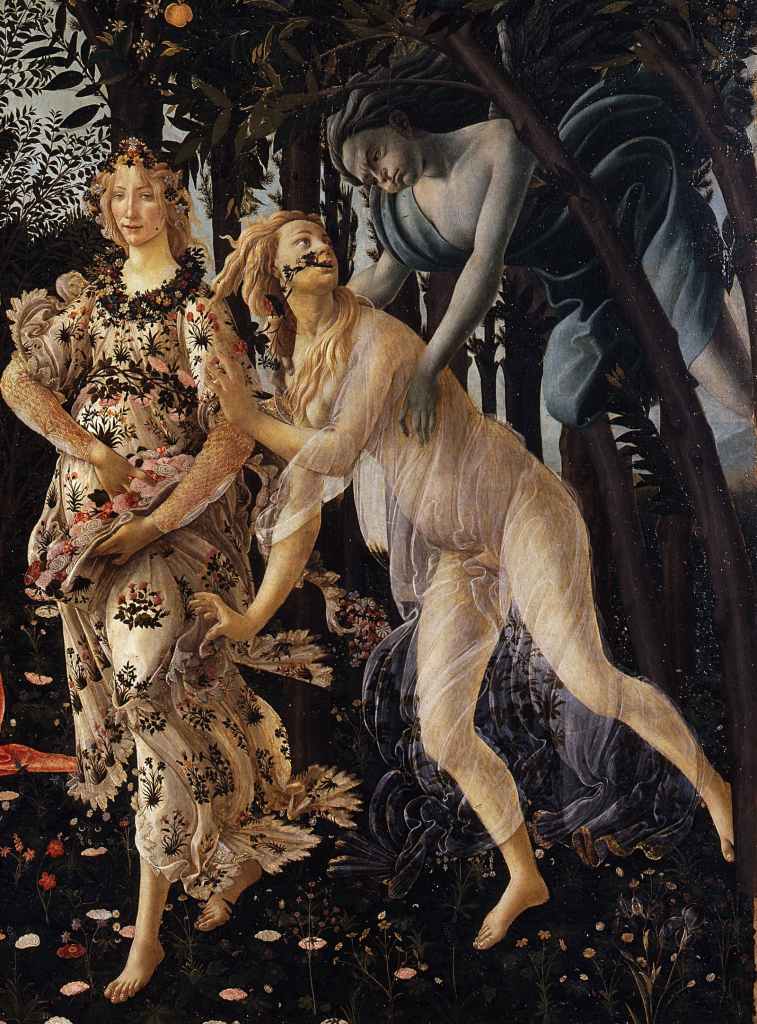
Detail: Chloris, Zephyrus and Flora. The west wind seizes the nymph Chloris, who transforms into Flora. The rough birth of spring.
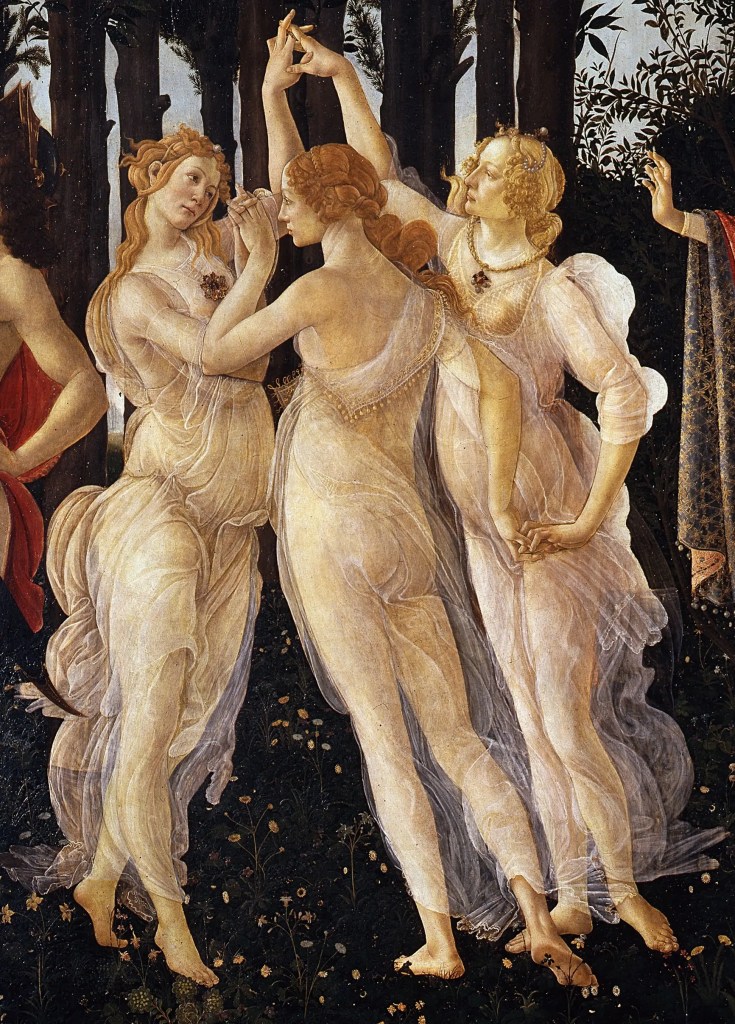
Detail: the Three Graces. The harmonious dance of three figures. The cyclical return of spring.
So I will leave it where it started, with a pioneer and his wonky horses. A person wrote this, thinking with a machine, and is putting her name to it. In 2026, that may turn out to be the whole point.
On what honest measurement looks like before a project starts rather than after it fails, see why more than four in five AI projects never work.
The latest thinking from Good CX
Ideas worth arguing with
Every so often we share what we’re learning about customers, the people who serve them, and what a leader can do with it. If we get in touch, it’s with something worth pulling apart with your team. Unsubscribe in one click.
You’ll get one confirmation email first, so we know it’s really you. We handle your details in line with our privacy policy.