
Your new footman starts in 2027. He’s AI in the workplace: quick, tireless and clueless about how your house runs, because nobody ever wrote it down. Here’s what your leadership team has to brief, supervise and pay for before he does something unforgivable at dinner.
- In 2027, AI stops being a tool you buy and becomes a new starter you have to brief.
- The constraint is not the technology. The constraint is the knowledge your business has never written down.
- Among larger ANZ firms in our research, 61% had executive sponsorship for customer experience, but only 13% ran a standing governance forum.
- Every AI agent needs a supervisor, a briefing and a budget line, like any new member of staff.
- Cutting entry-level roles saves money now and empties the leadership bench later.
- The briefing goes better with someone helping you get dressed for it. (We do buttons.)
“Is this an instrument of communication or torture?”
The Dowager Countess, eyeing Downton’s new telephone. Maggie Smith gives the receiver the look most of us save for a vendor’s second invoice.
Swap the telephone for workplace AI and you have most leadership meetings in New Zealand this year. Half the table thinks it’s communication. But the other half has sat through the demo. (Torture. Definitely torture.)
What will 2027 bring for AI in the workplace?
In 2027, AI in the workplace shifts from a tool you buy to an AI agent you brief, like any colleague. Gartner’s 2027 trends name AI context platforms, systems that learn how your business works, as a priority. Yet Deloitte’s 2026 Human Capital Trends found only 6% of leaders making progress on designing how people and AI work together. So the future of work belongs to leadership teams that can explain their own business: its judgement calls, its customer knowledge and its unwritten rules. Similarly, Amy Edmondson’s research on teams that surface uncomfortable information points the same way. So the business that can say what it knows will brief its AI well. The rest will automate their confusion.
Roy from IT is on line one
In New Zealand, 91% of organisations now use AI. Yet just 4% use it to change how the core of the business runs, and that figure halved in a year (Datacom, 2026). Four. Out of a hundred. Globally, meanwhile, 60% of executives use AI to make decisions and 5% say they manage it well (Deloitte, 2026). Everyone else is on the phone to Roy from The IT Crowd, being asked if they’ve tried turning it off and on again.
The tool was the easy bit.
Enter Thomas
Because 2027 isn’t another telephone. It’s a new footman, and his name is Thomas Barrow. He turns up in livery and white gloves, sharp, ambitious and alarmingly quick to learn. But he hasn’t the faintest idea which door the family uses. Or how his lordship takes his tea. Or which subjects are never, ever raised at dinner. Nobody wrote any of that down. Mr Carson simply knows. And Mr Carson isn’t filling in your onboarding form.
Gartner, not known for whimsy, went further. Its analyst Gene Alvarez told leaders to think of the context layer “as a new employee”. Congratulations. You’ve hired Thomas. Now somebody has to tell him where the spoons are.

Highclere Castle, the real Downton. A house this size runs on who briefs whom. Photo: Tim Alex on Unsplash
Which Crawley are you? Why AI in the workplace is a leadership question
I’ve met the Dowager
You are not the Dowager. I’ve met the Dowager, and she was my gran. In 2007 I visited her at her rather bougie rest home on the banks of Clewer Meadow, in the gap between bingo and the lunch rush. So I offered to show her some photos on my Sony Vaio and popped it on her lap.
“What is THIS?”
“A laptop,” I said.
“A LAP COT?”
Forget the photos. I might as well have put a spaceship on her knee.
You, on the other hand, have already used AI this week without reaching for the smelling salts. Nor are you Mr Carson, because Carson would never let a strategy deck near the silver. (Not a Crawley, I know. But Downton’s staff had a habit of rising through the ranks. Ask Branson.)
You are Robert
You are, I suspect, Robert. Decent. Loyal to the people who work for you. In charge of a house that runs on knowledge you have never personally needed. And, like Robert, perfectly capable of putting the family fortune into something you didn’t fully understand because everyone at the club was doing it. (In series three, it’s the Grand Trunk Railway. In 2027, it’s an AI licence for every seat.)
Nobody blames Robert for the railway. Railways were the future. But the trouble was that he backed the future without asking anyone downstairs what the present looked like.
Why does AI stall in leadership teams? Upstairs, downstairs and the green baize door
Every great house had a green baize door. On one side, the family, discussing the estate over the soup. On the other, the people who knew the estate was leaking. The kitchen knew the fish was off before the dining room did. The footmen knew which guest was trouble before the soup came out. As a result, upstairs found out last, usually from a newspaper.
But your business has the same door. It just has better branding. You call it the org chart.
The Silence of the System, our research with 123 senior leaders across Australia and New Zealand, read the results as a room of 100 leaders. In that room, 23 have a route from customer feedback to action that works. Another 59 gather feedback and act on it when they can. Finally, the last 18 are in the dark. So for most, the feedback arrives, wipes its feet, and waits by the door. And 60.2% of leaders said it reaches them informally, through team members. We called that the whisper network. Useful. Fragile. Gone the day a good person hands in their notice.
The whisper network
The silence even turned up inside our own survey. It was anonymous, with an optional email field at the end, and leaders still hesitated over that box. If people pause before leaving an email address on an anonymous form, imagine what goes unsaid in your all-staff meeting.
If you heard about the biggest customer complaint of the year from whoever makes the coffee, you’ve met it.
Enter Branson
The sociologist Ronald Burt called these gaps structural holes (1992): places where information stops because nobody bridges them. Downton, however, had a bridge in Tom Branson, the chauffeur who married into the family and ended up running the estate. After all, he was the one person who could walk through the baize door in both directions without anyone dropping a tray. But most leadership teams don’t have a Branson. They have a dashboard.
Now add Thomas. Workplace AI that arrives in a house where signals stall doesn’t fix the stall. Instead, it just stalls them faster, in better fonts. As we wrote in the paper, “A mobilised organisation with faster tools is simply mobilised at speed.”
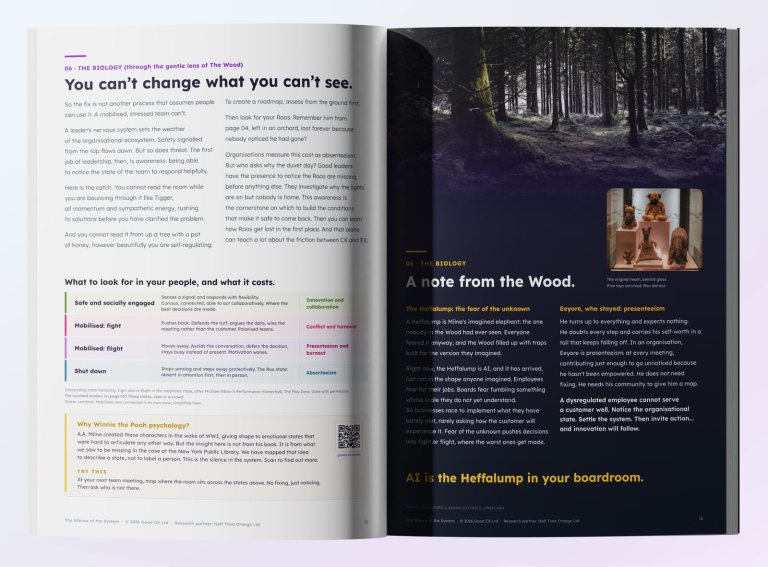
A note from the Wood, in The Silence of the System. AI is the Heffalump in your boardroom: the thing everyone fears and nobody has actually seen.
”A mobilised organisation with faster tools is simply mobilised at speed.
The Silence of the SystemGood CX research with 123 ANZ senior leaders, 2026
Who briefs the footman? Why AI needs context before it needs a login
In October 2025 I handed out pencils, and wrote that the most potent tech tool of the year was a pencil. People smiled politely, the way you smile at an aunt who still prints her emails.
Twelve months on, then, Gartner has more or less agreed with me, at considerably greater expense. And this year one of those pencils came back to me, just to report in. It had spent a hard year in the bag of someone who took it seriously, then went off to do an MBA. The pencil isn’t nostalgia. It’s what you write Thomas’s briefing with.
The squirrel files
Planners have been here before. If, like me, you’ve moonlighted in data for twenty years, with a dash of brand purpose on the side, you’ll know the feeling. I spent a decade convincing people I wasn’t a Salesforce salesperson, while burying the work in the CRM like a squirrel with its winter nuts. The market spends a decade buying shiny things, then announces with great ceremony that what it really needed was knowledge, insight and a sharp brief. Cue the planners, then, dusting off files we put away years ago. It’s very Jackson Lamb: drop the cigarette, peel an old memo off your shoe, and discover the answer from the Soviet era was stuck to you all along.

The planner’s filing system. Buried somewhere safe, found by nobody. Photo: Caleb Martin on Unsplash
Yet the intel was always there. We just preferred buying stuff. After all, a new AI context platform comes with a launch date and a logo. A manuscript of hard-won customer insight, gathered by some nerd (hello) over months, would have kept Gutenberg’s press busy for a year. Yet, strangely, nobody ever threw it a launch party.
”The pencil isn't nostalgia. It's what you write Thomas's briefing with.
Liz Pinfold ReedFounder, Good CX
What Thomas won’t find in the manual
So Thomas, like every AI agent, learns from what you feed him. Alvarez again: “The better you feed the data to it, the stronger the context layer will get.” Feed him the policy manual and he’ll learn the policy manual, word perfect, with the confidence of a man who has never once been wrong in front of the family.
What he won’t learn is that your biggest customer only picks up the phone after lunch. Or why the pricing exception on the Tauranga account exists. Or that when the founder says “let’s park that”, the idea has been parked permanently, in a field, with the engine removed.
Instead, all of that lives in Carson’s head. Meanwhile, in your leadership team there are several Carsons, and each of them is sure one of the others wrote it down.
So what goes in the briefing? Your purpose, and the customer you exist for. What that customer needs but rarely says. The decisions you’ve already made, and why. The lines you won’t cross. And the judgement calls you make so often you no longer notice them. The briefing takes a few afternoons with a pencil. Yet it’s the work most leadership teams skip, because it feels slower than buying something. It isn’t. It’s just less fun to put on LinkedIn, though.
What are people for in 2027? Mr Carson is not redundant
If Thomas can do the work, what is Carson for? It’s the future of work question most leadership teams ask in the car park after the meeting, rather than in it.
Deloitte’s answer comes from Kyle Forrest, its future of HR leader. He said “expertise moves to the work, work is designed around outcomes and learning is continuous, not episodic.” Translated from consultant: Carson stops polishing every spoon and starts deciding which dinners matter.
”Expertise moves to the work, work is designed around outcomes and learning is continuous, not episodic.
Kyle ForrestFuture of HR leader, Deloitte, 2026 Human Capital Trends
But Carson’s value was never the silver. It was knowing the house was about to go wrong, and walking into the room a minute before it did. In other words, knowledge you can download is getting cheap. That kind of judgement is not. It’s what AI leadership really comes down to in 2027, along with the nerve to look at a beautifully formatted AI answer and say “not like that”.
Who trains the next footman? AI in the workplace and the empty bench below stairs
A country house ran on an unofficial apprenticeship: hall boy, footman, under-butler, butler. Above all, you learnt the house by carrying things through it. Thomas himself climbed from footman to butler, which shows what a good apprenticeship can do for even the most determined schemer.
Now look at what AI is doing to the bottom rung. A Stanford working paper using ADP payroll data (August 2025) found a 13% relative fall in employment since late 2022 for 22 to 25-year-olds in the most AI-exposed jobs. Matt Poepsel of The Predictive Index put it bluntly: “when the leadership bill comes due, no one will be there to cover it.”
A house that lets every hall boy go runs out of butlers. Yet it’s the future of work nobody budgets for. Not this year, perhaps. But around the time your Carson retires to a cottage, you’ll be interviewing for one and wondering where they all went.
”When the leadership bill comes due, no one will be there to cover it.
Matt PoepselVP of talent optimisation, The Predictive Index
Hall boys wanted
So the question for 2027 is how your juniors learn the house while Thomas does the fetching. Then put them where AI can’t go: the customer call that goes sideways, the meeting where the real decision gets made. Carsons come from those rooms.
We’ve also seen it in our own house. In our 2025 intern case competition, three interns each took a real client from customer insight to a working plan. And our Gen Z team has a standing brief: call BS on any idea that will flop with their generation, and shout “duck” when we can’t see the missile coming. They’re especially good at spotting the blind spots of dusty old planners like us. And you.
What does AI in the workplace really cost? Keeping the household accounts
Nobody expects the Spanish Inquisition. Nobody expects the token bill either.
Yet Datacom found only 20% of New Zealand organisations have a dedicated AI budget with clear cost tracking. A third say returns exceed costs. Meanwhile, the pilot that cost a few hundred dollars a month becomes ten AI agents chatting to each other all night, like footmen left alone with the port. Then the invoice arrives, looking rather pleased with itself.
There’s a second bill, too, and it lands at the helpdesk. If you’ve become the household helpdesk this year (I have), you know the hours that disappear into checking, fixing and re-explaining. Those hours are a cost. But they never appear on the invoice.
Back then, a good housekeeper knew the price of every candle. So AI at work deserves the same attention. So track what each use of AI in your business costs to run, staff time included. Then set it against three returns: the financial result, the value to customers, and whether the work got more meaningful or less.
Is your leadership team ready for AI at work? Read the room before the report
Meanwhile, most of us have watched good reporting go unread. The dashboard is built, the numbers are right, and it sits on the silver tray like a letter nobody opens. The problem wasn’t the report. It was the room.
In fact, our research found that inconsistent action rises from 27% in small firms to 55% in firms of 51 or more staff. Meanwhile, 63% of leaders blamed time and competing priorities, not belief. Everyone agreed with the customer. They just never got round to them.
Then AI will meet the same fate. Ultimately, a context platform is only as good as the people feeding it, and a leadership team stuck in fight or flight doesn’t feed anything. It reacts. For example, Amy Arnsten’s research at Yale found that stress hormones impair the prefrontal cortex, the part of the brain that handles judgement. Hard information then lands as a threat, not as intelligence. So before you ask whether the business is ready for workplace AI, ask whether the room is steady enough to tell AI the truth.
How should a leadership team prepare for AI in the workplace? Five things to do before Thomas starts
1. Write down what Carson knows
Spend a few afternoons getting the unwritten rules out of heads and onto paper: decisions, judgement calls, customer knowledge, the lines you won’t cross. Those pages become Thomas’s briefing, and your next hire’s too.
2. Find your Branson and prop open the green baize door
Among the larger firms in our research, 61% said customer experience had executive sponsorship, but only 13% ran a standing governance forum. Sponsorship sets the tone. Governance sets the cadence. Give every customer signal a route, an owner and a date, and someone who walks it through the door.
3. Decide who supervises Thomas
Every AI agent is Thomas Barrow: brilliant with supervision, a liability without it. Gartner predicts that by 2028, 25% of enterprise security breaches will trace back to AI agent abuse. So name a human owner for each agent. Agree what it may draft, what it may do with approval, and what it may never do alone.
4. Keep the hall boys
Protect the entry-level roles that grow your future leaders, because those roles are where Carsons come from. Redesign them around the work AI can’t do, rather than deleting them.
5. Keep the household accounts
Give AI a budget line and track the true cost, including staff time and token spend. Judge it on three returns: profit, value to customers, and meaningful work.
Frequently asked questions about AI in the workplace in 2027
What will AI in the workplace look like in 2027?
AI will act less like a tool and more like a new colleague that has to learn how your business works. Gartner names AI context platforms as a 2027 trend. So the businesses that do well will be the ones that can explain their own knowledge, decisions and customers clearly.
What is an AI context platform?
An AI context platform gives AI agents the information they need to act inside one organisation: its data, documents, policies and rules. Gartner compares it to a new employee who learns how you do business over time.
Why does AI at work stall in leadership teams?
It usually stalls for human reasons, not technical ones. Knowledge sits in people’s heads, customer signals stop before they reach decisions, and stretched teams react rather than think. Datacom found only 4% of New Zealand organisations use AI to transform core operations.
Where should a leadership team start with AI in the workplace?
In short, good AI leadership starts with what you know, not what you buy. Write down the decisions, customer knowledge and judgement calls that run your business. Then decide who owns each AI use and how customer signals reach a decision.
How can Good CX help? Getting dressed for 2027
Every morning, Bates gets his lordship dressed. Studs in, collar on, tie straight. And somewhere between the cufflinks and the waistcoat, Robert tells him everything. The money worries. Then the trouble with Mary. And that thing he said at the club that he now rather regrets. Bates says very little. He has the face of a man who has heard it all, mostly because he has.
Today, of course, you’d film it as a “get ready with me” reel. People still tell the mirror things they’d never put in a strategy deck.
We’re not family. I found that out the last time we hosted a Come Dine With Me. Of course, our friends swept in dressed for a ball. I came as Mrs Patmore, mainly because I was actually cooking. We’re Bates. We do the buttons, we hear the truth, and we never repeat it at dinner.
Bates’s morning routine, updated for 2027
- The collar studs. We gather the details: what your leaders, your front line and your customers know, plus the data you already have. Every last stud, even the one that rolled under the wardrobe in 2019.
- The waistcoat. We pull it all together. Everything Carson knows becomes one briefing that holds its shape, for your people, your next hire and Thomas.
- The mirror. Using our research and the Crossing Model, we show you where customer signals stop at your green baize door. Not always flattering. Always useful.
- A word in your ear before the club. We lay out the questions to ask before anyone sells you a railway.
- Extra hands for the big night. Specialists from our bench for data, AI engineering and process, called in when you need them and sent home when you don’t.
Then Robert walks downstairs looking like he did it all himself. The family gathers round the piano, and the big decisions get made where they always have been. That’s your moment. Bates will be by the door, pretending he didn’t hear a thing.
Come Dine With Me
It’s how every good dinner party works, too. First, somebody spent the afternoon gathering ingredients, prepping and laying the table. Then the guests sing round the piano and take the credit for a marvellous evening. I should know. I was the one in the pinny.
Brief Thomas
The Dowager’s question still stands, and in 2027 the answer is up to you. AI in the workplace becomes an instrument of communication when somebody has done the briefing. Without one, it’s torture, only faster.
Robert kept Downton in the end, but only because he finally let the people who understood the estate help him run it. So any leadership team with a new footman on the payroll might take the hint.
Write it down. Prop the door. Brief Thomas. And for God’s sake, don’t get dressed without your valet.
If 2027 is the year Thomas joins your household, fifteen minutes with us is usually enough to work out where to start.
The latest thinking from Good CX
Ideas worth arguing with
Every so often we share what we’re learning about customers, the people who serve them, and what a leader can do with it. If we get in touch, it’s with something worth pulling apart with your team. Unsubscribe in one click.
You’ll get one confirmation email first, so we know it’s really you. We handle your details in line with our privacy policy.