You are about to produce an Ecce Mono. So am I. In August 2012, a Spanish grandmother called Cecilia Giménez accidentally created one of the most photographed images of the 2010s with a brush she had no business holding. She died in December 2025. Her story is a lesson for every leader now using AI about taste, humour, and the work worth doing.
In August 2012, in a small church in Borja, Spain, an elderly parishioner called Cecilia Giménez looked up at the local fresco of Christ and decided it needed a touch-up. She was 81. Cecilia would live long enough to see the whole world laugh at what happened next, learn to love her for it, and outlast the joke by well over a decade. By the time she died in December 2025, aged 94, she had been embraced by her town and made part of a global cultural memory she never sought.
The fresco itself was Ecce Homo by Elías García Martínez. Painted around 1930. A bit faded, a bit beloved, a bit nobody-was-asking-Cecilia.
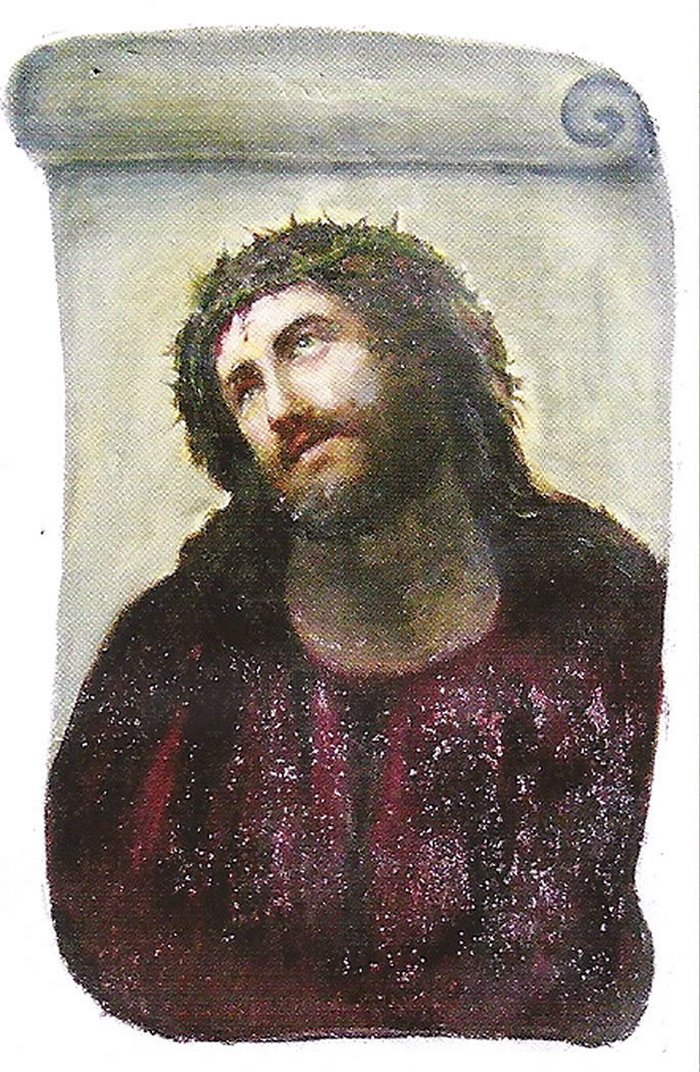
Ecce Homo by Elías García Martínez, around 1930. The beloved parish fresco in Borja, Spain, before Cecilia’s 2012 restoration. Public domain, via Wikimedia Commons.
But she gave it a go anyway. Brush in hand, with the calm confidence of a woman who had been told her whole life that a good clean-up never hurt anyone. Stepping back, peering through the soft fuzz of her cataracts, trying to decide whether less was more, or more was less.
In the end, she decided more.
The BBC’s Europe correspondent Christian Fraser later described her restoration as “a crayon sketch of a very hairy monkey in an ill-fitting tunic”. The result, christened almost instantly as Ecce Mono (Behold the Monkey), is now one of the most photographed pieces of art on earth. Although the painting was technically ruined, it became a tourist attraction. Cecilia, in turn, became the alchemist of a small Spanish town, helping it print money faster than a TikTok influencer. She breathed life into a crumbling old artwork with the same punch Bill Nighy brought to singing ‘Christmas Is All Around’ in his birthday suit, in Love Actually. If you are very lucky indeed, you can cause a rave sensation so beloved for the car crash it is that it eventually pays dividends. A comic opera, Monkey Christ, opened in Las Vegas in 2023. Cecilia’s half of the merchandise royalties went to a muscular dystrophy charity for her son, and to the town’s elderly.
So I have been thinking about Cecilia a lot in 2026.
Not because I am unkind about her. Quite the opposite. In her own way, she was the Banksy of Borja. Accidentally subversive. Massively viral. Vehemently anonymous, until she was not. She produced one of the few images of the 2010s with real staying power, by complete accident. And she did it with a tool she had no business holding.
Read that last sentence again. Because it is the parable.
What the learning curve actually used to do
For most of human history, the tools that mattered came with a curve attached.
A paintbrush, for instance, required years of life-drawing classes, fruit-bowl arrangements, and a tutor willing to tell you your perspective was a hate crime against the laws of geometry. Meanwhile, printing presses asked for apprenticeship to a master printer with ink under his nails and the patience to laugh at you for a decade. Cameras, in turn, meant chemistry, dark rooms, ruined rolls, and the discipline to understand that light is a thing you direct, not a thing you point at. So too coding, which asked for the humility to learn a language that fights back, and the willingness to be publicly wrong on Stack Overflow. Even a pen, the humblest of the lot, demanded reading, thinking, and the willingness to put your name to a sentence.
The curve was not a bug. After all, it was the filter. Specifically, the thing that kept the people who would otherwise paint a monkey onto someone else’s Christ at a respectful distance from the wall. At the same time, it kept the people who would do the work well in the room long enough to actually get good. In other words, the curve did two jobs at once. First, it filtered out the unready. Second, it trained the ready.
Apprenticeship was the cultural memory of that filter. For example: five years of mediocre painting before you were trusted with a commission. Or a decade of sub-editing before you were given a column. Or three years of pull-quotes and house pieces before you were trusted with a brand voice. So yes, the curve was annoying. But it was also load-bearing.
On principle, I am in favour of removing barriers to entry. However, I am also realistic about what happens when you do.
Now, in 2026, AI has removed the curve from almost every creative and intellectual discipline at once. A polished website by Friday. Whole brand identity by Tuesday. Novel by next month. Marketing strategy in the afternoon. Plus a research report, fundraising deck, customer journey map and value proposition all in the time it takes to write a half-decent prompt.
So the tools are extraordinary.
However, the taste required to use them well has not been distributed alongside them.
What is also true
AI has opened things up that took my generation a decade to learn. A founder with an idea can ship a working prototype in a weekend now. Small charities can have a brand identity by Tuesday. Writers can get past the blank page in an afternoon. Somewhere, a team in a country I will never visit is building me a tool I would not otherwise have. The upside is real.
This is not, then, an argument against the tool. I use AI every day. So does most of the team at Good CX, including our AI engineering lead Pasan Thilakasiri, who builds with these tools full-time. Whether to use AI has already been answered, in every category, by every reader of this piece.
What matters now is what you bring to the tool, so it can do what it does well without producing an Ecce Mono. Increasingly, the answer is taste.
Where it goes wrong (and why it is going to happen to all of us)
Before naming the pattern, let me name the condition. We are all going to produce Ecce Monos. That is not the failure state. That is the starting state. The question is not whether. It is what we develop in ourselves while we are doing it, so we can spot our own when they appear.
You are already seeing them. In your inbox. On your feed. In the work landing on your desk.
For example, the earnest fundraising email written in the voice of a model that has never met a human being, let alone needed one to donate. Or logo generators producing a vaguely-acceptable mark for something that could be a dental practice, a yoga studio or a small cryptocurrency. Or hero headlines that mean nothing because nobody stopped to ask what the customer was actually trying to do. Then there are annual reports that read as if no one in the building could remember who they were meant to be read by, or whether reading was the point.
I have written emails like the first one too. We all have. The pattern is not that some people are wrong. It is that the floor of acceptable has dropped, and we are all standing on it.
Meanwhile, the more public versions are accumulating. Two New York lawyers, in 2023, filed a federal court brief citing six prior cases. ChatGPT had hallucinated all six. The judge fined them five thousand dollars and the case, Mata v Avianca, is now in legal education textbooks. An author sold thousands of copies of an AI-generated book series before readers noticed it was filled with quotes nobody had ever said. Somewhere, a founder launched a product after a weekend of “vibe coding”. Three months in, however, nobody had thought about the customer who was meant to use it.
These are not isolated mistakes. Rather, they are an emerging cultural pattern. In fact, the cultural equivalent of a great many Ecce Monos. Confident, prolific, deeply earnest. Made by people who believed they had it in them, because the tool told them they did.
The reason to develop taste, then, is not so you never produce an Ecce Mono. It is so you know one when you have made it, and can decide what to do next.
Taste is the surviving discipline
The discipline has to move. In the AI era, “good” was something you outsourced to the people who held the brush. However, they cannot hold it for you any more, because everyone is holding it. So the discipline of recognising good has to move into your hands. The catch is that, like Cecilia, most of us will not know when we have produced an Ecce Mono until the photographers arrive.
Cal Newport, in Slow Productivity, calls it taste. Specifically, the capacity to recognise what good actually looks like, sounds like, feels like, and to explain why. According to him, you develop taste by paying close, slow attention to how the best people make the thing. Then your own output begins to catch up.
Similarly, Will Guidara, in Unreasonable Hospitality, calls it the practice of noticing what the person in front of you actually needs, and then caring enough to do something unreasonable about it. Different language. Same discipline.
For my part, I have been calling it proof of human, after writing earlier this year about Paolo Uccello. His wonky horses still hang in the National Gallery five centuries on. The wonky was the fingerprint. The reach of a real hand for something new. Cecilia had the same wonky, but without the years of training to know which wonky to keep and which to fix. So the tool gave her permission to act without taste. Now AI is giving the rest of us the same permission.
”The tools are extraordinary. The taste required to use them well has not been distributed alongside them.
Liz Pinfold ReedGood CX
So taste is the discipline that is going to separate the brands worth trusting from the brands that disappear by Tuesday. The leaders worth following from the leaders who scale their content output while their relationships thin. The work that lasts from the work that goes viral once and is never seen again.
Indeed, taste is the only thing left that is expensive to fake.
What to do if you lead a business right now
Three things. (I am aware this is the most LinkedIn-coded structure of all time. Bear with me.)
First, slow down the production. Most businesses are already producing more than they can think about. AI is about to double that output. So the win is not in producing more. Instead, it is in producing fewer things, with more taste behind each one.
Second, build a taste discipline inside your team. Look at the best work in your category, slowly, in detail. Then ask why it works. Read writers who write better than the average LinkedIn post. Also read books that have outlasted their hype cycle. Visit galleries. Notice what your favourite customers actually love. Taste is not a personality trait. Rather, it is a practice. You build it by paying attention.
Third, sign your work. Every piece that goes out from your business should carry, somewhere, a known, accountable person standing behind it. Not as a vanity credit. Instead, as a quality gate, and as an act of care for the people receiving it. After all, a person whose reputation is on the line is a person who will not let an Ecce Mono leave the building without at least stopping to look at it. That goes for me too.
None of this is to say you will not produce Ecce Monos. Cecilia did. Uccello did. So will you. So will I. The work is to keep the taste alive while we are doing it, and to be gentle with each other, and with ourselves, when we are not.
So the discipline of holding the line on taste, judgment and proof of human is probably the most useful work any of us can offer in the next decade. Often tiresome. Worth the candle.

The kind of parish ceiling that holds a town’s memory, and the hope of a touch-up. Photo: Malcolm Lightbody on Unsplash.
In memory of Cecilia
The Economist ran her obituary under the headline monstrosity or miracle, and concluded she had only meant to be helpful. That, in the end, is the most important sentence in this piece.
She was 81 when she picked up the brush. She was 94 when she put it down. In between, her town was embraced by the world. The fresco got its own museum. The opera made it to Las Vegas. Half her royalties went to muscular dystrophy research for her son. The rest went to the elderly people of her town. She was, in retrospect, the most successful unintentional content creator of her generation. The algorithm wishes it had her commitment. The rest of us wish we had her heart.
So the story had a happy ending. Ours can too, if we treat the curve as the thing that mattered. Not the brush. And if we can forgive each other, and ourselves, for the Ecce Monos we are already producing.
What is the most Ecce Mono thing AI has produced in your industry this year? Comment below, or tell me directly. I am collecting them for the next piece in our CX Education series, working title The Ecce Mono files.
PS. The craft of painting heritage buildings has been on my mind this year. We have been looking at that industry carefully, talking about preserving detail, what it really means to be custodians of what came before. I have been standing in front of old crumbling walls, thinking about all the hands that touched them, the layers they carry, the story they hold. I rather like that Cecilia’s version brings so much delight too, even in its roundabout way.
The latest thinking from Good CX
Ideas worth arguing with
Every so often we share what we’re learning about customers, the people who serve them, and what a leader can do with it. If we get in touch, it’s with something worth pulling apart with your team. Unsubscribe in one click.
You’ll get one confirmation email first, so we know it’s really you. We handle your details in line with our privacy policy.