
Every tactic you pay for is trying to persuade someone, and most of them can’t. Persuasion has needed the same three things for two and a half thousand years. Here’s what they are, why your business context is missing them, and who finds them.
You signed off the new website in the autumn. It’s lovely. Your mum said so.
The pitch deck has a mountain on the cover, because somebody once climbed one. Your sales script came from a contractor who has never met a customer. And the AI subscription hasn’t met one either, though it signs off every email like an old school friend.
The office phone, meanwhile, has taken a vow of silence.
Each of those things has one job, which is to persuade somebody. Your website persuades a stranger to call. The deck persuades an investor to stay awake. And the script persuades a buyer that you’re worth the extra. They all look the part, and none of them is persuading anyone.
Which is odd, because the rules for persuasion were written down a very long time ago, by a man who never needed a website.
- Every tactic you buy, from a website to an AI tool, is an attempt to persuade someone.
- Aristotle named what persuasion needs: who you are, who you’re talking to, and an argument that matters to them. Written down for your business, those three things are your business context.
- Big companies pay a team above marketing and HR to write that context and guard it. Most growing businesses have no such team, and no idea it’s missing.
- AI tools now ask for business context before they start. If nobody has written it down, they make it up.
- You can’t write it from inside the business. Someone outside it has to notice what you’ve stopped seeing. (We bring our own teabags.)
What is business context? (And what’s it got to do with a pseudo-psychic?)
Business context is the written account of your business that every tactic draws on: who you serve, what they need, why you, and how you behave. In brand strategy it lives in the brand architecture, the master plan your website, pitch, sales script and AI prompts should all be briefed from. Mark Ritson warns that marketing is sliding into “a base tactical pursuit devoid of strategic thinking”. Aristotle would have recognised the problem. His fix was the same then as now: work out who you are and who you’re talking to before you open your mouth. And the pseudo-psychic? Patrick Jane, of The Mentalist, made a career of finding the context nobody had written down. More on him shortly.

What would Aristotle make of your website? (He’d need a drink)
Aristotle and I would have got on. I like to picture us at the end of a long day in the agora, sharing a cup of kykeon. Homer served it to heroes: barley, grated goat’s cheese and wine, and it tastes exactly like it sounds. (Yes, I know the forum was Roman. He’d have corrected me too, at length, in three books.)
When he asked what I do, I’d say I help businesses persuade people. He’d nod, because he wrote the manual. In the Rhetoric he set out what persuasion rests on: the speaker’s character, the listener’s state of mind, and the argument itself. Ethos, pathos and logos. Twenty-four centuries of conference keynotes have failed to add a fourth.
Then I’d show him your website.
He’d squint at it. Where’s the character? “Passionate about excellence.” Who’s the listener? “Businesses of all sizes.” And the argument? A stock photo of two people shaking hands.
He’d order another kykeon. A large one.
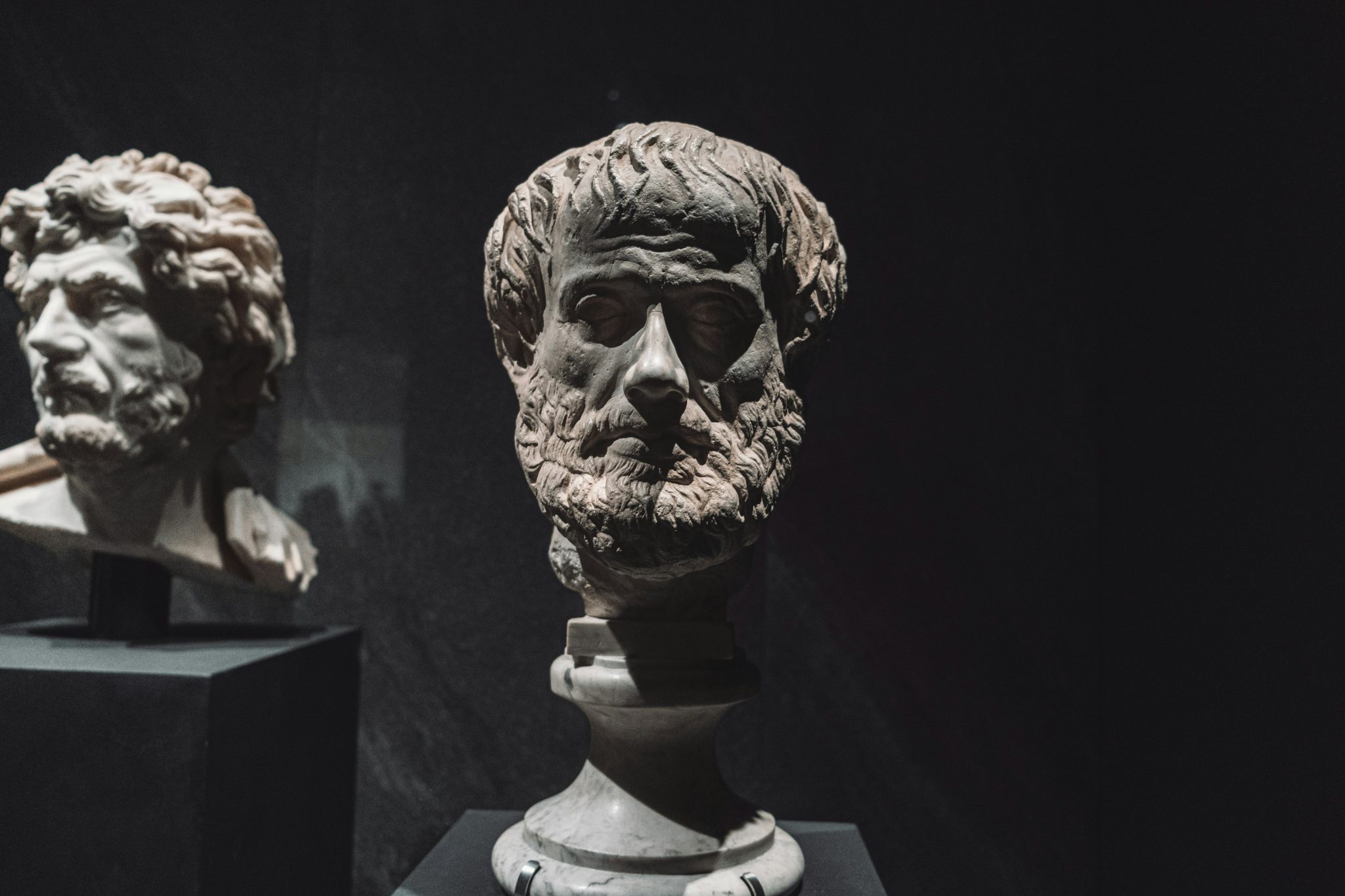
Every tactic is a speech. Each one needs what Aristotle asked for: who you are, who you’re talking to, and why it matters to them. Write those three down and you have business context. Skip them, and you’ve hired someone to give a speech about a person they’ve never met, to a crowd they’ve never seen.
Where does the story go? Sacrificed at the altar of brevity
So where did your three things go? Most businesses had them once, in somebody’s head, usually the founder’s.
My friend Nick Schwarz understands my job precisely from the finance end of the table. He has a name for what happens next: “sacrificing stories at the altar of brevity”.
You’ll know the ceremony. Somebody asks for “just the one-pager”. The origin story goes, because it’s long. The customer’s real worry goes, because it’s awkward. What survives is a list of adjectives, which is then handed to a supplier and treated with the reverence usually reserved for the Dead Sea Scrolls.
The one-pager wins the meeting. Then the supplier fills the gaps with a guess, and you pay for the guess.
Who looks after business context in a big company? (The fourth floor, by the biscuits)
Big companies keep a whole department for this. They live on the fourth floor, between Legal and the room with the good biscuits. Nobody there sells anything. Last year the team spent eleven weeks on the word “bold”.
Mock them if you like. But that floor does the long division before anybody is allowed to simplify. It works out the ideology and the origin: why the business exists, and what its founders believed before anyone paid them. Then it holds your internal DNA up against the need of the person who will actually pay. The two rarely match on the first go. Finding the gap between them is the job, and none of it is colouring in.
In a scaling business, the fourth floor is you, at 11pm, with a skinny bitch (the drink, not a colleague) and a Canva login.
So the values come out of a team day. Somebody writes passion, integrity, excellence, teamwork and fun on the whiteboard. Five words that describe a car yard, a law firm and a Year 9 netball team equally well. Everyone claps. Someone posts the photo.
The photo has since outperformed the values.
When the long division is done properly, it becomes your brand architecture: the pilings under the house. Nobody photographs pilings. Everybody notices when the house leans.
Why does every growing business call the tactician first? (And the neighbour’s cat)
Because the tactician is the only one you can see. When the phone stops ringing, the obvious fix is something you can hold. So you buy a new website, then a sharper deck, then a social media agency with a very confident account manager.
Before long you’re a hamster on a wheel. Plenty of awareness, very little engagement, and a growing urge to throw your phone off the deck. Your neighbour’s cat could have drawn the logo for all the difference it made.
None of this is the tactician’s fault. You asked a bricklayer for a cathedral and handed him a Post-it. Most of them have only ever worked from a simplified brief, so they never saw the long division that should come before one.
I’ve been watching this film since my twenties. At BMW we built dynamic email off the back of a spreadsheet, which at the time was cutting edge. Later, in UK travel, I suggested we stop sending everyone the same Malaga deal. Instead, we’d send city guides: the price of a beer in Amsterdam, a book to read before you booked. It was considered outrageous. The point was always a conversation with the customer, not more noise at them. Twenty years later, plenty of businesses still haven’t got the memo.
Why is your AI suddenly asking for business context? (Meet your newest hire)
Open a good AI tool, ask for a proposal, and it asks you something first. Who is this for? What do you stand for? Why should they choose you?
It’s being sensible. You’d onboard a new hire before letting them near a client. AI is the newest hire you’ll ever make, and it needs to learn how the place runs and where true north is.
So content is no longer king. Context is.
Skip the onboarding and AI does something worse than fail. It succeeds, beautifully, at the wrong thing. You get a best man’s speech from someone who met the groom at the stag do: warm, confident, and about a different person.
Briefing was shaky long before the robots arrived, mind you. In 2021, the BetterBriefs Project surveyed more than 1,700 marketers and agency staff in over 70 countries. Eighty per cent of marketers thought they wrote good briefs. Ten per cent of creative agencies agreed.
Eighty against ten. Aristotle would call that a problem of ethos. Everyone else would call it the weekly WIP.
Why do businesses skip writing their business context down? Three good alibis
Owners aren’t careless. They have three decent alibis.
The first is that the work is invisible. Nobody misses a department they’ve never visited.
The second is money. It’s hard to invest in something you can’t qualify because you’ve never bought it. Your website came with a demo. A master plan comes with a lot of questions, which feels suspiciously like paying for homework.
The third is time. You need a business big enough to look back on before you can say what it really is. So it can’t be done on day one.
Good CX is living proof of the third. For years, we lacked the very thing we build for other people, and only saw the gap in hindsight. Humbling, in a blog about noticing things.
That makes the scaling moment the right moment. You finally have enough history to read. Read it before you cross the Rubicon, not after. (We’ve written about crossing it with your head still on.)
So who finds your business context? (Not a psychic. Well, a retired one)
Not a psychic, sadly. But a fake one is a good place to start.
The Mentalist aired on CBS between 2008 and 2015. Simon Baker plays Patrick Jane, a celebrity “psychic” who admits on air that he made the whole thing up. So he goes straight, sort of, as a consultant to the California Bureau of Investigation. Agent Teresa Lisbon runs the team and makes the arrests. Jane lies on the office couch, drinks a great deal of tea, and solves the murder.
His old stage act ran on cold reading: say something warm and vague, and let the stranger fill in the rest. In 1948 the psychologist Bertram Forer gave 39 students the same personality profile, lifted from an astrology book. They rated its accuracy at about 4.3 out of five. Your homepage runs on the same trick. Everyone recognises themselves, and nobody remembers who said it.
Jane gave the act up, but he kept the part that was real. It’s very hard to see what’s right in front of you. Jane’s gift is that he notices, he asks, and he pays attention. He also smiles a lot and never hurries, so people relax. Once they relax, they tell him things.
Insight works the same way. The conditions have to be right before people will show you the truth. A survey on its own asks the conscious mind what it thinks, and rarely catches what people actually do. When we ran our own research, some leaders hovered over an optional email field on a form that was completely anonymous. That pause told us more than half the answers.
How would Patrick Jane find your business context? Kettle first
Jane wanders into the suspect’s kitchen and puts the kettle on. Nobody asked him to.
First he lies on the couch and listens while the room talks over itself. Then he makes everyone tea, so they stop performing. Meanwhile he clocks who glances at whom when the money comes up. Eventually he asks the one question nobody else would. And then he hands Lisbon the answer.
That’s the help, and it’s the part AI can’t do for you. You can’t co-regulate yourself, and you can’t read your own business from the inside. The person who spots it has to be in the room, relaxed enough to notice and brave enough to say it out loud.

That’s where we come in. Our DISTIL™ methodology starts with the truth beneath the brief. Then it turns what we find into a master plan your team and your tools can follow. You can see how the pieces fit in our methodology.
Case closed: what Aristotle and Jane would have you do next
Lisbon closes the case herself. She always does. Jane just made sure she was holding the right file.
There’s no such thing as psychics. There is such a thing as noticing, and Aristotle got there first. Know who you are, know who you’re talking to, and give them a reason that matters. Write it down before the next tactic goes out the door.
If you’re at that scaling moment, fifteen minutes is usually enough to tell whether you’ve got a tactics problem or a business context problem. Let’s find out which.
And for heaven’s sake, put the kettle on.
Frequently asked questions
What does business context mean?
Business context is the written account of who you serve, what they need, what makes you different and how you behave. Every tactic, team member and AI tool should be briefed from it.
What are Aristotle’s three modes of persuasion?
In the Rhetoric, Aristotle said persuasion rests on the character of the speaker (ethos), the state of mind of the listener (pathos) and the argument itself (logos). For a business, those map to who you are, who your buyer is, and why your offer matters to them.
Why does AI ask me for context about my business?
Because it can only work from what it’s told. Without a written view of your buyer, their need and your point of difference, AI fills the gaps with confident, generic guesses.
Isn’t this just a marketing problem?
It usually arrives dressed as one. The fix sits a level higher, in the brand strategy your sales team, HR, operations and marketing should all be working from.
How is brand strategy different from tactics?
Tactics are the things you make and do, like a website, a pitch or a sales script. Brand strategy is the master plan they’re briefed from. Tactics amplify whatever plan is there, including a missing one.
When should a growing business write its business context down?
When it has enough history to look back on, usually at the scaling or repositioning moment, and before the next big spend.
The latest thinking from Good CX
Ideas worth arguing with
Every so often we share what we’re learning about customers, the people who serve them, and what a leader can do with it. If we get in touch, it’s with something worth pulling apart with your team. Unsubscribe in one click.
You’ll get one confirmation email first, so we know it’s really you. We handle your details in line with our privacy policy.