Everyone in your business has somebody keeping an eye on how they cope. You get a board meeting, which isn’t quite the same thing. Leadership under pressure is the one job that goes uncoached, and your customer pays for it.
You’ve probably watched Welcome to Wrexham recently. Ryan Reynolds and a man who could reasonably pass for Ryan Reynolds bought a Welsh football club. They are, by common consent, two of the best-looking men on the planet.
So naturally I’ve been watching the manager, Phil Parkinson. Which I accept is a criminal waste of two perfectly good Ryan Reynoldses.
He’s essentially Roy Kent from Ted Lasso. Gruff, loyal, and if you bleeped the swearing you’d be left with morse code. I wouldn’t hear a word against him.
And every so often, the camera catches him losing the room.
Red mist comes down and the volume goes up. You can watch the players arrange their faces into the expression people use while they wait for weather to pass.
To be fair to the man, a camera crew will always keep the worst ninety seconds of somebody’s week. The rest of the time he’s probably an absolute dude. This isn’t reality TV, and I’m not here to mark him. Every leader I know has had their ninety seconds. You’ve probably had yours.
At this point in the episode I turn knowingly to Stu Reed and look smug. He’s heard this speech before. Lucky you, you’re next.
- Skill and performance under pressure are different things. The gap between them is state, and state is trainable.
- The All Blacks call it red head and blue head. Red is tight and rushed. Blue is calm and sees the whole field. I call it capacity.
- Nobody can co-regulate themselves. And it can’t be your partner or your board, because they all need you steady.
- In our diagnostic of 123 senior leaders, 52.4% of those invited personally completed it, against 43.2% who found it themselves. A relationship gets honest information through.
- Your state sets your team’s state, and their state is what your customer actually meets.
- Somebody has to hold your team for a while, or hold the hour for you. (Ideally somebody who isn’t on your payroll.)
Red mist is the most expensive thing in the building
Blowing your top burns a tremendous amount of fuel for very little return. It has also never once inspired anybody in the entire history of dressing rooms. We’ll all go there occasionally. It’s just that nothing good is waiting for us when we arrive.
You have watched somebody do this. Possibly in your own meeting room. Possibly, on a bad week, from the inside.
It makes no difference what the organisation is, either. A football club, a hospital, a school, a florist with four staff and a van. The dynamics are identical. Only the kit changes.

What the mist actually does. In the Crossing Model, leadership contracts too far under load, and the customer signal falls straight through the gap.
”Every player at Wrexham has somebody working on their state. The manager has a press conference.
Liz Pinfold Reed
Why do high performers stall under pressure?
High performers stall because performance rests on state and not on skill alone. The skill stays exactly where it was. What moves is how the nervous system reads the moment. That’s what decides whether somebody can reach the thing they already know perfectly well.
Stephen Porges, the neuroscientist behind polyvagal theory, described the mechanism. C. Sue Carter, who has spent a career on oxytocin, named part of it in 2022. She called it sociostasis, which is the finding that we steady ourselves through other people rather than alone.

The same argument at length, in our research. The cause is not strategy. It’s biology.
Red head and blue head
Sport worked this out decades ago and built vocabulary for it. A red head is tight, rushed and inaccurate. A blue head is calm and can see the whole field. Ceri Evans and Renzie Hanham of Gazing developed the idea. Gilbert Enoka carried it into the All Blacks as mental skills coach. Players there learn to move between the two on purpose.
I love the Enoka model, and I’d add one thing. Most of the traffic runs the other way. Your vagus nerve is the long cable wiring your heart, lungs and gut to your brain. Between 80% and 90% of its fibres carry messages up from body to brain. Only 10% to 20% carry orders down, according to a 2018 review in Frontiers in Psychiatry.
So telling yourself to calm down is the weaker signal. Your body has usually made up its mind before your head gets a vote. So you train the switch from red to blue through the body, the breath and the people around you. A pep talk won’t do it. I call that capacity.
So for ninety seconds, Parkinson has a red head. So would you, with a camera in your face. Most organisations still train the skill and hope the pressure behaves.
Why a leader can’t co-regulate alone
The whole thing turns on the co. You can’t co-regulate yourself, because nobody can. That’s not a character flaw or a gap in anybody’s training. It’s simply not how the wiring goes.
The owners have a doppelgänger each to steady them. Who steadies the manager? Roy Kent, in the end, got Keeley.
So you’d think the answer is just to find somebody. There’s a catch, though. That catch is the reason this ends up being a purchase rather than a chat at home.
Why it can’t be your partner or your board
Gordon Neufeld, the Canadian developmental psychologist whose attachment work sits underneath a good deal of this, describes two instincts. One provides care. The other seeks it. In his words, “one set of instincts is supposed to be the answer to the other.” The catch for a leader is that everybody around you needs you to be the answer.
Your partner has a stake in you. So does your board, your chief financial officer, and the person you promoted last year. Every one of them needs you solid. So you stay in the answering position even while you’re telling them how bad things are.
”The provider is fulfilled by being depended upon; the seeker is fulfilled by being provided for.
Gordon NeufeldCo-author, Hold On to Your Kids
My signed copy, pictured. I sat behind him, tapped him on the shoulder and asked. Officially a complete nerd groupie.
”The hour has to belong to somebody with no stake in it at all. Your partner, your board and the person you promoted last year all need you steady.
Liz Pinfold Reed
How do leaders get ready to perform under pressure?
I run our own OPEN Method™ before I walk into a client session now, and the sessions go better. Not because the method is magic. Because I’m not still thinking about whose school shoes got left at Nana’s house.
You can’t listen properly to a leadership team while you’re mentally looking under a bed.
So there’s a short rendition of Céline Dion at the traffic lights. Singing really is a vagal exercise, and the attitude you bring to it does a fair bit of the work. That’s my story and I’m sticking to it. It’s also how I remember not to come in hot.
Athletes have rituals for exactly this, and some are far better than others. It depends on how they were taught to come out of defence and into presence. Mine are probably every bit as odd as theirs. The difference is that I know what mine are, and it took me a few years to work them out.
None of that’s personality. It’s a process, and somebody has to sit down and design it.
Our own paper puts it more plainly than I just did. The most useful three minutes of any leadership meeting are the three minutes before it begins. Your nervous system sets the room, so set yours first.
And I need it, because I’m not the hero in that room. My clients are.
What a state problem looks like in your numbers
A state problem arrives in disguise, which is why it usually gets fixed with software.
Our own research, though, turned up something we weren’t looking for. We ran a readiness diagnostic with 123 senior leaders across New Zealand and Australia. The biggest difference in who finished it was whether a person had asked them.
Of the leaders we invited personally, 52.4% completed it. Of those who arrived through the website, 43.2% did.
So a relationship raised the odds that honest information made it all the way through. In a survey that’s a nine point gap. In your business it’s the difference between hearing about a problem and hearing about it in somebody’s exit interview.
The same research found the closing gets worse as you grow. Among small firms, 27% of leaders report inconsistent action on what customers tell them. Among firms of 51 or more it reaches 55%. So more people means more hand-offs, and every hand-off is one more place a signal can stop.
Asked why, 63% cited time or competing priorities rather than belief. They knew. They simply never got to it.
Which is what a state problem looks like by the time it reaches a spreadsheet. It reads as a diary problem instead. So somebody buys a project management tool, and everything carries on exactly as before.
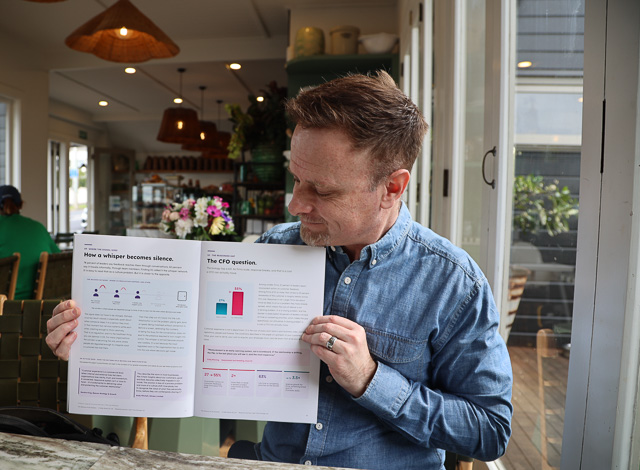
The paper itself. Brenton Webber of Half Time Orange, our research partner, with a printed copy.
The Silence of the System, Good CX with Half Time Orange, September 2026. Orange Zest readiness diagnostic, fielded April 2025 to March 2026. 123 senior leaders, from 140 completions including 17 international. The sample is self-selecting, so these are patterns among leaders already thinking about this rather than a national average. The methods sit on our customer experience methodology hub, with DISTIL™ for the listening and AFAR™ for the measurement.
Why your state reaches your customer
Your state doesn’t stay with you. It sets the state of your team, and their state is what your customer actually meets. The person on the phone. The one reading your quote. The one deciding whether to come back.
None of them ever sees your week. They just meet the version of your people that your week produced.
A leader regulates the conditions. The conditions set the team’s state. And the team’s state is what every customer and employee experiences. Leadership is the cause, and experience is the signal.
That’s our Crossing Model™ in one line. Leadership is the keystone between a business’s people and its customers. The state of the keystone decides whether the arch holds.
So when the mist comes down, nobody outside the building sees a thing. They get a slightly worse answer from somebody being slightly more careful than usual. Then they go elsewhere, and they never tell you why.
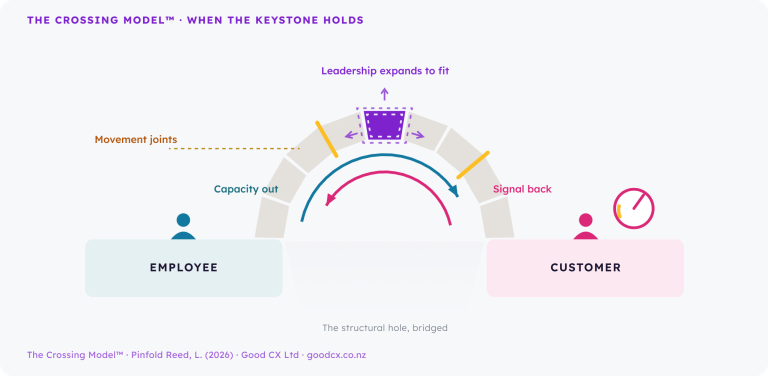
When the keystone holds, capacity reaches your people and the customer signal comes back. That’s the whole job.
”Leadership is the cause, and experience is the signal. The most expensive customer you'll ever lose is the one who leaves without complaining.
Liz Pinfold Reed
Who is coaching the chief executive?
Nobody, as a rule. Which is strange, since the job turns out to be mostly state management.
Somebody arrives rattled and you have read it before they finish the sentence. Bad news lands and you decide, in about four seconds, how much of it travels any further. You set what the week feels like for forty people. None of them has any idea that’s what you’re doing, and none of it ever reaches an agenda.
”You're managing the state of an entire business, rather well as it happens, and nobody has ever asked about yours.
Liz Pinfold Reed
What this kind of coaching actually buys you
Two things, and they are nothing like each other.
Hand the team over
The first asks nothing of you at all. You hand the team over to somebody skilled for a while and let them hold it. Which means you put the load down and go and do the job that only you can do.

Somebody else holding the room for a while. A leadership team mid-session, which is what handing it over actually looks like.

Not therapy. No butcher’s paper. Just the hour where you get to say the thing out loud.
Take the hour
The second is the one people come back for, and it’s harder to admit you want it. An hour that belongs to you. Somewhere to unpack the whole game plan and throw ideas about. Somewhere to work out why people keep surprising you. Not therapy, and no butcher’s paper.
That second one is most of what I do. Somebody hands me their team for a few months, or hands me an hour. Then I hold it so that they don’t have to.
And no, I’m not immune to any of this. I can’t co-regulate myself either, which is precisely why I have somebody too. The coach needs a coach, and after that I’m afraid it’s turtles the whole way down.
So if you’re sitting on one of these, fifteen minutes usually sorts out which of the two you need. Sometimes it’s the team. More often it’s you. Occasionally it’s neither. You simply needed to say the thing out loud to somebody who isn’t on your payroll.
Where this work lives
We do this with leadership teams as a standing piece of work, not a one-off session. The whole of it sits on one page, including what the engagements look like and who they suit.
Want this in the room, not just on the page?
I also take performance under pressure into the room. It runs as a keynote for conferences, a roundtable for senior leaders, or a training session for your team. Bring the sceptics.
Frequently asked questions about leadership under pressure
Is this coaching or therapy?
Coaching. Leadership coaching for performance under pressure works on how somebody functions under load, rather than on personal history. Where something surfaces that belongs with a therapist, Good CX says so and refers it on.
We already send people on leadership courses. How is this different?
A course teaches the moves. Your person already has the moves. This works on their performance under pressure. That’s the moment they have to use what they know.
Does this only apply to big organisations?
No. A football club, a hospital and a florist run on the same dynamics. The size changes how many people feel it, not whether it happens.
My senior team will think this is soft.
It’s not soft, it’s operational. People arrive in a state rather than as a personality type. The customer who meets your team at the door with a list is in fight. The one who rings three times a week, asking the same question four different ways, is in flight. They look like the same problem and they need opposite responses. Most people’s instinct is wrong for both. That’s a practical skill, and it came out of elite sport. Bring the sceptic. They usually get the most out of it. They already know the feeling and have never had language for it.
How long before anything shifts?
Not in one session, and anyone promising a silver bullet is selling one. Leadership coaching under pressure is habit-building, so Good CX sets a minimum of four long sessions. The first unpacks what the problem really is. Then we build a plan and start on the skills. Step one is awareness, and that shifts things on its own, because leaders begin reading rooms differently. The habit follows, with observation between sessions.
Is there homework between sessions?
Yes, although not the kind most people picture. The homework is observation and curiosity about yourself, rather than tasks to tick off. A typical one is a beer with a mate and a few questions for him. That’s about five minutes of actual work. Leaders routinely report finding it excruciating. That’s not a workload problem. It’s the state the coaching works on, and noticing it’s the first shift.
Do we need to be in the same room?
It depends on the size of the group. One to one, Good CX runs these engagements remotely wherever the organisation sits, and some have worked entirely that way. Group work is different. A leadership team needs at least one session in person, with the teaching parts sitting online around it. At conference scale, in person is the format rather than a preference.
Can you work with a division rather than the whole organisation?
Yes. Good CX often works with a single division, and frontline teams are a common starting point. Two things make that worth doing. The first is psychosocial risk, which is now a board-level concern rather than a wellbeing one. Frontline people absorb customers who arrive already mobilised, and teaching a team to regulate each other is the practical control. The second is design. The work builds those conditions into the system itself. So the funnel brings customers in without their hair on fire. The problem stops landing on whoever answers the phone. Good CX’s lead coach is Polyvagal-Informed certified and certified in the Safe and Sound Protocol. That matters when your front line meets distress all day. Readers may have seen this work at the CX Summit roundtables, at the Tech Expo, or in an Innovation Lab™.
The latest thinking from Good CX
Ideas worth arguing with
Every so often we share what we’re learning about customers, the people who serve them, and what a leader can do with it. If we get in touch, it’s with something worth pulling apart with your team. Unsubscribe in one click.
You’ll get one confirmation email first, so we know it’s really you. We handle your details in line with our privacy policy.