Ask a tarot reader what your AI strategy should be in five years and you would at least get a confident answer. Leading through AI uncertainty rarely offers that comfort. The Tower, most likely. Everything you have built, dramatically upended. It would be nonsense, of course. Then again, no more nonsense than a vendor promising you a five-year AI roadmap with a straight face.
Nobody can predict the next five years of AI. Not the futurists. Not the vendors. Certainly not the cards. So the five-year-plan question, asked of any leader, is a slightly cruel one.
Here is the better question. If you cannot predict the landscape, leading through AI uncertainty becomes a question of what kind of organisation can adapt to whatever it becomes. That is a leadership question, not a technology one. It is the one worth your time, and it is the one I kept returning to after the EMA’s “AI Made Easy for Small Business” evening.
A room that worked because it was unpredictable
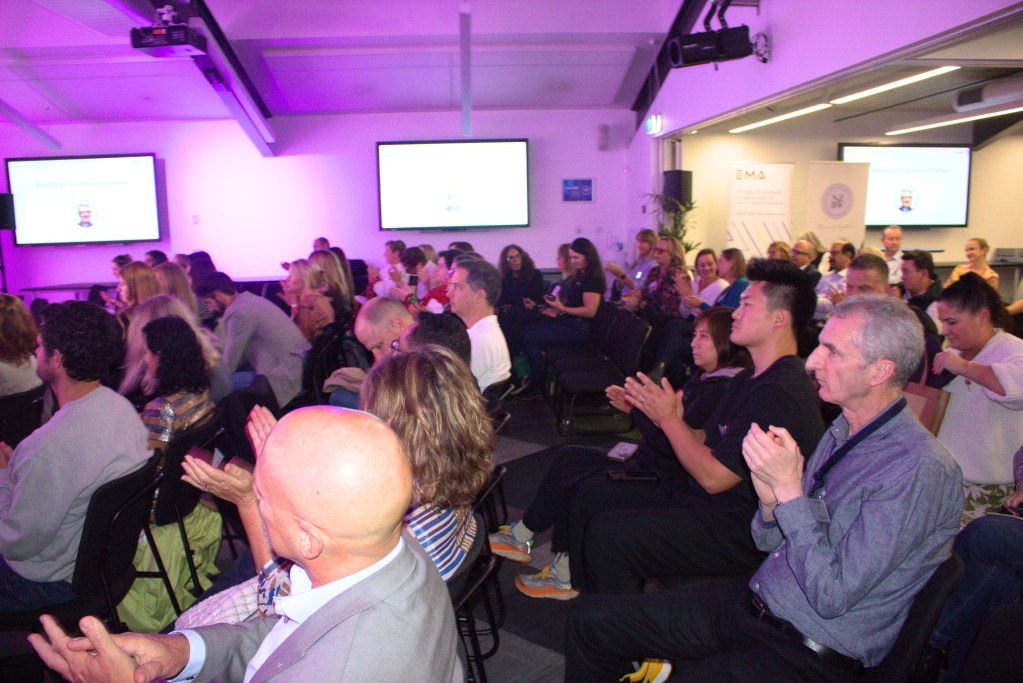
I was on the panel that night, in good company. The EMA convened it with Flux B2B and New Zealand Businesswomen. Michael Friedberg of Flux B2B moderated, and kept a roomful of sharp questions moving. Beside me sat Madeleine Ostoja of Tracksuit, Neeharika Chowdhary of One New Zealand, Matt Ensor of KiaOra.AI, Neil Bryant of Data Insight, and Husain Al-Badry of Seen Ventures. A genuinely strong room of New Zealand practitioners. What struck me most was not the tool tips, useful as they were. It was that the evening worked because it was unpredictable. The panel had prepared. The audience asked what nobody had prepared for. Which, if you sit with it, is the whole point.
Five things worth taking from the night
If you read nothing else, take these five.
- Stop trying to predict AI. Build a team that can adapt to it instead. Adaptability is the strategy.
- Brief before you prompt. AI reflects the brief it is given, so name the job to be done first.
- Use what you already pay for. Mind the quality of your data. Write your governance down.
- Cross the innovation threshold through safety, not fear. Let people be “strong and wrong.”
- Start with human purpose, not the tool. And take the EMA’s takeaway document, which holds the whole panel’s practical toolkit.
The rest of this piece is why those five matter, and what the panel taught me about each.
What does leading through AI uncertainty actually take?
Leading through AI uncertainty is a leadership discipline far more than a technical one. The organisations that pull ahead will not own the cleverest tools. They will be the ones whose leaders make it safe for people to stay curious and adaptable while the ground keeps shifting. Human-centred AI starts there, with the people who have to use it, not with the software. Every practical point on the EMA panel sat on top of that one truth. AI readiness is mostly people readiness.
AI reflects the brief it is given
My own contribution was less a forecast than a discipline. AI is only ever as good as the instructions you hand it. Give it a vague ask and you get vague output, then blame the machine. Give it a clear brief, with the goal and the human it serves spelled out, and it performs.
This is not really an AI insight. It is an old strategic habit in new clothes. Before you prompt, you brief. And a good brief starts with the question Clayton Christensen spent a career pressing on leaders: what is the job to be done? What are you hiring this tool to do, for whom, and why? Get that wrong and no prompt-craft will save you. Get it right and you can hand AI an assignment it completes with a bit of panache.
Where the panel converged
A good panel is not everyone agreeing. It is several people circling the same truth from different doors. The convergence is the signal. Here is what I took from the leaders beside me.
Madeleine Ostoja was refreshingly blunt. Be specific in your prompts. Point AI at the mundane tasks first, the ones quietly bleeding your week dry. Neil Bryant made the point leaders forget at their peril. Your outputs are only as good as your data. Feed a brilliant model a pile of half-finished spreadsheets and you get confident nonsense, faster.
Neeharika Chowdhary offered the advice that quietly saves money. Use your native tools first. Find out what Copilot or Gemini can already do inside the kit you are paying for before you go shopping. Husain Al-Badry put the governance point more sharply than most will say out loud. If the product is free, your data is often the price. So pay for the tool, or use the paid one you already have, and write the governance down. And Matt Ensor brought the practitioner’s map. Four foundations under any sensible rollout: permission, agreed tools, privacy, and upskilling.
Different doors, same room. Start with the human problem. Govern it properly. Build the capability deliberately. None of that is about the model.
”Leading through AI uncertainty is a leadership problem wearing a technology costume.
Liz Pinfold ReedGood CX, EMA AI panellist
Adaptability: the real strategy for leading through AI uncertainty
Here is the uncomfortable part for anyone who likes a tidy roadmap. You cannot plan your way to certainty in a landscape that reinvents itself every quarter. So employee adaptability and confidence stop being soft extras. They become the competitive advantage. And that advantage is built, not bought.
Roger Martin calls the underlying capability integrative thinking. It is the knack of holding two opposing ideas in tension without collapsing into the easy binary. From the friction, you generate a better third option. Move fast and be careful. Adopt AI and protect your people. Embrace the tool and keep the human in the loop. Leaders who can sit in that tension, rather than bolt for the nearest either-or, are the ones who help their teams cross the innovation threshold.
You do not cross that threshold through fear. You cross it through safety. This is exactly why we coach leaders to lead AI change with flow, not fear. Ethan Mollick, whose newsletter One Useful Thing was rightly on the night’s reading list, frames AI as a co-intelligence. A co-worker and coach, not a replacement. You only get the benefit of a co-worker if your people feel safe to experiment in public. To ask the naive question. To try the prompt that flops. (The same list, fairly, sent us to Yuval Noah Harari and Geoff Hinton for the harder existential questions. A balanced diet.)
I learned this somewhere unexpected. My singing teacher. Over the better part of a decade she taught me to sight-read melodies and own the notes, flat, sharp, or frankly wobbly, on the way to getting them right. She called it being “strong and wrong.” It is the most useful leadership idea I know. A team allowed only to be quietly right will never tell you what it does not understand about AI. A team allowed to be strong and wrong shows you exactly where the blind spots are. That is the only place learning happens. We build that condition deliberately in our Innovation Labs, where contributor and challenger safety is the point, not a nicety.
Leading through AI uncertainty: what would need to be true?
If you want AI to do something worthwhile in your organisation, start at the other end from the technology. Define the human purpose first. What is the job to be done, for which customer, and what value are you genuinely exchanging? Then ask the planner’s favourite question. What would need to be true for AI to complete that assignment well? Usually the honest answer has little to do with the model. It has everything to do with whether your people trust each other enough to make ethical, well-governed, slightly brave decisions together.
The EMA has helped New Zealand businesses through change since the industrial revolution. Embracing the next shift is the rule for them, not the exception. It showed. Innovation is not reserved for boardrooms. It is driven just as hard by founders, scale-ups and students, several of whom asked the sharpest questions of the night.
The future of AI here will be shaped less by the cleverness of the tools. It will be shaped more by the trust your team has to plan around real human value. That is the part no crystal ball can sell you. It is the part worth building.
Frequently asked questions
How should a leader start with AI when the future is uncertain?
Start with the human problem, not the tool. Define the job to be done and the value you are exchanging. Then ask what would need to be true for AI to do that job well. Adaptability and a clear brief beat any five-year prediction.
Is leading through AI uncertainty a technology problem or a leadership problem?
It is a leadership problem wearing a technology costume. The constraint is rarely the model. It is whether your people feel safe enough to experiment, and whether your data and governance are in order enough to let them.
What did the EMA AI panel agree on?
The New Zealand practitioners converged on a few things. Start with your pain points. Use the tools you already pay for before buying more. Mind the quality of your data. Write your AI governance down. And build capability deliberately through permission, agreed tools, privacy and upskilling.
Why does AI give disappointing results in business?
Most often because the brief is poor or the data is messy. AI reflects the instructions it is given. A vague prompt on top of incomplete data produces confident nonsense. A clear brief on clean data produces something useful.
How do you get a team to adopt AI without fear?
Build the safety for people to be, as I put it, strong and wrong. Introduce AI through low-stakes, practical tasks. Encourage peer learning. Make it acceptable to try a prompt that flops. Confidence is built in public, not mandated by memo.
If this way of thinking is useful, that is rather our work. Good CX helps founders and senior leaders cross the innovation threshold by getting the human conditions right first: safety, connection and purpose, then the clever tools. If you would rather think out loud than predict the future, let’s have a conversation. We will listen, ask the right questions, and tell you honestly whether we are the right fit.
More on the work: AI coaching for executives, our AI strategy and governance service, and leadership vision and roadmapping for growing SMEs. For the methods underneath, see the OPEN method.
Related reading: five pencils for the kete, lessons in seamless CX leadership, and how SMEs fuel AI adoption through play and pause. A year on from the panel, the numbers arrived: what New Zealand’s 83 per cent adoption rate hides about workforce readiness.
Liz Pinfold Reed is the founder of Good CX, an insight-led CX and innovation strategist, executive coach, and an EMA AI panellist. More about Liz.




The latest thinking from Good CX
Ideas worth arguing with
Every so often we share what we’re learning about customers, the people who serve them, and what a leader can do with it. If we get in touch, it’s with something worth pulling apart with your team. Unsubscribe in one click.
You’ll get one confirmation email first, so we know it’s really you. We handle your details in line with our privacy policy.