Have you ever walked out of a leadership meeting feeling optimistic, then watched the week unfold as though nothing had been said? That gap is where good intentions go to die. Turning insight into momentum is the problem underneath it.
So we asked. We heard from 123 senior leaders across New Zealand and Australia about what happens to customer feedback once it lands. Eighty-two per cent gather it. But only twenty-three per cent have a clear process to act on it. The listening happens. The closing does not.
Those findings are out now, in The Silence of the System. What follows is the thinking behind the questions, because the five things we looked for turn out to be the five places momentum dies. Each one sits where customer experience meets employee experience.
Update, September 2026. The white paper is published.
The Silence of the System explains where the signal dies, why the cause is biological before it is organisational, and what to do about it. Read The Silence of the System.
In brief:
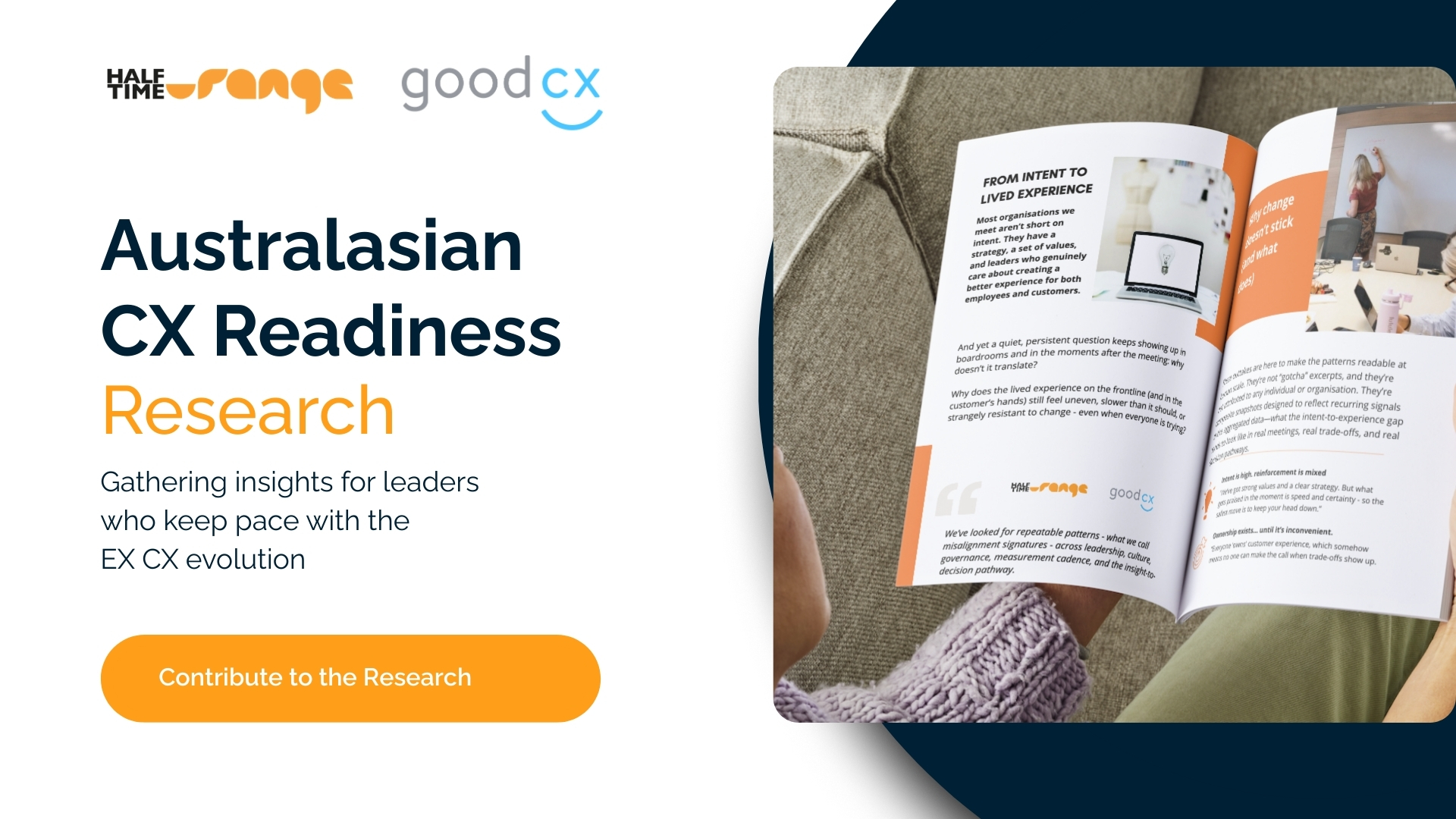
Good CX and Half Time Orange ran CX research to understand what turns employee and customer insight, the kind a voice of customer programme builds into momentum across NZ and AU. This anonymous fifteen-minute survey explores operating-system factors that help change stick: reinforcement, ownership, measurement cadence, psychological safety, and insight-to-decision pathways. Findings are now published in The Silence of the System, a practical 2026 white paper for New Zealand and Australian leaders.
Where turning insight into momentum breaks down
Most firms are not short on intent. Leaders care. Teams are able. And the strategy deck reads well.
But the system under that intent? It is often doing something else.
No one built it that way. It grew, through hundreds of small calls about what gets praised, what gets counted, who owns the hard choices, and whether it feels safe to speak up early.
So those small, repeated moments decide whether change lands or just gets talked about.
The invisible system running your business
When people say “operating system” here, they do not mean software. Think of it as what happens when nobody is watching.
So, does feedback ever change a decision? Or does it just get “noted”? When two plans clash, is it clear who owns the call? And does what you hear from staff and clients shape what you do next?
These are not soft culture questions. They are design questions. And you can answer them.
Here is the odd part. Two firms can hold near-identical plans, similar budgets and equally smart people, then perform worlds apart. The gap is rarely the plan. It is whether the system backs up what the plan claims to value.
What makes change stick (and what doesn’t)
In partnership with Half Time Orange, we looked at five practical areas where turning insight into momentum either happens or does not:
What gets rewarded
What gets rewarded day to day often cuts against what the strategy says matters. People spot that gap at once.
Who owns it
When “everyone owns experience,” nobody actually owns it. Fuzzy ownership kills momentum every time.
How often you measure
Annual surveys are not learning loops. They are data events. So the impact is not the same.
The route from insight to action
If customer and employee insights don’t reliably shape decisions, people stop sharing them. So turning insight into momentum stalls at the first hand-off, and eventually you’re flying blind. The path back is often strategic discovery: going back to the original signal before scale obscured it.
Psychological safety
If speaking up feels risky, problems show up late. By then they cost a lot to fix.
What turning insight into momentum looks like in practice
Findings are pooled and anonymous. So here is what the paper gives you:
Where intent outruns culture
Patterns that repeat, and show where what leaders want outruns what the culture can give. Read it as an early warning for friction.
Practical levers
Not theory. Design changes to ownership, rhythm and the route a decision takes, so the system works with you.
Composite snapshots
Short made-up examples, not quotes, so you can spot the pattern at human scale.
So this is not generic advice. It is pattern work built on evidence, for leaders who want turning insight into momentum to be a process, not a personality trait.
Why your input matters
If your firm has cracked this, even in part, we want to hear it. Some teams move insight fast, keep trust real, and build learning in without burning people out. Those design clues matter to the rest of us.
But the messy middle counts just as much, where some things work and others do not. Because contrast is where the pattern shows up.
Take the survey (and get your free copy)
Your answers are anonymous. If you add your email, Half Time Orange will send you a complimentary copy of their Orange Zest report, for your eyes only, and Good CX only ever sees the summary findings. It takes about fifteen minutes, and everything gets aggregated, so there are no scorecards, no naming and no shaming.
Join the next wave and get your own readiness report
And if you know someone in ops, CX, people and culture, or change who would give a thoughtful answer, do pass this on.
Want to explore how Good CX helps teams turn insights into momentum? Check out the Innovation Labs, learn about Good CX, or start a conversation.
You can also learn more about Half Time Orange here.
Thank you to everyone who has taken part. You are helping build something real and useful. Not just for the next plan, but for leaders who want to set up the conditions where people do their best work.
Because ultimately, that’s what this is about. Turning insight into momentum should not need heroics, so build the organisation where truth travels early and nothing gets stuck.
Huge thanks to Brenton Webber and the Half Time Orange team!
The latest thinking from Good CX
Ideas worth arguing with
Every so often we share what we’re learning about customers, the people who serve them, and what a leader can do with it. If we get in touch, it’s with something worth pulling apart with your team. Unsubscribe in one click.
You’ll get one confirmation email first, so we know it’s really you. We handle your details in line with our privacy policy.