
Have you ever walked out of a leadership meeting feeling genuinely optimistic, only to watch the week unfold as if nothing changed?
If you’re responsible for culture, innovation, employee experience or customer experience in New Zealand or Australia, you’ll recognise that particular tension. Intent is there. Strategy is documented. Effort is real. Yet somehow, the lived experience stays uneven.
That’s exactly what this CX research NZ AU project is exploring.
In brief:
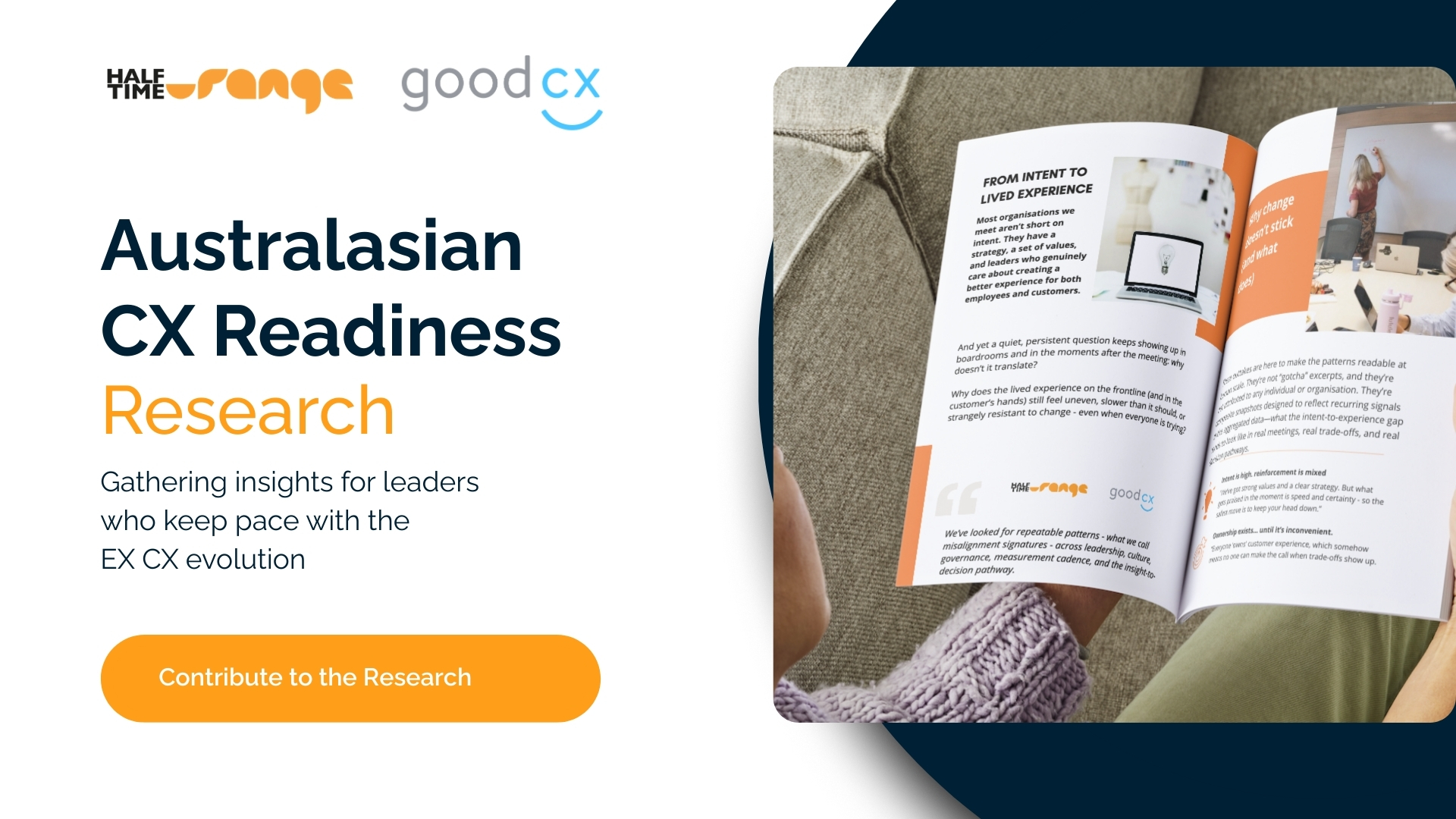
Good CX and Half Time Orange are running CX research to understand what turns employee and customer insight into momentum across NZ and AU. This anonymous 10-minute survey explores operating-system factors that help change stick: reinforcement, ownership, measurement cadence, psychological safety, and insight-to-decision pathways. Findings will be aggregated into a practical 2026 white paper for New Zealand and Australian leaders.
Why this CX research NZ study exists
Generally, organisations aren’t usually short on intent. Leadership cares. Teams are capable. And strategy documents are thoughtful.
However, the operating system underneath that intent? It’s often doing something slightly different.
Not because anyone designed it that way. Rather, it evolved through hundreds of small decisions about what gets praised, what gets measured, who owns the tricky calls, and whether speaking up early feels safe or risky.
Moreover, those patterns – those tiny, repeated moments – actually shape whether change lands or just gets talked about.
The invisible system running your organisation
When people mention an “operating system,” they don’t mean software. Instead, think of it as the human mechanics deciding what happens when nobody’s watching.
For instance, does feedback reliably change a decision, or does it just get “noted”? When priorities collide, is it obvious who owns the call? Similarly, do insights from customers and employees shape what happens next?
These aren’t soft culture questions. On the contrary, they’re design questions. And they’re completely answerable.
What’s fascinating is that two organisations with nearly identical strategies, similar budgets, and equally smart people can perform completely differently. Usually, the difference isn’t the strategy. Rather, it’s whether the system reinforces what the strategy claims to value.
What makes change stick (and what doesn’t)
In partnership with Half Time Orange, this research explores five practical areas where momentum either builds or dies:
Reinforcement patterns
What gets rewarded day-to-day often contradicts what the strategy says matters. People notice that disconnect immediately.
Ownership clarity
When “everyone owns experience,” nobody actually owns it. Fuzzy ownership kills momentum every time.
Measurement cadence
Annual surveys aren’t learning loops. They’re data collection events. Consequently, there’s a big difference in impact.
Insight-to-decision pathways
If customer and employee insights don’t reliably shape decisions, people stop sharing them. Eventually, you’re flying blind.
Psychological safety
If speaking up feels risky, problems surface late. By then, they’re expensive to fix.
What the white paper will show you
Findings will be aggregated and anonymous. Nevertheless, here’s what’s being built:
Misalignment signatures
Repeatable patterns showing where leadership intent outpaces what culture can deliver. Think of it as an early warning system for friction.
Practical levers
Not theory. Instead, design changes around ownership, cadence, and decision pathways that make systems work with you.
Composite snapshots
Short illustrative examples (not quotes) that help you recognise patterns at human scale.
Ultimately, this isn’t generic advice. It’s evidence-based pattern work for leaders planning 2026 with clarity.
Why your input matters
If your organisation has cracked this – even partially – that perspective is needed. Ultimately, teams that make insight move quickly, keep safety real, and embed learning without burnout? Those design clues matter to everyone else.
Equally, if you’re in the messy middle where some things work and others don’t? That perspective is just as valuable. After all, contrast is where patterns emerge.
Take the survey (and get your free copy)
The survey results are anonymous (if you add your email, Half Time Organe will send you a complementary copy of their excellent Orange Zest Report for you eyes only. The Good CX will get summary findings only. It takes 10 minutes, and answers get aggregated – no scorecards, no naming, no shaming.
Take the CX research NZ survey
Additionally, if you know someone in operations, customer experience, people and culture, or transformation who would give a thoughtful answer, please share this with them.
Want to explore how Good CX helps teams turn insights into momentum? Check out the Innovation Labs, learn about Good CX, or start a conversation.
You can also learn more about Half Time Orange here.
One last thing
Thank you to everyone who has already contributed. You’re helping build something evidence-based and genuinely useful – not just for 2026 planning, but for leadership that creates conditions where people do their best work.
Because ultimately, that’s what this is about: designing organisations where insight doesn’t get stuck, truth travels early, and momentum doesn’t require heroics.
Huge thanks to Brenton Webber and the Half Time Orange team!
